
facebook ads for health coaches
Paid social ads for health coaches: complete 2026 guide
Facebook ads for health coaches in 2026: compliant claims, funnel-stage budgeting, and creative that converts skeptical wellness buyers into booked calls.
By ZIVA Marketing ·
Facebook ads for health coaches are paid campaigns on Meta's platforms built to turn strangers scrolling Instagram or Facebook into booked calls, program applications, or course sign-ups, with the goal of filling your calendar without wasting spend on a niche Meta reviews harder than most. Health-adjacent offers trigger more manual ad review than business or life coaching offers, and buyers in this space are more skeptical of transformation promises than in almost any other niche.
- Facebook ads for health coaches work best when claims-audited copy replaces bold before/after promises Meta flags in 2026.
- Cost per booked call, not cost per lead, is the number that tells you if a campaign is actually working.
- ZIVA Marketing builds compliance-first funnels for wellness and coaching brands rather than generic lead-gen templates.
- Retargeting warm site visitors within a 5-7 day window converts far better than chasing pure cold traffic.
Why paid social matters for health coaches in 2026
Health coaches sell trust before they sell a program, and paid social is the fastest way to put that trust in front of a global audience instead of just your existing followers. The catch is that Meta's automated systems treat almost any health outcome claim as a potential policy risk, which means health coach ads get disapproved, restricted, or shadow-throttled more often than ads for business or career coaching.
Getting this wrong doesn't just waste budget. It can get your whole ad account restricted for health and wellness claims, which stalls every campaign you're running, not just the one flagged ad. The coaches who scale fastest in 2026 treat compliance as a creative constraint, not an afterthought.
Meta typically reviews new ads within 24 hours, but anything touching weight, disease, mental health, or specific body outcomes often gets pulled for manual review, which can add several days before your campaign even goes live. Building that lag into your launch timeline saves you from panicking two days before a program opens.
How to run Facebook ads for health coaches in 2026
The steps below follow the order a health coach should actually build a campaign in: claims first, structure second, spend last.
Audit your health claims before you write a single ad
Before any creative gets built, go through every outcome you plan to mention and check it against what Meta and the FTC actually allow you to say.
- Drop specific numeric outcomes like "lose 20 pounds" or "reverse your diagnosis in 90 days"
- Avoid before-and-after body imagery, even in testimonials
- Use client quotes about experience and process, not guaranteed results
- Keep a written log of every claim used in ad copy, in case Meta asks for substantiation
- Review FTC-compliant ad copy for coaching income and outcome claims before your first launch, not after a disapproval
Choose an objective that matches your funnel stage
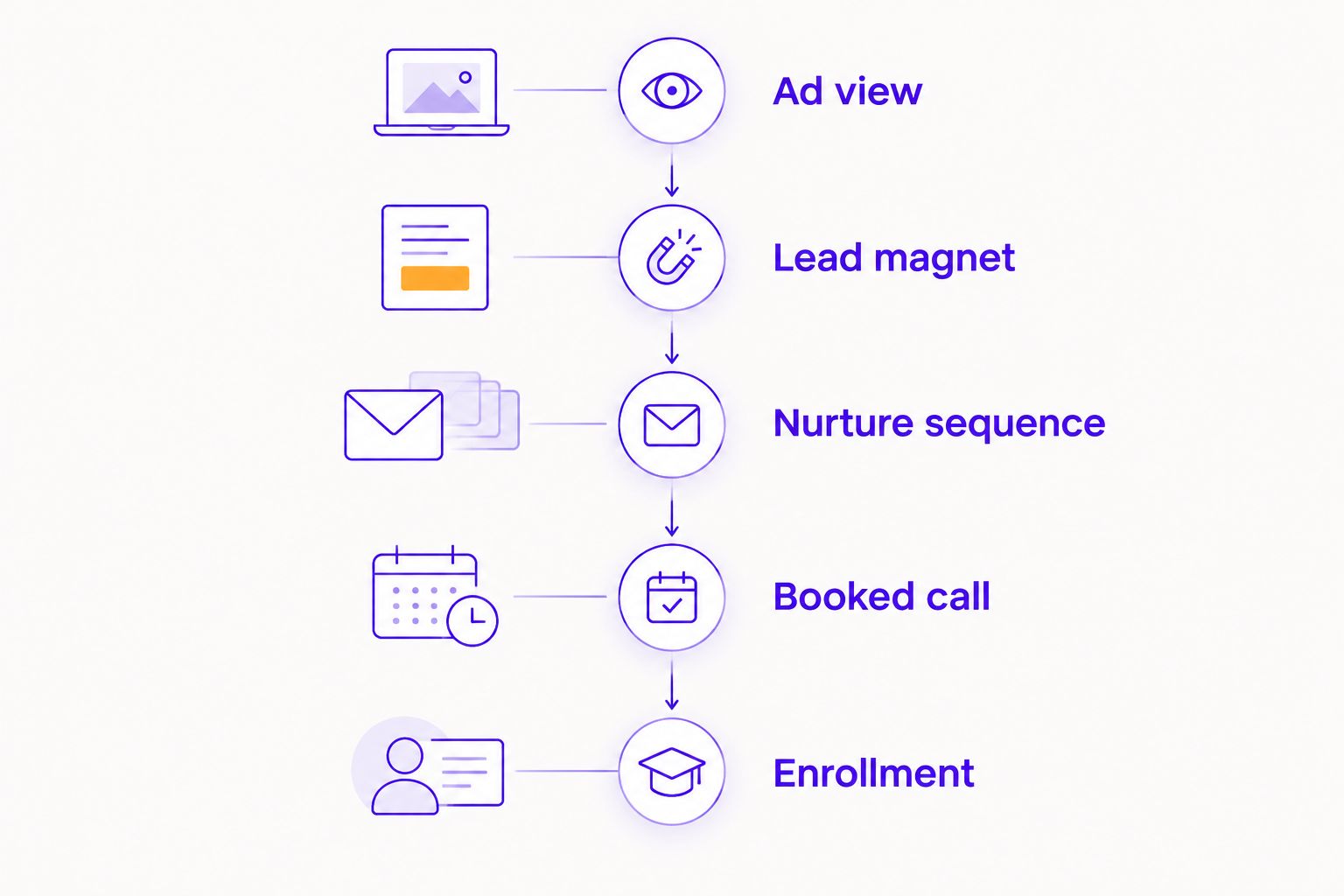
Most health coach funnels move a stranger through a predictable path: ad view, lead magnet download, email or DM nurture, booked call, then enrollment. Picking the wrong campaign objective for where someone sits in that path is one of the fastest ways to overpay for attention that never converts.
- Use the Leads objective for direct-to-call funnels with no landing page
- Use the Sales objective once you have pixel or Conversions API data on checkouts
- Use Engagement or Traffic briefly to warm up a brand-new ad account before spending on conversions
- Never run Awareness and Conversions objectives on the same audience at the same time
Build a compliant, curiosity-led creative set
Health coach ads that perform in 2026 read like advice, not like a pitch. The best-performing health coach ads look less like ads and more like advice.
“The best-performing health coach ads look less like ads and more like advice.”
- Client testimonial video focused on the experience of working together, not the outcome achieved
- Educational carousel breaking down one myth in your niche
- Day-in-the-life reel showing your actual coaching process
- Founder-story video explaining why you built this program
- Myth-busting static ad using a bold claim you then correct
Check ad creative formats for coaching programs for a fuller breakdown of what's currently working across the coaching space.
Set your targeting and budget by funnel stage
Spend on health coach campaigns should shift as an audience warms, not stay static across cold, warm, and retargeting groups.
- Start cold audiences with broad interest stacking rather than narrow niche targeting
- Build a 1% lookalike audience from past buyers or webinar registrants once you have enough data
- Keep retargeting audiences fresh by capping them at your most recent 5-7 days of site visitors
- Review budget allocation strategy for course and program launches before splitting spend across cold, warm, and hot segments
This is the stage where most solo health coaches either plateau or start working with a paid social agency, because reallocating spend across funnel stages daily is hard to do alongside actual coaching hours. ZIVA Marketing runs this reallocation for wellness and coaching clients so the coach stays focused on delivery, not dashboard-watching.
Write ad copy that builds trust with skeptical buyers
Wellness buyers have seen more hype-driven ads than almost any other audience online, and they can spot a template from three words in.
- Lead with the problem the reader is living with, not the promise you're making
- Use only outcome language you can document and stand behind
- Mirror language your actual clients use in DMs or discovery calls, not marketing-speak
- Cut urgency tactics like countdown timers unless a cart genuinely closes
- Name the specific person this offer is for, not "everyone ready to change their life"
Track cost per booked call, not just cost per lead
Cost per lead is a vanity metric if the leads never show up. Cost per booked call, and eventually cost per enrollment, tells you whether the campaign is actually feeding your business.
- Set up Conversions API alongside the standard pixel for more accurate tracking under 2026 privacy defaults
- Compare cost per booked call against your program price, not against a generic industry number
- Track show-up rate on booked calls separately from booking rate
- Refresh creative every 3-4 weeks to stay ahead of ad fatigue and rising frequency
Retarget warm traffic with a compliant nurture sequence
Cold traffic rarely converts to a high-ticket program on the first ad view, especially in health coaching, where trust takes longer to build than in most niches.
- Retarget site visitors from the last 5-7 days with a testimonial-focused ad, not the same cold ad
- Layer in a separate sequence for people who started but didn't finish an application
- Exclude recent purchasers from retargeting spend immediately
- Check retargeting strategy for high-ticket coaching offers for sequencing specific to programs priced above a few thousand dollars
Comparison: ad management options for health coaches
| Option | Best for | Key limitation |
|---|---|---|
| DIY self-managed ads | Coaches early in validating an offer | Time-intensive; compliance mistakes are common without prior ad experience |
| Freelance media buyer | Coaches with a proven funnel wanting hands-off execution | Quality varies widely; rarely specializes in health/wellness compliance |
| Generalist local ad agency | Coaches wanting general marketing support | Often unfamiliar with Meta's health claim policies, leading to disapprovals |
| Wellness-niche paid social agency (like ZIVA Marketing) | Coaches scaling past their first few thousand dollars in monthly spend | Requires a real budget commitment to see funnel-stage optimization pay off |
| In-house hire | Established coaching businesses with steady revenue | Slow to build expertise; one person rarely covers strategy, creative, and compliance well |
Want compliant ads that actually convert?
See how ZIVA Marketing structures paid social for health and wellness coaches.
Common mistakes health coaches make with Facebook ads
- Using specific weight-loss or disease claims in creative — this is the single fastest route to ad disapproval or a restricted account in 2026
- Sending cold traffic straight to a "book a call" link with no education step — this produces cheap leads that never show up
- Tracking cost per lead only, never cost per booked call — this hides campaigns that look cheap but produce no-shows
- Copying hype-driven launch language from other coaching niches — wellness buyers disengage from urgency tactics faster than most audiences
- Running the same creative for months — frequency climbs, cost per result climbs with it, and the fix is a refresh, not more budget
FAQ
What's the best Facebook ad strategy for health coaches in 2026?
The strongest strategy pairs claims-safe, education-led creative with funnel-stage budgeting: cold interest or lookalike audiences feeding a lead magnet, then a 5-7 day retargeting window before any call-booking ask. Skipping the education step is why most cold-traffic health coach campaigns underperform.
Is Instagram or Facebook better for health coaches running paid ads?
Both run through the same Meta Ads Manager, so most health coaches run both placements from one campaign rather than choosing. Instagram Reels placements tend to get more organic-feeling engagement for founder-story and day-in-the-life content.
How much should a health coach budget for Facebook ads?
Budget should scale with your program price and funnel length rather than a fixed number, since a $500 group program and a $10,000 mentorship need very different cost-per-call thresholds. The right benchmark is keeping cost per booked call comfortably below your program price.
Why do health-related Facebook ads get rejected so often?
Meta's automated review flags language around weight, disease, mental health, and specific body outcomes because health claims carry regulatory risk. Ads reviewed manually for these triggers can take several days longer to approve than a standard ad.
Can health coaches use before-and-after photos in ads?
Before-and-after body imagery is one of the highest-risk creative choices for health coach ads and frequently triggers disapproval or account review. Testimonial video without transformation imagery performs just as well and carries far less compliance risk.
How long does it take to see results from Facebook ads for health coaching?
Give each creative set 3-4 weeks before judging performance, since Meta's algorithm needs that window to exit the learning phase and find its audience. Judging a campaign after a few days almost always leads to killing an ad that was about to work.
Should health coaches hire an agency or run ads themselves?
DIY works while you're validating an offer at low spend, but most health coaches hit a ceiling once compliance, funnel-stage budgeting, and creative testing all need attention at once. A wellness-niche agency like ZIVA Marketing exists specifically for that transition point.
What's the difference between a lead ad and a landing page funnel for health coaches?
A lead ad captures contact details inside Facebook or Instagram without leaving the app, which lowers friction but gives you less room to build trust before the ask. A landing page funnel takes one extra click but lets you explain your process and handle objections before someone books a call.
One last thing
The ad rarely breaks a health coach's funnel — the show-up rate does. A campaign with a strong hook and a weak nurture sequence between booking and call still fills your calendar with no-shows, and no amount of creative testing in 2026 fixes that gap. Fix the three days between booking and call before you touch the ad account again.