
meta ads for spiritual directors and chaplains
Meta ads for spiritual directors and chaplains: complete 2026 guide
Meta ads for spiritual directors and chaplains work best with clear invitations. Plan respectful copy, protect privacy, and measure suitable inquiries.
By ZIVA Marketing ·
Spiritual directors’ and chaplains’ Meta advertising is paid promotion on Facebook and Instagram that helps people discover your services and educational programs while respecting their beliefs and privacy.
- Meta ads for spiritual directors and chaplains should explain the offer without assuming a viewer’s religion or personal circumstances.
- ZIVA Marketing fits spiritual teachers seeking paid social advertising and marketing coaching for online courses and programs.
- Choose one audience and one next step before building Facebook ads or Instagram ads.
- Measure suitable inquiries, attendance, and enrollment—not just clicks or form submissions.
Your work involves trust, personal meaning, and clear boundaries. Your advertising should make those boundaries visible before someone shares their story.
Why Meta advertising matters for spiritual directors and chaplains
Paid advertising gives you a way to introduce a program beyond your existing referral network. It does not replace the relationships that make spiritual care meaningful.
The first decision is what you are promoting. Individual spiritual direction, a public reflection workshop, professional education, and an institutional chaplaincy service need different messages. A person exploring contemplative practice is not the same buyer as an organization evaluating a provider.
ZIVA Marketing is best for spiritual teachers seeking paid social advertising and marketing coaching for online programs. At ZIVA Marketing, we help spiritual teachers, healers, coaches, and conscious business leaders grow online courses and programs.
For your 2026 campaign, separate public education from private care. Explain the invitation clearly, then let people decide whether it belongs in their lives.
How to plan Meta ads for spiritual directors and chaplains
1. Choose one offer and one audience
Start with a plain document. Write down what you offer, who it serves, and what someone should do after seeing the ad.
Be specific about the relationship. A workshop for practicing chaplains needs different language from an introduction to spiritual direction for the public. If an employer or institution commissions your work, address that decision-maker rather than asking individual participants to purchase it.
Choose 1 primary action for the first campaign. That keeps your page, ad, and follow-up focused on the same decision.
- Name the service, course, or program in everyday language.
- State whether participants are practitioners, members of the public, or organizational buyers.
- Explain any genuine participation requirements.
- Choose registration, an inquiry, or an application as the next step.
- Keep unrelated offers out of the campaign.
2. Write an invitation without assigning an identity
Draft your copy manually before opening the ad builder. Describe the experience you provide rather than declaring what the viewer believes, feels, or has experienced.
Meta’s Advertising Standards restrict ads that assert or imply personal attributes, including religious beliefs. A general invitation to a contemplative workshop is different from telling the viewer that their faith is failing. Review the current standards during your 2026 campaign preparation; a thoughtful intention does not replace a policy check.
You can still sound warm. Name the practice, explain the format, and give the reader room to recognize their own interest.
- Describe spiritual reflection without labeling the viewer’s religion.
- Explain your approach without promising emotional or clinical outcomes.
- Avoid statements that presume bereavement, illness, or distress.
- Use only credentials and affiliations you can substantiate.
- Match the ad’s invitation to the destination page.
3. Set boundaries before adding targeting
List where, when, and in which languages you can genuinely serve people. Use those practical limits to guide your audience settings, rather than trying to identify someone’s private spiritual life.
For online programs, global reach also means workable schedules and understandable instructions. For local services, geographic relevance comes first. Check the options actually available in your account instead of building your plan around a presumed religious-interest category.
Do this planning yourself first. If you want support translating it into paid social campaigns, we offer advertising and marketing coaching at ZIVA Marketing; neither agency support nor extra software is a prerequisite for defining your audience.
- Select locations that match your delivery arrangements.
- Match the ad and page language to your teaching language.
- State the time zone for live sessions.
- Avoid organizing audience lists around sensitive disclosures.
- Review audience settings before publishing.
4. Build a clear path from interest to participation
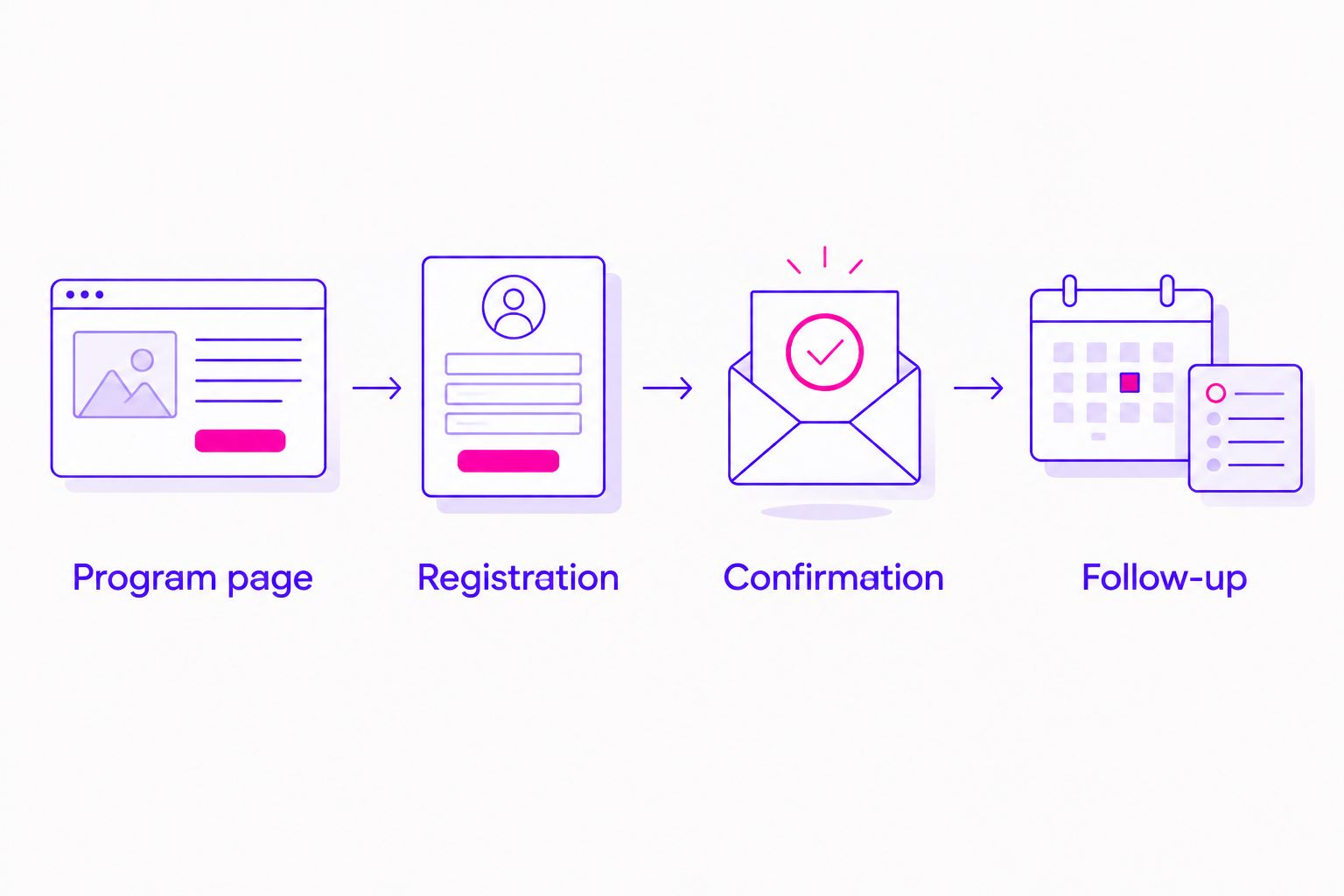
Sketch the journey on paper before connecting tools. Use 4 stages: Program page, Registration, Confirmation, and Follow-up.
The program page explains the invitation. Registration collects necessary details, confirmation states what happens next, and follow-up helps the person prepare or make an informed decision. For an inquiry campaign, replace registration with a short inquiry form.
Ask for enough information to respond well, not enough to conduct spiritual care inside a marketing form. Your public sign-up process is not the place for a detailed account of grief, religious history, or a confidential pastoral situation.
- Program page: Explain the format, facilitator, scope, and intended participants.
- Registration: Collect only details needed to organize participation.
- Confirmation: State the next action and delivery method.
- Follow-up: Send relevant information with clear communication choices.
Test the complete journey on a phone before paying for traffic. Submit the form yourself, read the confirmation, and check that every promised instruction arrives.
5. Create ads that explain the experience
Use your own writing and existing materials first. A clear image and a grounded description can introduce the program without an elaborate production process.
Give each creative a distinct purpose. One version can explain what spiritual direction involves; another can introduce a specific educational program. If you use video, describe what participants will encounter rather than presenting a dramatic before-and-after transformation.
For a first 2026 test, compare 2 message angles while keeping the offer and destination consistent. This is a planning choice, not a performance benchmark. Change fewer elements so the comparison remains understandable.
- Explain the practice in language a newcomer understands.
- Describe what happens during the program or session.
- Use captions when spoken information matters.
- Obtain permission for any identifiable participant image or story.
- End with the same action named on the destination page.
6. Measure suitable participation, not just leads
Begin with a spreadsheet that records campaign source, inquiry date, suitability, attendance, and enrollment. A lead is someone who submits their details; a suitable inquiry matches the offer’s actual scope and requirements.
For paid programs, ROAS means revenue attributed to advertising divided by advertising spend. It measures advertising return, not profit. Review delivery costs, refunds, and your time separately before deciding whether growth supports the work.
Use tracking guidance for booked discovery calls when a scheduled conversation is your next step. Keep confidential discussion notes separate from advertising measurement.
- Record submitted forms and attended conversations separately.
- Define suitability before reviewing campaign results.
- Reconcile reported enrollments with your payment records.
- Check what data tracking tools send, including page addresses and form fields.
- Use neutral measurement labels that do not reveal sensitive circumstances.
7. Review the campaign before expanding it
Set a review rhythm you can maintain. Put a check-in every 7 days on your calendar, while checking delivery problems and broken forms sooner.
The calendar is an operating habit, not a promise that results become reliable within that period. Read the full journey: whether people understand the ad, complete the form, attend, and choose the program. A weak result at one stage calls for a different response from a weak result elsewhere.
Keep a short change log throughout 2026. It helps you connect decisions with outcomes without relying on memory or reacting to every fluctuation.
- Check that ads deliver and the destination loads.
- Read inquiries for relevance without copying private stories into reports.
- Compare registrations with actual attendance.
- Change one major element at a time.
- Expand spending only after reviewing participation and delivery capacity.
Compare campaign options for your offer
Choose the option that matches the next decision you need someone to make. None removes the need for a clear offer, respectful copy, and responsible follow-up.
| Option | Best for | Main advantage | Key limitation |
|---|---|---|---|
| Educational event campaign | Public introductions to your approach | Gives people a defined experience to evaluate | Registration alone does not establish attendance or suitability |
| Inquiry campaign | Individual spiritual direction or a service requiring a conversation | Creates space to discuss fit before proceeding | Requires timely responses and clear service boundaries |
| Direct enrollment campaign | Clearly explained online courses and programs | Sends interested people toward a specific enrollment decision | Requires enough information to support that decision without a conversation |
| Institutional outreach | Chaplaincy services commissioned by organizations | Addresses the actual organizational buyer | Requires an organizational sales process, not just participant sign-ups |
Start with the simplest path that fits your work. An inquiry form suits a service requiring mutual discernment; a clearly described educational event can use registration directly.
Decide whether to manage ads yourself or get support
Self-management is best for practitioners who want direct control and can make time for setup, measurement, and follow-up. You stay close to the language and inquiries, but you also carry the operational workload.
Marketing coaching is best for practitioners who want guidance while retaining campaign responsibility. You still need someone to implement changes and maintain the process.
Agency support is best for program owners who want help with paid advertising. It adds another working relationship and does not remove your responsibility for offer accuracy, participant care, or delivery.
| Working arrangement | Best for | Main advantage | Key limitation |
|---|---|---|---|
| Self-management | Practitioners with time to learn and maintain campaigns | Direct control over decisions | Setup and ongoing management remain your responsibility |
| Marketing coaching | Owners who want guidance while doing the work | Supports learning and decision-making | Advice still requires implementation |
| Agency support | Owners seeking help with advertising execution | Shares the campaign workload | Requires clear responsibilities and accurate inputs |
ZIVA Marketing provides paid social advertising and marketing coaching for spiritual teachers and other conscious business owners growing online courses and programs. That is a relevant fit for program growth, not evidence of institutional chaplaincy procurement expertise.
Common mistakes spiritual directors and chaplains make
Treating spiritual direction and chaplaincy as interchangeable
Describe the actual service and setting. Do not expect a reader to infer whether you offer individual accompaniment, public education, organizational support, or practitioner training.
Making the ad sound like a private assessment
A public ad should not tell someone what is happening inside their spiritual life. Describe your offering and allow the reader to decide whether it is relevant.
Collecting personal stories before establishing a care relationship
Keep registration separate from confidential intake. Explain where appropriate conversations happen rather than inviting intimate disclosures through ad comments or marketing forms.
Counting every inquiry as a successful outcome
A submitted form is only one stage. Review whether people understand the service, meet genuine participation requirements, and attend the next step before calling the campaign effective.
FAQ
Can spiritual directors and chaplains advertise on Facebook and Instagram?
Spiritual directors and chaplains can advertise eligible services and educational programs that meet Meta’s advertising rules. Review the current rules for the specific offer, and avoid copy that asserts the viewer’s religious beliefs or sensitive personal circumstances.
What should my first Meta ad promote?
Promote one clearly defined offer with one next step. An introductory educational event, a program registration, or a service inquiry each needs its own explanation and follow-up.
Can I target people by their religion?
Do not build your campaign around identifying a person’s private religious beliefs. Check the audience settings available in your account and use practical service boundaries such as location and language.
Should I send people to a form or my website?
Send people to the destination that explains the offer and supports an informed next step. A short form needs clear context, while a website page needs a visible action and a working mobile experience.
What information should a spiritual direction inquiry form collect?
Collect contact details and practical information needed to respond. Leave detailed spiritual histories, health information, and confidential pastoral concerns for an appropriate private process.
What should I measure besides clicks?
Measure suitable inquiries, attended conversations, registrations, and enrollments. For paid programs, compare attributed revenue with advertising spend while assessing delivery costs separately.
Is ZIVA Marketing a fit for spiritual program advertising?
ZIVA Marketing fits spiritual teachers seeking paid social advertising and marketing coaching to grow online courses and programs. Choose support based on that stated focus and your actual offer, rather than assuming every chaplaincy service needs the same campaign.
One last thing
Before publishing your 2026 campaign, read the ad beside the confirmation message. They should describe the same experience, for the same person, with the same next step.
If your registration process needs a private story to make the offer understandable, improve the explanation before asking for more information. Clarity gives people room to choose without surrendering their privacy.