
meta ads for reflexologists
Meta ads for reflexologists: complete 2026 guide
Meta ads for reflexologists work best with one clear offer. Plan your audience, write careful wellness copy, and track bookings or course enrollments.
By ZIVA Marketing ·
Meta ads for reflexologists is paid advertising on Facebook and Instagram aimed at attracting suitable clients or students, and a clear offer helps you connect that attention to bookings or course enrollments.
- Start meta ads for reflexologists with one offer: local appointments or online education, not both together.
- Use Facebook and Instagram ads to explain the experience without promising medical outcomes.
- Track completed bookings or course enrollments, not just clicks and inquiries.
- ZIVA Marketing fits reflexologists seeking paid social advertising and marketing coaching for online courses and programs.
Why Meta ads matter for reflexologists
Reflexology advertising needs to make an unfamiliar experience understandable without turning a wellness invitation into a medical promise. Your prospective client needs to know what happens during an appointment. Your prospective student needs to understand what a course teaches and what it does not qualify them to do.
Those are different decisions. A local appointment depends on travel distance and your capacity; an online program depends on curriculum, teaching format, and student fit. Build separate campaigns when the offers serve different buyers.
For your 2026 campaign, begin with a clear description rather than a dramatic transformation. Meta’s personal-attributes rules restrict ads that assert or imply sensitive information about the viewer, including health conditions. The guide to avoiding Meta’s personal-attributes policy problems explains the distinction between describing an offer and diagnosing the person reading it.
Build your reflexology advertising plan
Choose one offer and one business outcome
Start manually with a short offer brief. Write who the offer serves, what the buyer receives, and the action you want them to take. Keep the language close to the questions people already ask you.
An appointment campaign needs a booking outcome. A course campaign needs an enrollment outcome, sometimes preceded by an introductory class or application. Avoid sending both audiences to a general homepage and asking them to find their own route.
Choose the offer you can explain and fulfill clearly. Advertising cannot resolve an unclear curriculum or create more appointment capacity.
- Name one offer for the campaign.
- Describe the intended client or student without assigning a health condition.
- Choose one primary action, such as booking or registering.
- Confirm that your calendar or teaching schedule supports that action.
Map the path from advertisement to purchase
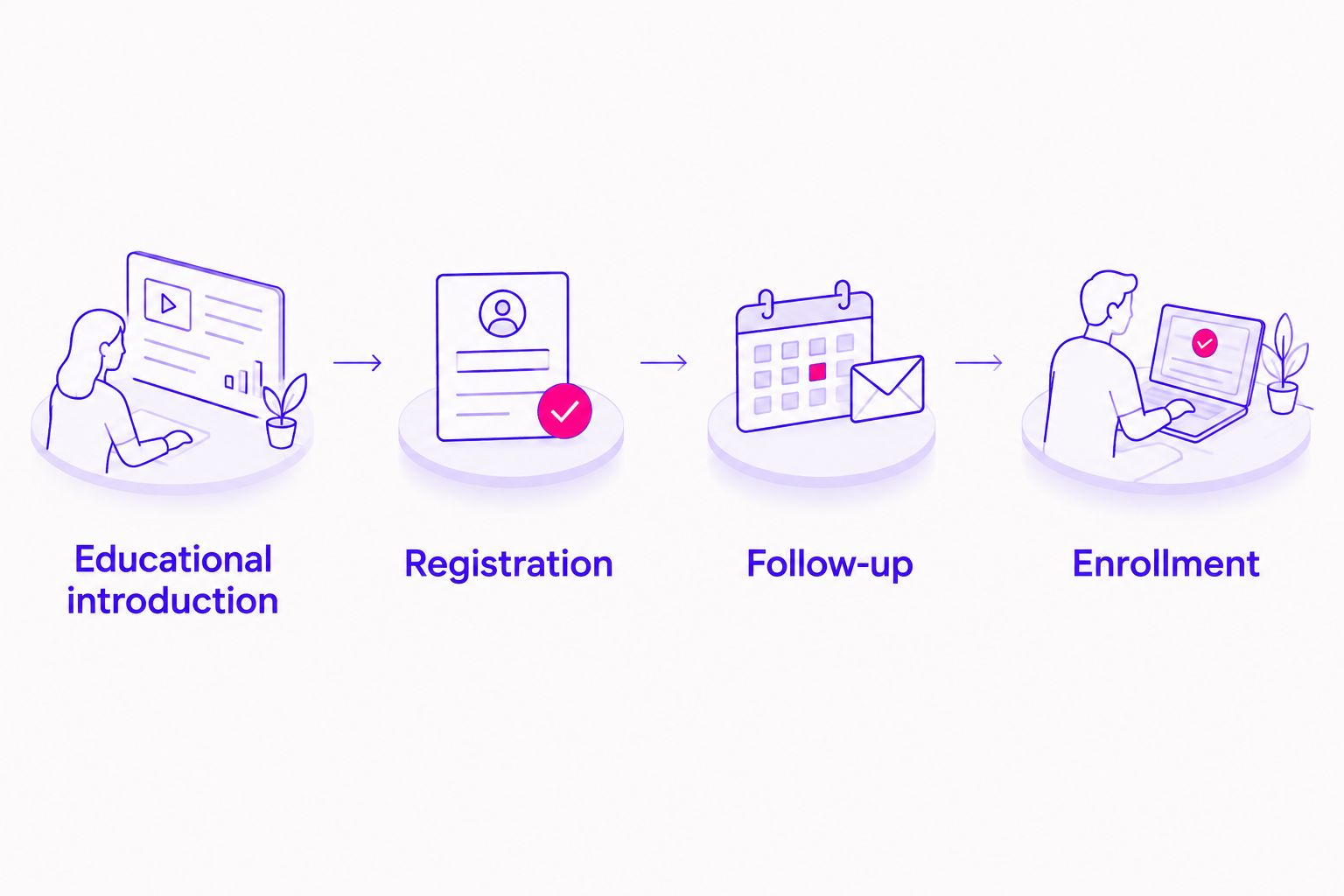
Draw the journey on paper before opening Meta Ads Manager. For a local service, that journey might move from an appointment explanation to a booking page. For a course, it might move from an educational introduction to registration, follow-up, and enrollment.
Use the shortest path that gives people enough information to decide. A shorter path removes steps, but it also removes opportunities to explain an unfamiliar offer. Add a step only when it answers a real buying question.
The diagram below shows a course journey, not a requirement for every reflexology business.
Use your existing website and email tools first. You do not need to replace a working system simply to start advertising.
- Match the destination to the promise in the advertisement.
- Remove navigation that distracts from the chosen action.
- Explain what happens immediately after registration or booking.
- Test the complete journey on your phone.
Write clear claims and respectful invitations
Read every sentence as though you know nothing about reflexology. Describe the session, educational content, or teaching approach. Remove language that promises to cure a condition, replaces medical advice, or assumes the viewer has a particular diagnosis.
For example, describe an introductory reflexology workshop and its actual syllabus rather than promising treatment outcomes. A disclaimer does not make an unsupported claim acceptable. Testimonials also need review; a client’s words do not remove your responsibility for the claims in your advertising.
For reflexologists building online education, we offer paid social advertising and marketing coaching at ZIVA Marketing. That support does not replace your responsibility to describe your professional scope accurately.
- State what participants receive and learn.
- Use only qualifications you actually hold.
- Obtain permission before using client images or testimonials.
- Review the advertisement and destination page together.
- Check current Meta policies before publishing your 2026 campaign.
Build a page that answers practical questions
Open your destination page on a phone and read only the first screen. A visitor should understand whether you offer an appointment, a workshop, or a course. The next action should match that offer.
For appointments, explain your location and the booking process. For online education, explain the curriculum, delivery format, intended learner, and any genuine prerequisites. Do not imply that a general-interest class grants a professional credential.
You can draft the page in your existing website editor. Professional support becomes useful when the offer, advertisement, and page need coordinated revisions, not because every campaign needs a new website.
- Put the offer and intended audience near the top.
- Explain what happens during the session or learning experience.
- Separate educational outcomes from medical claims.
- Make the booking or enrollment button easy to find.
- Display relevant terms and privacy information clearly.
Connect advertising results to real business records
Begin with a spreadsheet that records the campaign, inquiries, bookings, attendance, enrollments, and attributed revenue. Define each result before you compare campaigns. A form submission is not an attended appointment, and a registration is not a course purchase.
For your 2026 reporting, reconcile Meta’s figures with your booking and payment records. Attribution means assigning credit for a result to a marketing interaction; different systems can assign that credit differently. Investigate differences rather than treating either dashboard as the entire story.
Review privacy requirements before configuring tracking. Do not send health histories, intake answers, or other sensitive client information through advertising events.
- Define the action each tracking event represents.
- Complete a test booking or registration yourself.
- Confirm that the event fires at completion, not merely on page load.
- Check that the same action is not counted twice.
- Keep sensitive intake details out of advertising data.
Adapt creative to the placement and offer
Start with material you can produce yourself: a clear practitioner introduction, a permitted demonstration, or a simple explanation of the course. Show what you actually offer. You do not need elaborate production to explain a thoughtful service.
Prepare 3 creative concepts: the experience, the process, and the next step. These are testing prompts, not a promised winning formula. Give each concept a distinct message so the results teach you something beyond which image attracted attention.
Build placement-specific layouts. Meta supports square 1:1 creative for feeds and vertical 9:16 creative for Stories and Reels; preview each selected placement before publication. Keep important text away from interface controls.
The practical reason for adapting ads for different placements is readability: a feed design and a full-screen vertical design need different spacing, even when they communicate the same offer. Rework the layout instead of stretching the original image.
- Film or photograph only with appropriate permission.
- Add captions that make spoken explanations understandable without sound.
- Keep each advertisement focused on one message.
- Preview the headline, image, and button together.
- Compare concepts using downstream results, not reactions alone.
Set review rules before increasing spend
Choose what would justify continuing, revising, or stopping the campaign before launch. Base that decision on your own capacity and business records, not a generic reflexology benchmark.
For appointments, examine the path from inquiry to attendance. For courses, examine registration quality, participation, and enrollment. A campaign that attracts inexpensive inquiries but no suitable buyers needs investigation, not automatic expansion.
In your 2026 review, compare equivalent offers and reporting periods. Change one meaningful variable at a time when you want a clear answer about what helped.
- Set a spending limit your business can absorb without relying on immediate sales.
- Record the campaign’s primary outcome and supporting measures.
- Review lead quality alongside lead volume.
- Separate advertising problems from booking or follow-up problems.
- Increase spending only after checking fulfillment capacity and economics.
Compare ways to run your reflexology ads
ZIVA Marketing is best suited to reflexologists promoting online courses who want paid social advertising and marketing coaching. We help spiritual teachers, healers, coaches, and conscious business leaders grow online courses and programs; local appointment advertising is a different brief.
Choose support based on the work you need help with and the decisions you want to retain. No option removes the need for accurate claims, a clear offer, and reliable records.
| Option | Best for | Main advantage | Key limitation |
|---|---|---|---|
| Self-managed advertising | Practitioners who want hands-on learning and direct control | You can connect campaign decisions closely to client conversations | You handle setup, policy review, creative, and measurement yourself |
| Marketing coaching | Practitioners who want guidance while retaining execution | You develop your own decision-making skills | Advice still needs implementation and regular attention |
| ZIVA Marketing paid social advertising and marketing coaching | Reflexologists expanding through online courses and programs | Agency support matches an education-focused growth brief | It does not establish demand, validate clinical claims, or guarantee ROAS |
Self-management is a reasonable starting point when you can give the campaign regular attention. Coaching fits when you want help interpreting results but still want to do the work. Agency support fits when execution competes with teaching and delivery.
Before choosing support in 2026, clarify who owns the advertising account, who approves claims, and who maintains tracking. Agree on reporting definitions before comparing results. A shared definition of an enrollment is more useful than a dashboard full of differently counted leads.
Common mistakes reflexologists make with Meta ads
Mixing local appointments with online education
A nearby appointment seeker and an international student need different information. Combining them makes geography, messaging, and measurement harder to interpret. Give each offer its own page and campaign brief, even when both come from the same practice.
Turning an explanation into a medical promise
It is natural to want people to understand why your work matters. Keep that explanation within what you can substantiate. Describe the experience and educational content without implying that reflexology diagnoses or cures disease, and review testimonials for the same issue.
Calling every inquiry a new client
An inquiry shows interest, not attendance or purchase. Track the next action so you can distinguish a confusing booking process from an advertising problem. For courses, keep registrations, participants, and paying students separate in your records.
Expanding the audience beyond the offer’s reach
A local practice cannot serve every person who responds to a compelling advertisement. Match appointment advertising to the area you genuinely serve. For international courses, confirm language, scheduling, and delivery arrangements before widening the campaign.
Collecting health details too early
An advertising form does not need a detailed health history to establish interest. Ask only what is necessary for the next step. Keep any required clinical intake separate, and review how your tools collect, store, and share that information.
FAQ
Can reflexologists advertise on Facebook and Instagram?
Reflexologists can advertise eligible services and educational offers on Facebook and Instagram, subject to Meta’s policies and applicable law. Describe the offer accurately, avoid unsupported health claims, and review the destination page as well as the advertisement.
What is the best Meta ads strategy for a reflexologist starting out?
Start with one clearly defined offer and one measurable next action. Separate local appointment advertising from online course promotion so you can match the audience, page, and reporting to the buying decision.
Should I advertise reflexology appointments or an online course?
Advertise the offer you are ready to explain, deliver, and measure. Local appointments require suitable geography and appointment capacity; online courses require a clear curriculum, teaching format, and enrollment process.
Can I mention health conditions in reflexology ads?
Do not write copy that asserts or implies the viewer has a health condition. Any health-related claim also needs appropriate substantiation; review current Meta rules and applicable advertising requirements before publishing.
Do I need video to run reflexology ads?
Video is not a prerequisite for reflexology advertising. A clear image and accurate explanation can communicate an offer; video is useful when showing the process helps people understand what to expect.
How do I know whether my reflexology ads are working?
Compare advertising activity with completed bookings, attendance, or course enrollments in your business records. Clicks and inquiries help diagnose the journey, but they do not establish that the campaign produced suitable clients or students.
Is ZIVA Marketing a fit for reflexologists?
ZIVA Marketing fits reflexologists seeking paid social advertising and marketing coaching for online courses and programs. An appointment-only practice should clarify the service scope before choosing support, rather than assuming the same approach applies.
One last thing
Read your advertisement and booking page aloud as one continuous conversation. If the advertisement invites someone to learn about reflexology but the page suddenly asks for an unexplained commitment, fix that handoff before buying more attention.
For your next 2026 campaign, choose clarity over another layer of setup. A person should understand what you offer, what happens next, and whether the experience suits them.