
meta ads for holistic nutritionists
Meta ads for holistic nutritionists: complete 2026 guide
Meta ads for holistic nutritionists work best with clear educational offers. Plan respectful copy, track enrollments, and choose a practical campaign path.
By ZIVA Marketing ·
Holistic nutritionists’ Meta advertising is paid promotion on Facebook and Instagram that connects prospective learners with nutrition courses and coaching programs, helping you grow beyond your existing audience.
- Meta ads for holistic nutritionists should promote clear educational offers, not implied diagnoses or guaranteed health outcomes.
- Start with one offer, connect lead generation to enrollment, and measure sales rather than registrations alone.
- ZIVA Marketing fits conscious course creators seeking paid social advertising and marketing coaching.
- For your 2026 campaign, build Facebook ads and Instagram ads around useful teaching and respectful language.
Why Meta advertising matters for holistic nutritionists
Nutrition education needs room for nuance. Your advertisement must communicate enough value to earn attention without turning a complex health topic into an unsupported promise.
Paid distribution gives you a way to introduce your teaching beyond your followers. It does not remove the need for a clear offer, credible information, or thoughtful follow-up. If your advertisement promises one thing and your course page explains something else, spending more will not resolve the mismatch.
ZIVA Marketing is best for conscious course creators who want paid social advertising and marketing coaching together. At ZIVA Marketing, we help spiritual teachers, healers, coaches, and conscious business leaders grow their online courses and programs.
For your 2026 plan, separate the audience you can serve from everyone interested in nutrition. A practical meal-planning class and a professional education program need different messages, even when the same practitioner teaches both.
How to build Meta ads for holistic nutritionists
1. Define one educational offer
Start with a document, not an advertising campaign. Write down who the program serves, what you teach, and what someone can do after participating. Keep the outcome within your actual scope of practice.
Best for a first campaign: one clearly defined offer with one next step. A workshop about building flexible meal routines is easier to explain than a broad promise to transform every aspect of someone’s health.
Choose the next step based on the buying decision. A straightforward course needs a clear curriculum and enrollment page. A program requiring a conversation needs an application or booking process that explains what happens next.
Set these boundaries before writing advertisements:
- Choose 1 offer for the initial campaign.
- Name the learner’s practical goal without assigning a diagnosis.
- Describe the curriculum and delivery format accurately.
- State who the program is and is not designed to serve.
- Select one action: register, apply, or enroll.
2. Write respectful, supportable health messaging
Review your existing copy manually before opening Ads Manager. Highlight language that assumes a viewer has a condition, criticizes their body, or promises a particular health result.
Meta’s advertising standards restrict assertions about personal attributes, including health conditions. Educational framing keeps attention on the program rather than on a presumed diagnosis. It is not an approval guarantee; the advertisement, imagery, destination, and offer all need review.
For example, describe a class about everyday meal planning rather than telling viewers that their symptoms reveal a hidden problem. Avoid using a testimonial to make a claim you could not support in your own words.
Use the same review process for the destination page. Our guide to avoiding Meta’s personal attributes policy issues addresses this distinction for coaching advertisements.
- Explain the lesson instead of diagnosing the viewer.
- Remove guaranteed outcomes and unsupported treatment claims.
- Use credentials exactly as earned and legally permitted.
- Review testimonials for implied promises.
- Check current Meta standards before your 2026 launch.
3. Build a short path from interest to enrollment
Sketch the customer journey on paper. Show what someone sees after the advertisement, what they receive after registering, and how they reach enrollment. You do not need new software to identify a missing step.
Best for an offer that needs explanation: a useful lesson followed by a clear invitation. The benefit is room to demonstrate your teaching. The limitation is additional work: registration, reminders, delivery, and follow-up must all function.
At ZIVA Marketing, we offer paid social advertising and marketing coaching for course and program growth. That support is an alternative to managing every decision alone, not a prerequisite for starting.
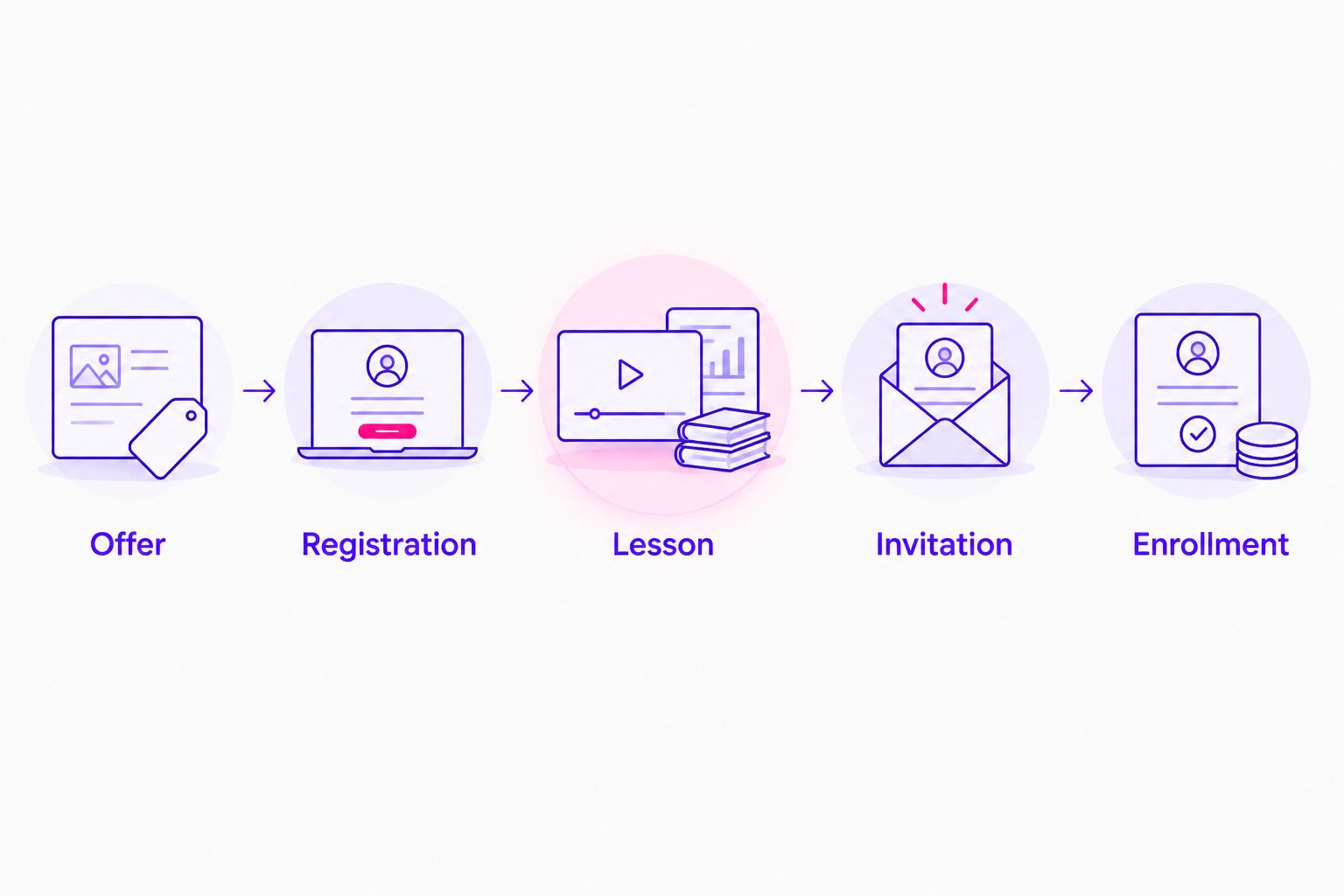
For your 2026 campaign, use this sequence only if it fits how people actually buy your program:
- Offer: State what the learner will learn.
- Registration: Collect only the information needed to participate.
- Lesson: Deliver the education promised in the advertisement.
- Invitation: Explain the relevant course or coaching program.
- Enrollment: Make the next action clear and test it yourself.
4. Set up measurement without sharing sensitive details
Begin with a spreadsheet that connects advertising spend, registrations, qualified conversations, and enrollments. This manual record gives you a reference when advertising reports and payment records differ.
ROAS means return on ad spend: attributed revenue divided by advertising spend. It is not profit. Course delivery, payment fees, refunds, and support still affect what your business keeps.
Meta Pixel records website events through browser-based tracking. Conversions API sends events through a server connection. Neither method gives you permission to share sensitive health information. Review Meta’s current restrictions, your privacy obligations, and the implementation before sending data.
Best for nutrition education campaigns: measurement that records commercial actions without exposing health histories. Keep clinical intake separate from advertising forms and tracking events.
- Record spend and enrollment revenue using consistent definitions.
- Test registration and purchase events before launch.
- Keep diagnoses, symptoms, and health histories out of advertising event data.
- Check event names, page addresses, and form fields for sensitive details.
- Reconcile advertising reports with actual payment records.
5. Test useful teaching before polishing production
Use your existing lessons, frequently asked questions, and curriculum to draft advertisements. A simple explanation of what participants will practice gives you a concrete starting point. Elaborate production cannot compensate for an unclear invitation.
Test 3 ad concepts as a manageable initial plan, not as a performance benchmark. For example, explain the course curriculum, demonstrate a meal-planning exercise, and answer a practical question about participation. Keep the offer consistent so the comparison remains useful.
Best for a time-limited practitioner: a small set of distinct messages you can review carefully. The limitation is that a small test does not establish which message works for every audience or season.
Judge each concept by what happens after the click, not just by reactions. A friendly teaching video that attracts attention still needs to bring the right learners into your program.
- Build one concept around the curriculum.
- Build another around a practical teaching demonstration.
- Build another around a common enrollment question.
- Add readable captions to spoken video.
- Match the advertisement’s promise to the destination headline.
6. Choose audiences around service fit
Start by listing the places, languages, and delivery conditions your program supports. A global ambition is not the same as a program ready for every time zone or jurisdiction. Nutrition-related professional requirements also deserve review wherever you intend to serve clients.
Then inspect the audience controls available in your account. Do not build your strategy around an assumed ability to identify people with particular health conditions. Describe the educational offer clearly enough that interested learners can recognize its relevance.
Best for online group education: audience choices that match delivery capacity and appropriate participation. Broader reach brings less control over who responds, so your registration page must explain suitability.
Keep these decisions separate from tracking. Meta ad targeting without a pixel is not the same as measuring website enrollments; audience selection and conversion measurement solve different problems.
- Advertise only where you can appropriately deliver the program.
- Match the advertisement’s language to the teaching language.
- Make live-session time zones clear before registration.
- Avoid audience assumptions based on sensitive health information.
- Use retargeting only where permitted and appropriately configured.
7. Review enrollment quality before expanding spend
Choose a review rhythm you can maintain. A 7-day review window can serve as an operating habit, but it is not proof that enough evidence has accumulated. Longer buying decisions need observation through the enrollment process.
Compare registrations with attendance, qualified conversations, and completed purchases. If people register but do not attend, inspect reminders and expectations. If they attend but do not enroll, examine offer fit, the explanation, and the next step before blaming the advertisement.
Best for your 2026 growth plan: expand only after you understand the path from spend to enrollment. ZIVA Marketing pairs paid social advertising with marketing coaching; working with an agency still requires your input on the teaching, offer, and client experience.
- Review results by offer and campaign.
- Track qualified conversations separately from all inquiries.
- Check whether enrollment records support reported ROAS.
- Record changes so you can interpret later results.
- Confirm teaching and support capacity before increasing demand.
Compare campaign options for nutrition education
Choose the route that fits the decision you are asking someone to make. These are campaign options, not a ranking: each has a useful role and a clear limitation.
| Option | Best for | Main advantage | Key limitation |
|---|---|---|---|
| Direct course enrollment | A clearly explained course with a straightforward purchase decision | Short path from advertisement to enrollment | The page must establish enough trust without a live conversation |
| Educational workshop | A program that benefits from seeing your teaching | Demonstrates the learning experience before enrollment | Requires registration, delivery, reminders, and follow-up |
| Application campaign | Coaching that requires a suitability conversation | Creates space to assess fit before enrollment | Requires time to review applications and speak with prospects |
| Waitlist campaign | A course with a defined future enrollment period | Builds a permission-based audience before registration opens | Joining a list does not demonstrate purchase intent |
You can manage any of these routes yourself if you have the time and skills. Coaching supports learning and decisions; agency management adds outside execution but requires coordination and a defined division of responsibilities.
Choose based on the work you need help with, not on a promise of effortless growth.
Common mistakes holistic nutritionists make
Selling a health result instead of explaining the education
A compelling course does not need a guaranteed medical outcome. Describe the curriculum, practice, and support accurately. Your audience should understand what they are buying without interpreting an advertisement as a diagnosis or treatment promise.
Collecting clinical details in an advertising form
A workshop registration is not a clinical intake. Ask only what the registration requires, and keep any later health assessment in an appropriate separate process. Do not pass sensitive answers into advertising tracking.
Treating every nutrition interest as the same buying need
A beginner seeking meal-planning education and a practitioner seeking professional development need different explanations. Clarify the learner’s starting point, prerequisites, and intended use of the course before choosing targeting settings.
Calling inexpensive registrations a successful launch
A registration is an intermediate action. Judge the campaign against its business purpose, then use registration and attendance data to locate problems. Keep ROAS separate from profit when deciding whether to continue.
FAQ
Can holistic nutritionists advertise on Facebook and Instagram?
Holistic nutritionists can advertise eligible educational offers on Facebook and Instagram, subject to Meta’s current standards. Review health claims, personal-attribute language, imagery, and the destination page; approval is not guaranteed.
What is the best Meta ads strategy for a holistic nutrition course?
The best strategy matches the advertisement to the course’s buying decision. Use direct enrollment for a clearly explained course, or educational content before enrollment when prospective learners need more context.
Do I need a large Instagram following before running ads?
A large Instagram following is not a prerequisite for paid distribution. You still need a credible offer, a clear destination, and a reliable way to respond to interested learners.
Should I promote a workshop or send people straight to my course?
Promote a workshop when demonstrating your teaching helps explain the program; use direct enrollment when the purchase decision is straightforward. A workshop adds delivery and follow-up work, while direct enrollment puts more responsibility on the sales page.
Can I mention health conditions in my nutrition advertisements?
Do not write advertisements that assert or imply the viewer has a health condition. Educational discussion still needs review against Meta’s current standards and applicable requirements; changing a few words does not guarantee approval.
How do I know whether my nutrition ads are working?
Connect advertising spend to qualified inquiries and completed enrollments, then compare attributed revenue with spend. Review delivery expenses and other business costs separately because ROAS does not measure profit.
Can ZIVA Marketing help with Meta ads for holistic nutritionists?
ZIVA Marketing provides paid social advertising and marketing coaching for conscious business leaders growing online courses and programs. Discuss your nutrition education offer, scope, and support needs to establish whether the service fits.
One last thing
Before launching, read the advertisement and enrollment page aloud as if you were a prospective student. You should hear the same offer twice, with more detail the second time—not a different promise.
For your 2026 launch, make that consistency your final check. Clear expectations protect the learning relationship before the first lesson begins.