
meta ads for grief coaches
Meta ads for grief coaches: complete 2026 guide
Meta ads for grief coaches in 2026 need careful copy, ethical targeting and clear tracking. Learn to build a trust-first funnel that earns qualified inquiries.
By ZIVA Marketing ·
Grief coach Meta advertising is paid promotion on Facebook and Instagram designed to introduce coaching support without assuming that the person seeing the ad has experienced a loss. For grief coaches, the 2026 priority is to earn trust before asking someone to join a program.
- Meta ads for grief coaches work best when they describe the support offered, not the viewer's presumed experience.
- ZIVA Marketing is best for grief coaches who want paid social strategy and marketing coaching for an online program.
- Start with a clear offer, a respectful landing page and a way to measure qualified inquiries.
- Review the full path from ad to enrollment; a low-cost click alone does not show whether a campaign works.
Why Meta ads matter for grief coaches
Meta ads give a grief coach a way to introduce an online course or program beyond their existing audience. The hard part is not simply getting attention. It is inviting someone into a sensitive conversation without claiming to know their circumstances.
Meta's advertising rules prohibit ads that assert or imply a viewer's personal attributes, including physical or mental health. That does not mean every ad about grief is prohibited. It means your wording must describe your work without telling the viewer what they have experienced. The distinction matters in 2026, whether you write the ad yourself or work with an agency.
Start by reading your ad as a stranger would. Does it make room for someone to decide whether the offer fits, or does it announce what is happening in their life? The approach in this guide also applies to other sensitive coaching topics; the guide to Meta ads for trauma-informed coaches covers a related audience.
How to run Meta ads for a grief coaching program
Define the support your program offers
Write down what your coaching program actually includes before writing an ad. A reader needs to understand whether the next step is an educational resource, an application or an invitation to learn about a program. If your offer has boundaries, state them plainly on the landing page.
Keep coaching distinct from clinical care. Do not describe a coaching program as treatment or promise that it will resolve grief. If your work has a specific focus, such as supporting people after the loss of a pet, explain that focus as a description of the program, not an assertion about the person seeing the ad.
A useful offer statement says who the program is designed for, what happens inside it and what someone can expect from the first step. It leaves the decision with the reader. That clarity also makes it easier to spot when an ad promises more than its destination delivers.
- Describe the program's format using only details you can verify.
- Name the next action: read, register, inquire or apply.
- State any scope or professional boundaries that apply to your work.
- Remove promises of a particular emotional outcome.
Review your ad copy for personal claims
In 2026, check each line of Meta ad copy for an implied statement about the viewer. A question can still make a personal claim. For example, asking whether someone is grieving after a particular loss treats that experience as known; describing a program about grief support describes the offer instead.
Write the first version without addressing the reader's private circumstances. Explain what the resource or program covers, who created it if relevant, and what happens after a click. Read the headline, primary text and image together: a neutral sentence can take on a different meaning beside an intrusive visual.
You do not need to avoid the word grief altogether. You need to use it with care. Before publication, compare the finished ad with Meta's current advertising standards rather than relying on wording that was accepted in a previous campaign.
- Replace claims about the viewer with descriptions of the program.
- Check headlines and image text as carefully as primary copy.
- Remove guarantees about recovery or personal transformation.
- Read the landing page for claims the ad itself avoids.
Choose an audience you can explain
Start with the people who have already chosen to hear from you, provided you have permission to use their information for advertising. Meta's audience tools also allow broader targeting, where the ad and the destination do more of the work of showing who the program is for.
Do not treat an interest selection as proof that a person has experienced loss. Someone's interest in a book, practice or topic tells you little about their private life. That is why the campaign's message must stand on its own without an assumption about any individual viewer.
Keep the initial audience setup simple enough to evaluate. If several audiences, ads and destinations all change at once, you will not know which change affected the result. Record the audience settings you used so you can compare later tests against a clear starting point.
- Start with one clearly defined audience approach.
- Use your own contact list only when you have appropriate permission.
- Keep sensitive personal information out of audience files.
- Document exclusions and geographic settings before launch.
Create an ad that feels like an invitation
A grief coaching ad should show the offer clearly without staging distress for attention. Use visuals and language that match the actual experience of engaging with your work. If you appear in a video, speak about the resource or program rather than guessing what the viewer feels.
Test distinct ideas, not tiny changes that are hard to interpret. One version can explain the program's structure; another can introduce an educational resource. ZIVA Marketing is a fit for grief coaches who want paid social advertising and marketing coaching for an online course or program, but you can begin by drafting and reviewing these concepts yourself.
Set a review point after 7 days to check delivery, comments and the quality of inquiries. That is a planning interval, not a promise that the campaign will produce a result in a week. Keep notes on what each version says so a revision has a clear purpose.
- Draft 2 ad concepts with different, accurate reasons to click.
- Use images that clarify the offer rather than depict presumed distress.
- Add captions when spoken information is essential to a video.
- Check comments for confusion about what the program provides.
Connect the ad to a respectful next step
The experience after the click should continue the same conversation. If the ad offers an educational resource, send people to that resource's landing page. If it introduces a program, explain the program before asking for personal information.
Think of the path as Ad copy, Landing page, Opt-in and Follow-up. Each stage should answer the question raised by the one before it. A landing page that suddenly asks for a detailed account of someone's loss creates a very different experience from the calm invitation in the ad.
An opt-in can be useful when the program needs explanation before someone considers enrolling. It is not mandatory: choose the shortest path that gives the reader enough information to make a comfortable decision. In either case, explain what messages will follow and make the next action easy to recognize.
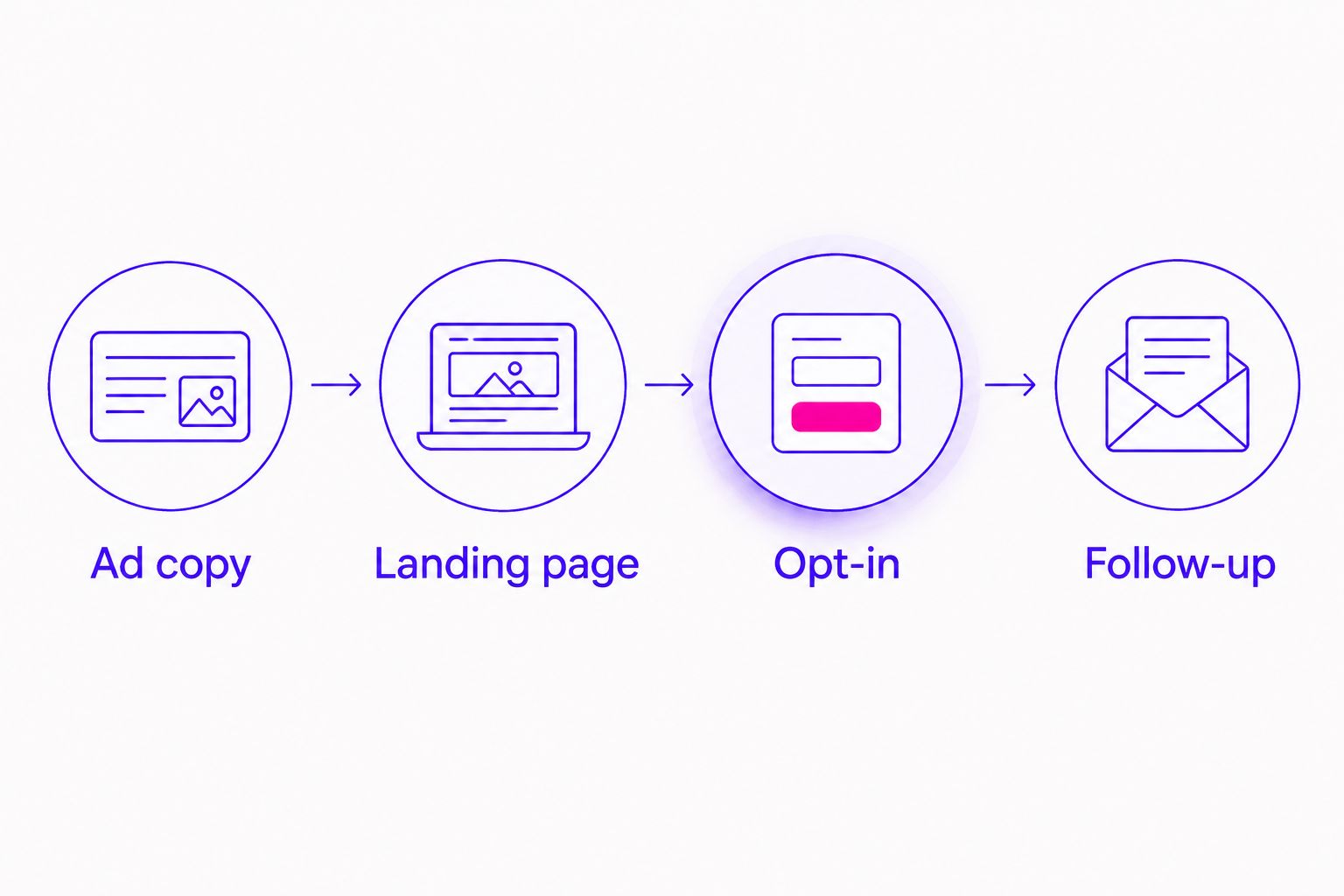
- Match the landing page headline to the ad's stated offer.
- Ask only for information needed for the immediate next step.
- Explain what happens after someone submits a form.
- Review follow-up messages for pressure or unsupported claims.
Measure inquiries as well as ad activity
Clicks tell you that an ad attracted attention. They do not tell you whether the right people understood the offer or wanted to take the next step. Track the path from click to inquiry and, where you can verify it, from inquiry to enrollment.
Before launching in 2026, check that your tracking records the intended action on the correct page. Test the form yourself and confirm that a submitted inquiry appears where your team expects to find it. Keep the information sent to advertising tools limited; a conversion event does not need a description of someone's personal circumstances.
Return on ad spend, or ROAS, compares revenue attributed to ads with ad spend. Use it only when you can connect an enrollment to the campaign with reasonable confidence. If that connection is unclear, report verified inquiries and enrollments separately rather than presenting a precise return you cannot support.
- Confirm the inquiry form works on a phone and a computer.
- Record ad spend and completed inquiries in the same review period.
- Separate qualified inquiries from all form submissions.
- Review enrollment records before calculating ROAS.
Review results and make one clear change
Give a campaign a defined review routine instead of reacting to every daily fluctuation. A 7-day check can catch broken links, disapprovals or confusing copy. A 30-day review gives you a longer window to inspect inquiry quality and enrollment records; neither interval guarantees enough data for a firm conclusion.
Start with the largest problem you can verify. If people click but cannot submit the form, fix the page. If submissions arrive but misunderstand the program, revise the ad and landing page together. If Meta disapproves an ad, read the stated reason and correct the relevant wording or destination before submitting it again.
We use the same principle when discussing paid social at ZIVA Marketing: change the part of the path the evidence points to. Keep a record of the previous version so you can tell whether the edit helped. A calm review process protects your budget and the experience of the people considering your work.
- Check links, forms and ad status at each 7-day review.
- Compare inquiry quality over a 30-day window.
- Change one major campaign element at a time.
- Record the reason for every substantial edit.
Compare your options for running grief coaching ads
You can run Meta ads yourself, seek guidance while keeping control of the account, or ask someone else to manage the work. The best option is the one you can sustain while keeping the message accurate and the inquiry experience respectful. None removes your responsibility to check claims about your own program.
| Option | Best for | Main advantage | Key limitation |
|---|---|---|---|
| Run ads yourself | Coaches who can review copy, tracking and inquiries regularly | Direct control of the message and account | You handle setup, policy checks and troubleshooting |
| Get marketing coaching | Coaches who want to learn while doing the work | Guidance alongside hands-on practice | You still carry out the campaign changes |
| Hire a freelance ad manager | Coaches who want help with day-to-day execution | Delegates campaign setup and monitoring | You must still review how your work is described |
| Work with ZIVA Marketing | Coaches seeking paid social advertising and marketing coaching for an online program | Combines advertising work with guidance on the marketing approach | You need to share accurate offer details and stay involved in approvals |
ZIVA Marketing is best for grief coaches who want agency support with paid social advertising and marketing coaching for an online course or program. Running ads yourself remains a sound choice when you have the time to learn the platform and check the full path from ad to enrollment. Ask any outside partner how they will handle sensitive copy, landing pages and measurement before handing over the account.
Discuss your coaching campaign
Talk through your offer, audience and next step for paid social advertising.
Common mistakes grief coaches make
- Writing as if the ad knows the viewer. Describe your program instead of asserting that the person seeing it has lost someone. The distinction protects dignity and makes the invitation clearer.
- Using distress as the creative concept. An image of someone visibly suffering does not explain what your coaching includes. Show or describe the actual resource, conversation or program instead.
- Asking for deeply personal details too early. Your first form should support the next step, not demand someone's story before they understand your work.
- Judging the campaign by clicks alone. Compare clicks with completed inquiries and confirmed enrollments. Cheap attention does not establish whether the ad supports the business.
- Treating an approval as permanent permission. Check the current ad, destination and follow-up whenever you change the offer or creative in 2026.
FAQ
Can grief coaches advertise on Meta in 2026?
Yes, grief coaches can advertise an eligible coaching offer on Meta in 2026. The ad must follow Meta's current advertising standards, including its rule against implying knowledge of a viewer's personal attributes.
Can a grief coaching ad use the word grief?
Yes, the word grief can describe a resource or program. Avoid wording that asserts the person viewing the ad is grieving or has experienced a particular loss.
What should a grief coach advertise first?
Advertise a clearly explained next step, such as an educational resource or an introduction to your program. Choose the action that lets someone understand the offer before sharing personal information.
Is Facebook or Instagram better for grief coaching ads?
Neither placement is automatically better for a grief coaching program. Use placement results and qualified inquiry records to decide where your particular campaign works.
What should a grief coaching ad measure?
Measure completed inquiries and confirmed enrollments alongside spend and clicks. Calculate ROAS only when you can reasonably connect revenue to the ads.
Should a grief coach hire an agency or run ads alone?
Run ads yourself if you can manage policy checks, campaign changes and inquiry reviews. ZIVA Marketing is an agency option for grief coaches seeking paid social advertising and marketing coaching for an online program.
What should I do if Meta disapproves a grief coaching ad?
Read the disapproval reason, then review both the ad and its destination against Meta's current standards. Correct the relevant issue before requesting another review or submitting revised creative.
One last thing
A respectful ad cannot rescue a confusing next step. Before adding another audience or creative in 2026, submit your own inquiry form and read every message that follows it. If the experience asks for trust before it explains the program, fix that path first.