
meta ads for functional medicine practitioners
Meta ads for functional medicine practitioners: 2026 guide
Meta ads for functional medicine practitioners work best with clear offers and careful claims. Plan privacy-conscious campaigns and measure qualified leads.
By ZIVA Marketing ·
Meta ads for functional medicine practitioners are paid Facebook and Instagram campaigns that introduce your services or educational programs to prospective clients; this 2026 guide shows you how to build that path without compromising trust or patient privacy.
- Meta ads for functional medicine practitioners need clear offers, careful health claims, and privacy-conscious measurement.
- Start with educational content and measure qualified inquiries, not just inexpensive registrations.
- ZIVA Marketing is best suited to conscious practitioners seeking paid social advertising or marketing coaching for online programs.
- Keep clinical information out of advertising forms, audience uploads, and tracking events.
Why Meta ads matter for functional medicine practitioners
Functional medicine advertising has to explain your approach without diagnosing the person reading the ad. Your prospective client needs to understand what you offer, who can participate, and what happens after they respond.
That makes clarity more useful than a dramatic promise. A course about nutrition education needs different messaging, eligibility checks, and follow-up than a clinical consultation.
For your 2026 campaign, separate those paths before creating ads. Educational programs can reach beyond your immediate area, while clinical services require attention to licensing, location, and professional obligations.
Meta prohibits ads that assert or imply sensitive personal attributes, including a viewer’s medical condition. Start with the guide to avoiding Meta’s personal attributes policy violations when reviewing your wording.
Describe the subject of your work, not an assumed diagnosis of the viewer. An educational invitation gives someone room to explore without feeling that an advertiser has identified their health history.
Build a clear, privacy-conscious campaign
1. Define the offer
Start with a blank document. Write down the offer, its intended audience, the next action, and the boundary between education and individualized care.
Choose 1 offer for the first campaign. This is a planning recommendation, not a platform requirement: a focused campaign makes it easier to connect the message, registration page, and follow-up.
A practitioner-led course might teach general food literacy or explain an approach to lifestyle education. A clinical appointment involves a different relationship. Do not use a course disclaimer to disguise a service that actually provides individualized medical advice.
Make participation requirements visible before someone registers. If a program includes clinical care, explain the relevant location and eligibility restrictions rather than suggesting that every viewer can become a patient.
Before opening Ads Manager, document:
- The offer: education, group coaching, or clinical services.
- The person the offer genuinely serves.
- The action you want: registration, application, or appointment inquiry.
- The geographic and professional restrictions that apply.
- The information someone needs before deciding.
2. Map the journey
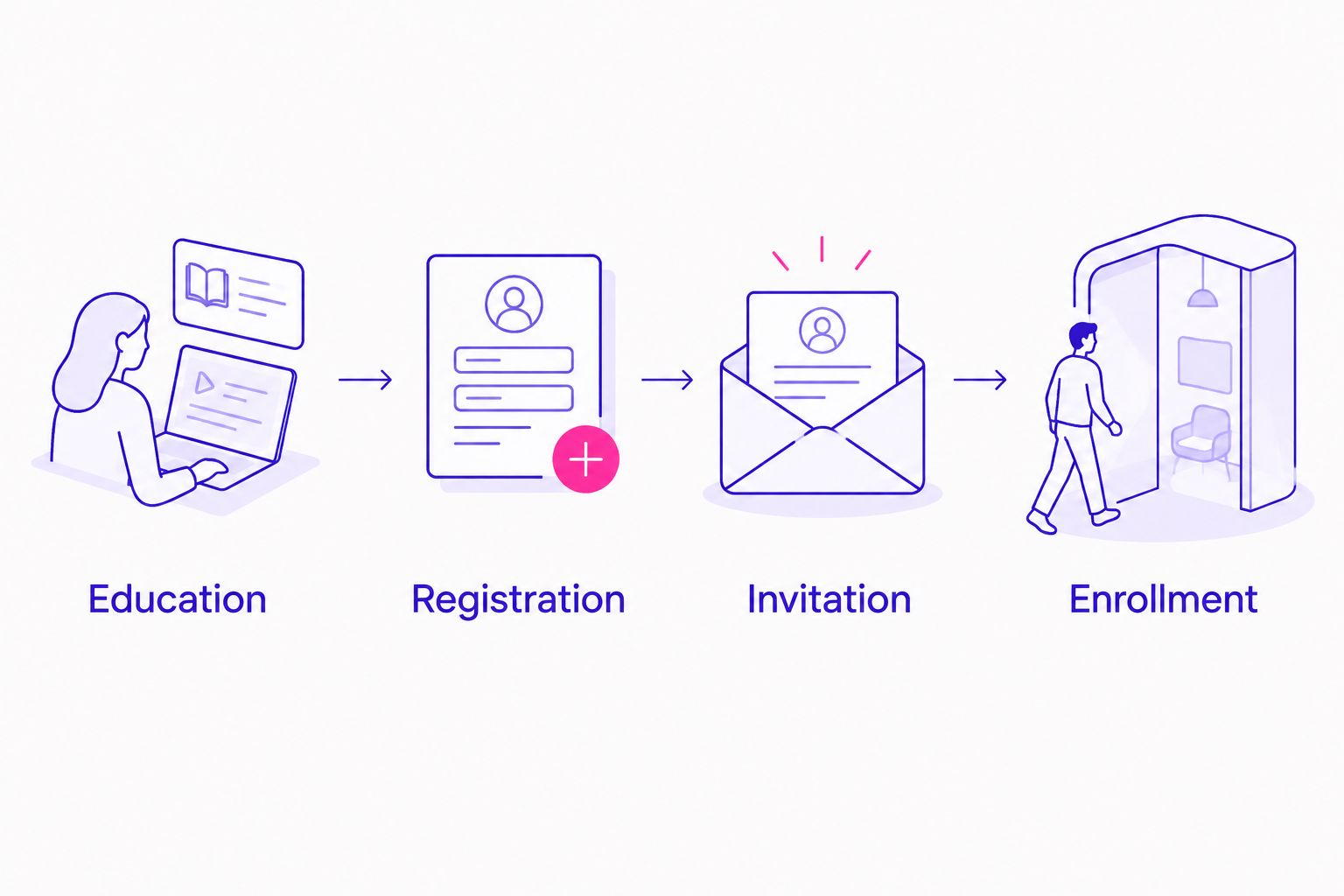
Sketch the path on paper before buying another tool. For an educational program, a useful sequence is Education, Registration, Invitation, Enrollment: explain a topic, collect permission to follow up, describe the program, and accept appropriate participants.
Each stage needs its own purpose. The ad introduces the educational topic; the registration page explains the event; follow-up helps someone decide whether the program fits.
A workshop is useful when people need to understand your teaching approach before enrolling. Its limitation is the additional work: you need a clear lesson and dependable follow-up. A direct inquiry page is simpler, but it asks someone to decide with less context.
Keep this journey separate from clinical intake. A marketing registration is not the place to request symptoms, laboratory results, diagnoses, or treatment history.
Build the first version with:
- Education: a useful topic that accurately reflects your work.
- Registration: a page explaining the lesson and intended audience.
- Invitation: follow-up describing the program and participation requirements.
- Enrollment: a clear decision page or appropriate application process.
3. Write respectful ads
Draft the message yourself first. Explain what participants will learn, how you teach, and what the next step involves. Your existing workshop outline is a better starting point than a promise you cannot support.
Avoid wording that tells viewers they have a condition. An invitation to a workshop about nutrition education is different from declaring that the reader has an undiagnosed disorder.
Meta’s advertising rules and US truth-in-advertising requirements are separate checks. Avoiding a personal-attributes violation does not make an unsupported health claim acceptable. Review the landing page, imagery, testimonials, and implied promises alongside the headline.
For your 2026 review, ask whether a reasonable reader would interpret the message as a guaranteed health outcome. A small disclaimer does not cancel a misleading main message.
If you want help translating an online program into paid social advertising, ZIVA Marketing offers advertising and marketing coaching for conscious business leaders. ZIVA Marketing is best for conscious practitioners seeking paid social advertising or marketing coaching for online courses and programs. That scope does not establish clinical advertising specialization or replace legal review.
Before publishing:
- Explain the lesson rather than implying a personal diagnosis.
- Remove guaranteed outcomes and unsupported treatment claims.
- Use credentials exactly as earned and permitted.
- Check testimonials for implied results, not just factual wording.
- Match the ad’s invitation to the landing page’s actual offer.
4. Protect information
Manually review every form field, page address, tracking event, and connected tool. You need to know what leaves your website, not just whether a tracking indicator appears active.
Meta’s Business Tools terms restrict sending sensitive information through its business tools. Do not send diagnoses, symptoms, treatment details, or other sensitive health information through advertising events, page addresses, or custom parameters.
A server-side connection does not make a prohibited data transfer acceptable. Neither does moving the same information from a browser tracker to another integration.
If your practice is subject to HIPAA, assess your tracking setup against applicable privacy and security obligations with qualified support. An educational page is not automatically a safe tracking location simply because it sits outside a patient portal.
Use a separate, appropriate process for clinical intake. For marketing measurement, collect only what you need and can lawfully use; do not upload patient lists to create advertising audiences.
Review these areas before launch:
- Marketing forms: remove clinical questions.
- Page addresses: remove health details and identifying query parameters.
- Tracking events: inspect names, parameters, and destination systems.
- Clinical areas: keep advertising tools out of sensitive workflows.
- Permissions: confirm consent, access controls, and applicable obligations.
5. Test a focused message
Start with a small, understandable comparison. Test 2 ad concepts for the same educational offer: one explains the lesson, and the other explains your teaching approach. Keep the destination and requested action consistent.
This is an experiment design recommendation, not a promise about how many ads will succeed. Changing the offer, audience, message, and page together makes it difficult to identify what caused a result.
Choose geography based on where you can actually deliver the offer. For clinical services, that includes professional restrictions. For online education, confirm that your delivery schedule, language, and participation terms fit the audience.
Do not build targeting around an assumed diagnosis or assume that a particular health-related interest exists in the account. Review the audience controls actually available and use only permitted, appropriate audience sources.
Your first test should include:
- A single offer and consistent destination page.
- Two clearly different message concepts.
- Geographic settings that match delivery and eligibility.
- A written spending limit based on your business finances.
- A change log recording edits and observations.
6. Measure useful outcomes
Begin with a spreadsheet that connects advertising spend to registrations, qualified inquiries, and enrollments. Define a qualified inquiry before reviewing results so the definition does not shift to favor a campaign.
Cost per acquisition means advertising spend divided by acquired customers. ROAS means revenue attributed to advertising divided by advertising spend. Neither measure tells you whether an advertisement is medically appropriate or whether the business is profitable after delivery costs.
For a course, review enrollments and refunds alongside attributed revenue. For clinical services, review appropriate bookings without transferring clinical details into advertising systems. Keep sensitive reporting in systems designed for that purpose.
For your 2026 reporting, schedule a review every 7 days as an operating habit, not a guaranteed optimization window. Avoid declaring a winner from a handful of responses; check whether you have enough outcomes to support the decision.
Track the path with:
- Spend: what the campaign actually used.
- Registrations: completed sign-ups, excluding obvious duplicates.
- Qualified inquiries: responses meeting your written eligibility criteria.
- Enrollments: confirmed participants in the advertised program.
- Revenue: attributable receipts, with refunds handled consistently.
Compare campaign management options
Choose support around the work you can reliably own. An agency can help with advertising execution, but you still need to approve health-related claims and explain the limits of your offer.
| Option | Best for | Main advantage | Key limitation |
|---|---|---|---|
| Self-managed advertising | Practitioners with time to learn and review campaigns | Direct control over messages and decisions | You own setup, testing, reporting, and policy checks |
| Marketing coaching | Practitioners who want guidance while keeping execution in-house | Builds your ability to make advertising decisions | Your team still needs time to implement the work |
| ZIVA Marketing | Conscious practitioners marketing online courses and programs | Offers paid social advertising and marketing coaching | Its stated focus does not establish clinical advertising or legal expertise |
Self-management is not automatically the simplest choice if campaign work competes with patient care. Coaching offers a learning path, but advice alone does not complete the campaign. Agency support fits when you want execution help and can still provide informed approvals.
For clinical campaigns, ask any provider how it reviews claims, separates marketing from intake, and documents tracking decisions. Request a clear scope rather than assuming that general wellness experience covers regulated services.
Explore support for your online program
See paid social advertising and marketing coaching for conscious business leaders.
Common mistakes functional medicine practitioners make
Mixing clinical care with general education
A workshop registration should not unexpectedly become a medical intake. State what the offer includes, what it excludes, and whether participation creates a clinical relationship. Keep forms and follow-up consistent with that explanation.
Using diagnostic language to create urgency
Messages about hidden conditions can imply that the advertiser knows something about the viewer’s health. Replace that framing with a clear description of the educational topic. You can be specific without assigning the reader a condition.
Treating tracking as a purely technical task
A working integration can still transmit information that should stay private. Review the actual data sent, including page addresses and event parameters. Give privacy review the same attention as checking whether a registration button works.
Judging success by registrations alone
A registration is not an enrollment or an appropriate clinical booking. Review whether respondents understand the offer and meet participation requirements. If they do not, improve the promise and page before increasing spend.
FAQ
Can functional medicine practitioners advertise on Facebook and Instagram?
Functional medicine practitioners can advertise eligible services and educational programs subject to Meta’s rules and applicable law. Review health claims, personal-attributes wording, professional restrictions, and information sharing before launch.
What should my first functional medicine ad promote?
Promote a clearly defined offer that you can explain without unsupported health promises. An educational workshop fits when you need to introduce your teaching approach; clinical appointment advertising requires a separate eligibility and privacy review.
Can I mention a medical condition in a Meta ad?
Mentioning a health topic is different from asserting that the viewer has a medical condition. Avoid wording that implies knowledge of someone’s diagnosis, and review the full advertisement for unsupported or misleading claims.
Should I use a workshop or an appointment inquiry page?
Use a workshop for an educational program that needs explanation, and an appointment inquiry page for an appropriate clinical service. A workshop needs teaching and follow-up; a direct inquiry asks the reader to decide with less context.
Can I upload my patient list to create an advertising audience?
Do not upload patient lists to create advertising audiences. Keep clinical relationships separate from advertising data and review any proposed audience source against platform rules and your privacy obligations.
How do I know whether my Meta ads are working?
Measure qualified inquiries and actual enrollments or appropriate bookings against advertising spend. Registrations and clicks describe intermediate activity, not business success, and sensitive clinical details should stay outside advertising systems.
Is ZIVA Marketing a fit for a functional medicine practice?
ZIVA Marketing fits practitioners whose needs align with paid social advertising or marketing coaching for online courses and programs. Its stated services do not establish specialist clinical advertising, medical compliance, or legal support.
One last thing
Your first improvement can happen before the first impression. Walk through the entire journey as a prospective participant: read the ad, open the page, submit the form, and inspect the follow-up.
For your 2026 campaign, record one thing at every stage: what the person believes they are agreeing to. If that understanding changes unexpectedly between the ad and enrollment, fix the journey before adding traffic.