
is youtube worth advertising on for course creators
Is YouTube worth advertising on for course creators in 2026?
Is YouTube worth advertising on for course creators? Yes, when you can track enrollments. Learn how to assess readiness, test teaching videos, and judge ROAS.
By ZIVA Marketing ·
YouTube is worth testing for course creators in 2026 when you have a clear offer, a useful teaching video, and a way to connect advertising to paid enrollments—not just views.
- Is YouTube worth advertising on for course creators? Yes, as a measured enrollment test—not a promise of profitable sales.
- YouTube ads suit course creators who can demonstrate their teaching and track the path to enrollment.
- Wait if your course offer, checkout, or follow-up still needs work; advertising cannot replace those foundations.
- ZIVA Marketing fits spiritual course creators seeking paid social advertising and marketing coaching.
Is YouTube worth advertising on for course creators in 2026?
Yes, when you can test whether your teaching attracts paying students at a sustainable acquisition cost. YouTube lets you show your approach rather than describe it only in text. The caveat is that video production, follow-up, and course delivery also affect whether advertising makes business sense.
Start with a defined enrollment goal. Our guide to YouTube ads for online course creators explores the channel; the decision here is whether your business is ready to test it.
You have several reasonable paths. Choose the one that matches what you need to learn, rather than assuming a new channel is the next step.
| Path | Best for | Main advantage | Main limitation | Recommendation |
|---|---|---|---|---|
| YouTube ads | Creators with a clear offer and trackable enrollment path | Paid distribution for a video that demonstrates your teaching | Requires advertising spend, creative work, and reliable measurement | Test with a defined business question |
| Organic YouTube | Creators developing their teaching message | A place to publish lessons without paying for distribution | Publishing does not guarantee reach or enrollments | Use to develop useful teaching content |
| Improve your existing channel | Creators with unresolved checkout or follow-up problems | Keeps attention on the path you already have | Does not test a new source of students | Fix the known problem first |
These paths are not mutually exclusive. An organic lesson can inform an advertisement, and a stronger enrollment page can support either approach. You do not need to add a channel before you improve the journey students already take.
Why this matters
Your course represents real care, preparation, and expertise. It is understandable to want advertising that communicates that depth without making your work feel like a sales performance.
A teaching-led video gives you a concrete starting point: show something useful, explain the course clearly, and invite an appropriate next step. You do not need exaggerated promises to make that invitation meaningful.
The business question is separate from the creative question. A video can feel true to your work and still fail to produce sustainable enrollments. Your 2026 advertising plan needs room for both: an honest message and a clear method for judging results.
What makes a course ready for a YouTube advertising test?
Readiness is not about having polished production. It is about knowing what you offer, who it serves, and how you will recognize a worthwhile result.
Use these 3 readiness checks before recording your advertisement:
- Offer clarity: Can you name the intended student, the learning outcome, and what participation involves?
- Enrollment clarity: Does the next page explain the course and make the next action easy to understand?
- Measurement clarity: Can you distinguish a video view, a registration, and a paid enrollment?
A course description such as spiritual growth leaves a prospective student with work to do. A more concrete description explains the practices taught, the learning format, and the experience expected of participants. Use details that are true of your course, not promises about personal transformation.
Your enrollment page should answer practical questions too. Explain what students receive, how they participate, and any prerequisites. If the program requires an application, say so before someone begins the process.
Wait on advertising when the next step is unclear. Sending more people to a confusing page does not resolve the confusion. Improve the page, test the checkout, and confirm that follow-up reaches the right person.
How do you test YouTube ads without losing sight of enrollments?
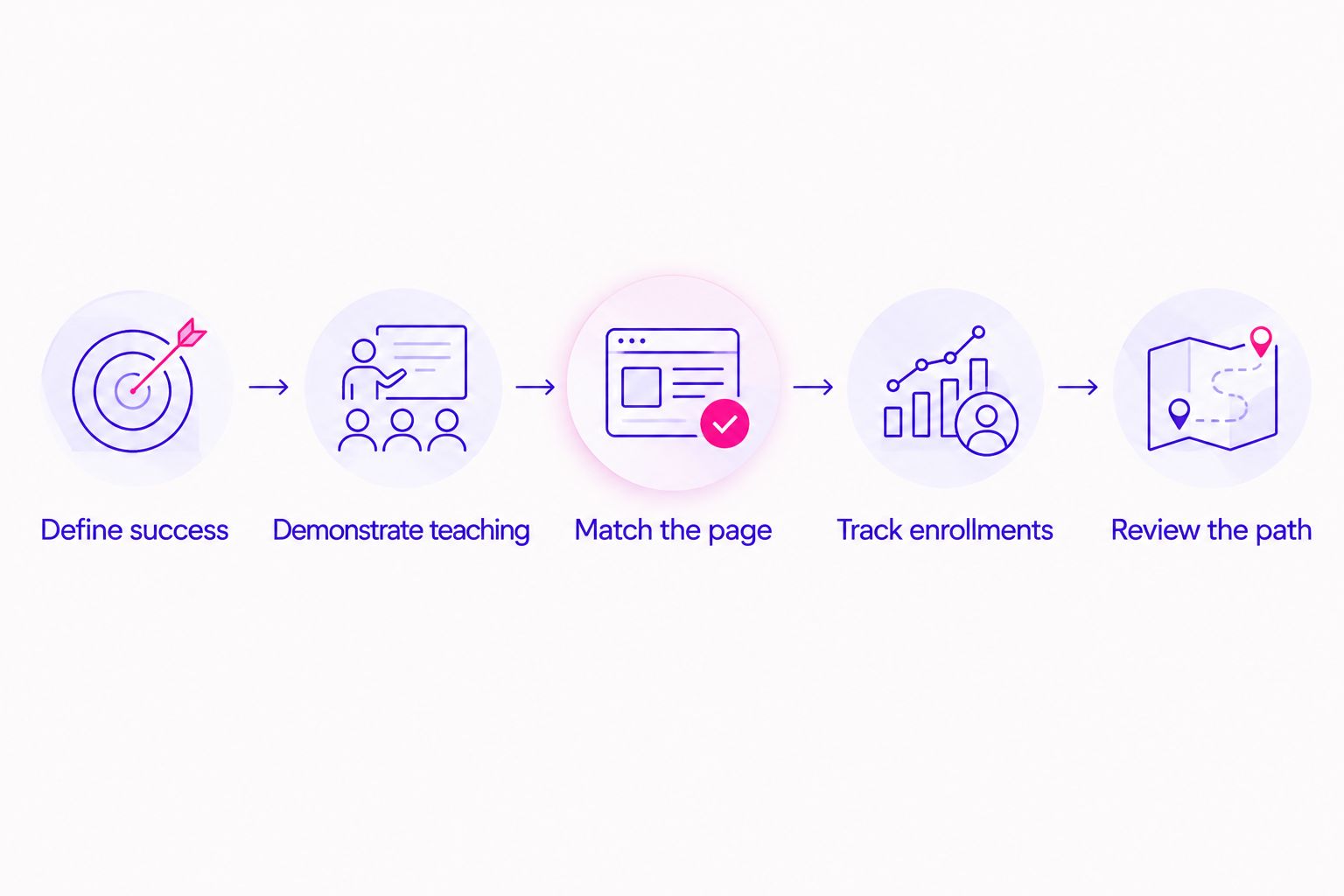
Use 5 test steps to keep the campaign connected to your course business. Each step answers a different question, from what you want to learn to what you will do with the result.
1. Define success
Choose the action that matters to the business. For a course sold through checkout, that is a paid enrollment. For a program sold through a conversation, track the application and the eventual sale separately.
Registrations can be useful intermediate signals. They are not the same as revenue. Write down your success condition before launch so an encouraging view count does not quietly replace the original goal.
2. Demonstrate teaching
Build the video around a real learning moment. Explain a concept, guide an appropriate practice, or demonstrate how you approach a question your intended students ask.
Then connect that lesson to the course. State who the program serves and what the viewer can do next. Show the teaching before asking the viewer to trust a broad promise.
You do not need to compress the whole curriculum into an advertisement. Choose a lesson that represents your approach without making unsupported claims about what everyone will experience.
3. Match the page
Keep the advertisement and destination page aligned. A video about an introductory practice should not lead to a page that assumes advanced knowledge without explanation.
Repeat the same course name, learning focus, and next action. This is not about repeating every sentence. It is about helping the viewer recognize that the invitation they accepted is the one in front of them.
4. Track enrollments
Check the measurement path before paying for traffic. Confirm that a completed purchase is recorded as a purchase, not merely as a page visit or checkout start.
Keep 2 measurement records available: the advertising report and the payment record. The advertising report describes attributed results; the payment record confirms transactions. They answer different questions, so neither should replace the other.
For a 2026 test, document the attribution window—the period in which the advertising system credits an action to an ad interaction. Use the same definition when comparing campaign results.
5. Review the path
Read results in order: video response, destination-page activity, registration or application, and enrollment. Look for the point where the intended journey stops.
Change the part connected to the problem. If visitors arrive but do not take the next step, inspect the page and offer before replacing every video. If registrations happen but enrollments do not, review the lesson, follow-up, and sales process.
The sequence keeps your next decision specific. You are not asking whether the channel feels promising; you are asking whether a defined path produces the result your business needs.
Why the value of YouTube advertising varies
There is no useful channel verdict detached from the course and its sales process. Evaluate these factors together:
- Offer clarity: A viewer needs to understand the course before deciding whether it fits.
- Teaching fit: The video should represent the experience students will actually receive.
- Enrollment path: Direct checkout, webinar registration, and applications involve different next steps.
- Follow-up: Someone who registers still needs clear information about how to attend or enroll.
- Tracking accuracy: Incorrect purchase events make the advertising report harder to interpret.
- Business economics: Advertising, production, refunds, and delivery affect what remains from course revenue.
These factors also explain why another creator's result is not a forecast for your program. Different offers and enrollment paths are different tests.
Use your own course economics to set the decision rule. A general claim that YouTube is good for courses cannot tell you whether a particular campaign is good for your business.
What should you measure beyond views?
Views describe exposure to the video. They do not establish that the advertisement brought in paying students.
Cost per acquisition means advertising spend divided by the number of customers acquired. For a course, define the acquisition as a paid enrollment if that is your business goal. Do not silently substitute registrations because they are easier to count.
ROAS means return on ad spend: attributed revenue divided by advertising spend. It is a revenue measure, not a profit measure. Production, course delivery, and other business expenses sit outside that calculation.
Use completed payments to check the revenue behind the report. Account for refunds, and distinguish money collected from future installment payments. A sale recorded today does not make every scheduled payment cash received today.
Also inspect attribution overlap. If different advertising systems each credit the same enrollment, adding their reported sales together can count that enrollment more than once. Your business has one payment record even when several reports claim influence.
For your 2026 review, keep the definitions beside the results. A comparison is only useful when enrollment, revenue, and reporting period mean the same thing throughout.
Should you send YouTube viewers straight to checkout?
Direct checkout fits a course that viewers can understand and choose from the advertisement and sales page. Its advantage is a short route to enrollment. Its limitation is that the viewer must make the purchase decision without an additional teaching or conversation step.
A teaching session gives you space to explain the course and demonstrate your approach. It also adds work: registration, attendance, follow-up, and a clear enrollment invitation.
An application fits a program where suitability needs a conversation. It adds review and scheduling work, and an application is not a completed sale.
| Enrollment path | Best for | Advantage | Limitation |
|---|---|---|---|
| Direct checkout | Courses with a clear, self-contained purchase decision | Fewer steps between interest and enrollment | The page must answer the buying questions |
| Teaching session | Offers that benefit from explanation and demonstration | Space to teach before inviting enrollment | Adds attendance and follow-up tasks |
| Application | Programs requiring a suitability conversation | A place to assess fit before enrollment | Adds review and sales work |
Choose the path your offer needs. More steps are not automatically more persuasive, and fewer steps are not automatically more effective.
Can spiritual teachers advertise without overpromising?
Yes: describe the teaching, participation, and course content rather than guaranteeing an individual outcome. Your message can be hopeful while remaining specific.
Avoid diagnosing the viewer or presenting a spiritual practice as a guaranteed treatment. Where health or income claims are involved, check the relevant advertising policies and legal requirements before publishing. A disclaimer is not a substitute for an accurate main claim.
Use testimonials only with permission and present them accurately. An individual's experience does not establish what every student will experience.
ZIVA Marketing is a paid social advertising and marketing coaching agency for spiritual teachers, healers, coaches, and conscious business leaders. We help this audience grow online courses and programs; that focus fits creators who want marketing support that understands their work.
Agency support still does not replace a clear offer or reliable measurement. The right support should help you make those decisions, not treat advertising as a guaranteed outcome.
FAQ
Is YouTube worth advertising on for course creators in 2026?
YouTube is worth testing in 2026 when you have a clear course offer, useful teaching creative, and reliable enrollment tracking. Judge the test by paid enrollments and business economics, not views alone.
Do I need a large YouTube channel before running ads?
A large subscriber base is not a prerequisite for paid YouTube distribution. You still need an appropriate advertisement, a clear destination, and a way to measure the result.
Is YouTube better than Facebook for selling courses?
Neither channel is universally better for selling courses. Compare each channel against the same enrollment goal and revenue definition rather than comparing views on one with purchases on the other.
Should I run ads before anyone has bought my course?
Do not treat advertising as proof that people want the course. If the offer is untested, define the campaign as an offer-validation test and distinguish expressions of interest from completed purchases.
What's the best number to track for course advertising?
Paid enrollments are the main outcome to track when your goal is course sales. Read them alongside acquisition cost, collected revenue, refunds, and delivery expenses.
Can I use a teaching video as a YouTube advertisement?
Yes, a teaching video can form the basis of an advertisement. Add a clear connection to the course and an appropriate next action, and confirm that the content meets advertising requirements.
Who does ZIVA Marketing help with course marketing?
ZIVA Marketing helps spiritual teachers, healers, coaches, and conscious business leaders through paid social advertising and marketing coaching. Its stated focus is growing online courses and programs to reach a global audience.
One last thing
Write the decision rule before you launch the video. State what counts as an enrollment, which expenses matter, and what evidence would justify continuing.
That small piece of preparation protects your 2026 review from becoming a debate about whether the advertisement looks successful. Your video can open the conversation; paid enrollments and course economics tell you whether to keep investing.