
is the highly sensitive coaching niche worth advertising in
Is the highly sensitive coaching niche worth advertising in?
Is the highly sensitive coaching niche worth advertising in? Test a proven offer, track paid enrollments, and assess your margins before increasing ad spend.
By ZIVA Marketing ·
The highly sensitive coaching niche is worth testing with paid advertising in 2026 when your offer has attracted paying clients, your margins support acquisition costs, and you can track enrollments—not just clicks.
- Is the highly sensitive coaching niche worth advertising in? Test a proven offer before increasing spend.
- For Meta ads, judge qualified inquiries and paid enrollments—not engagement alone.
- ZIVA provides paid social advertising and marketing coaching for spiritual teachers, healers, and coaches.
- Use clear coaching outcomes, respectful messaging, and reliable sales tracking to assess whether advertising works for your business.
Is the highly sensitive coaching niche worth advertising in?
Yes to a controlled test; no to assuming the niche itself guarantees profitable advertising. Your decision rests on the offer, the buying journey, and the money left after delivering the program. A recognizable audience label does not establish buying intent.
Start by checking whether people already pay for the specific support you offer. A program about practicing boundaries has a clearer purpose than a promise to transform every part of a sensitive person's life. Describe the work, the intended outcome, and the limits honestly.
For channel-specific planning, the guide to Instagram ads for highly sensitive person coaches addresses the closely related advertising topic.
Use this decision table before committing more spending:
| Approach | Best for | Advantage | Limitation | Recommendation |
|---|---|---|---|---|
| Test paid advertising | Coaches with a clear offer and evidence of paid demand | Tests whether you can acquire buyers beyond your existing audience | Requires spending, tracking, and follow-up | Test with a defined spending limit |
| Improve the offer first | Coaches whose inquiries rarely become clients | Addresses the buying decision before adding traffic | Does not immediately expand reach | Clarify the offer before advertising |
| Continue organic outreach | Coaches still learning what buyers want | Creates opportunities for direct conversations | Does not establish paid acquisition economics | Use conversations to refine the offer |
These are business-readiness choices, not judgments about your ability as a coach. You can do meaningful work and still need a clearer invitation before advertising it.
Why this matters
Advertising puts your promise in front of people who do not already know you. That makes clarity essential: the reader needs to understand what the program teaches, how it works, and whether it fits their situation.
If spending feels uncomfortable, give the experiment boundaries. Decide what you want to learn and what you can afford to lose before launching. You do not need to turn uncertainty into a large commitment.
For your 2026 plan, separate two questions: whether people want the offer, and whether paid advertising can acquire those people sustainably. An offer can sell through referrals without yet supporting paid acquisition.
Treat advertising as a business test, not a verdict on the value of your work. The useful result is a clearer next decision.
How to test highly sensitive coaching ads
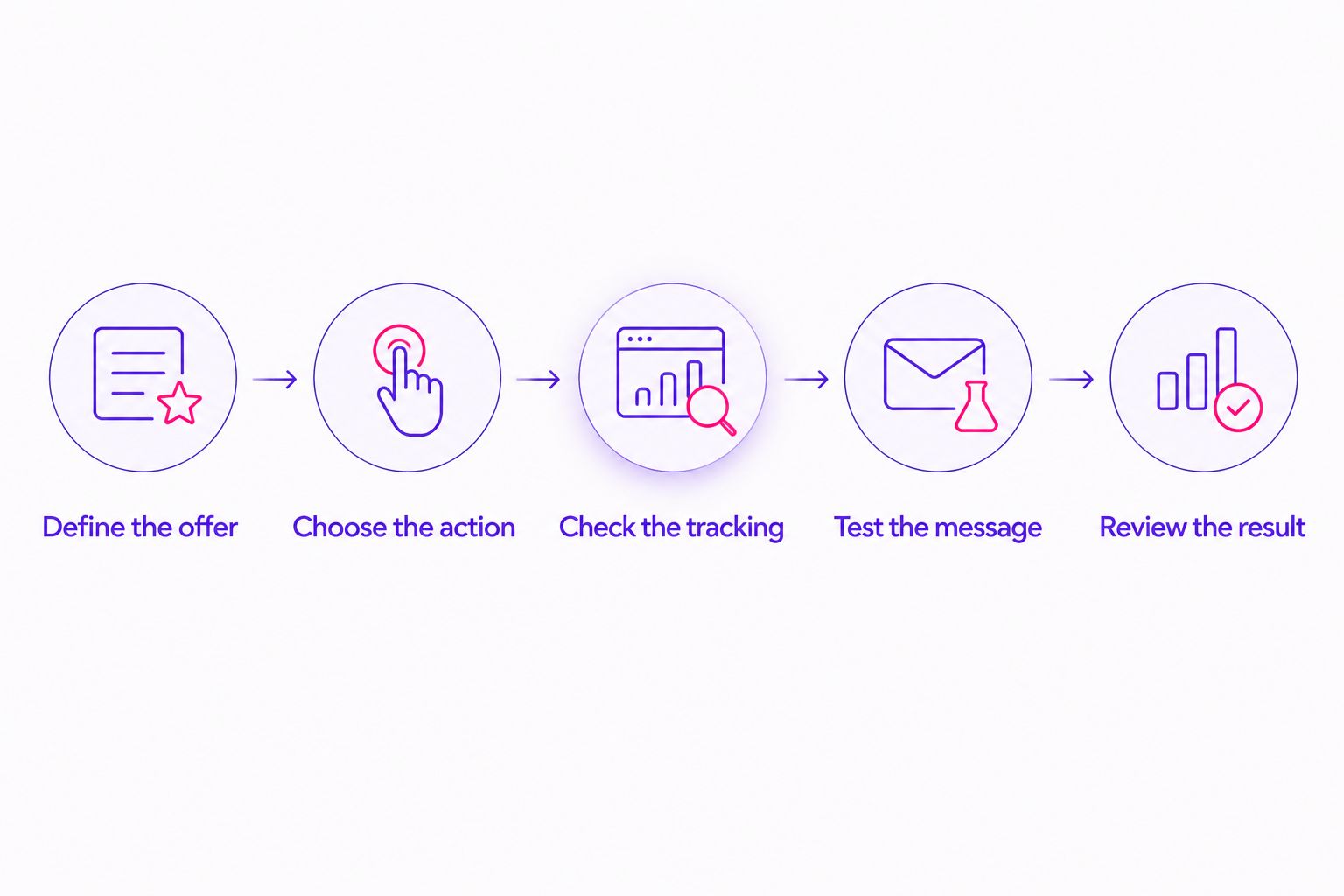
Use these 5 steps to keep the test understandable. Each step answers a different question, from what you are selling to whether the resulting enrollments support further spending.
1. Define the offer
Choose one program and one practical outcome to feature. State what participants will learn or practice, who the program serves, and what participation involves.
Describe coaching as coaching. If your program teaches communication or boundary-setting skills, explain those activities rather than promising treatment or guaranteed emotional change. Make sure your claims match your qualifications and the service you actually provide.
Your offer should make sense without a discovery call explaining every sentence. A call can explore fit; it should not have to translate the entire sales page.
2. Choose the action
Pick the next action that matches your buying process. That might be an application, a booked conversation, or an enrollment. Do not ask for an immediate purchase if your offer requires a fit conversation first.
Keep the path consistent. If the advertisement invites someone to learn about a group program, the destination should explain that program and its next step—not introduce an unrelated offer.
Record the meaningful actions along that path. A form submission and a paid enrollment answer different questions, so keep them separate in your reporting.
3. Check the tracking
Confirm that your measurement records the actions you intend to evaluate. Complete the journey yourself, from the advertisement's destination through the form or checkout, and check the resulting records.
Compare advertising reports with your booking and payment records. An event appearing in an advertising dashboard is not, by itself, proof that a client paid. Your business records should remain part of the evaluation.
Choose a reporting window that reflects your actual buying journey. If prospects need a conversation before enrolling, do not treat the first day's inquiries as a complete sales result.
4. Test the message
Write 2 message versions around different aspects of the same offer. One can explain a skill participants practice; the other can explain the program's structure. Keep the offer and destination consistent so you can interpret the difference.
Use invitation-based language. Describe a workshop about setting boundaries rather than telling the reader that they have poor boundaries. This keeps the message focused on your service instead of making assumptions about a stranger.
Read the advertisement and landing page together. Remove any promise that the page cannot explain or the program cannot support.
5. Review the result
Review the full journey: inquiries, fit, conversations, enrollments, and delivery costs. A campaign that creates attention but no suitable buyers has not yet demonstrated a reason to increase spending.
Choose the next action based on the weak point. Improve the message when inquiries misunderstand the offer. Improve the buying process when suitable prospects encounter unnecessary friction.
Increase spending only after the sales results and delivery economics support it. More traffic does not resolve an unclear offer.
Why highly sensitive coaching ad results vary
Your niche label is only part of the advertising decision. These 5 factors give you a practical way to review your own campaign without borrowing another coach's results as a forecast.
- Offer clarity: The reader needs to understand the program's purpose, activities, and next step. Review inquiries for signs that the message is being misunderstood.
- Buyer readiness: Someone exploring sensitivity is not necessarily looking for coaching. Check whether inquiries express interest in the actual program rather than general information.
- Message consistency: The advertisement, page, and conversation should describe the same service. Conflicting promises make it harder for a prospect to make an informed choice.
- Buying process: Forms, booking, payment, and follow-up affect the route to enrollment. Test that route before attributing every lost inquiry to audience fit.
- Delivery economics: Advertising must fit alongside the time and expenses required to serve clients. Revenue alone does not show what remains for the business.
For a 2026 campaign, use these factors as review categories rather than excuses for disappointing results. Identify the specific point that needs attention, make a focused change, and record what happens next.
Avoid assuming that everyone who identifies as highly sensitive shares the same goals. Let your program's subject and suitable-client criteria guide the message.
What should you measure before increasing spending?
Use 3 measures together: cost per qualified inquiry, cost per acquisition, and return on ad spend. They describe different parts of the business result; none should stand alone.
Cost per qualified inquiry is advertising spend divided by inquiries that meet your defined fit criteria. Set those criteria before reviewing the results. Relevant criteria include interest in the program's subject and willingness to participate in its format.
Cost per acquisition is advertising spend divided by new paying clients attributed to the campaign. This connects spending to enrollment rather than attention. Keep the attribution method consistent so your comparisons remain useful.
Return on ad spend, or ROAS, is attributed revenue divided by advertising spend. ROAS describes revenue relative to ads, not profit. Delivery expenses, payment fees, refunds, and other business costs still matter.
Use your own costs to establish what you can sustain. Do not copy a target from another coach without knowing their delivery model and expenses. A target is useful only when it fits your business.
For your 2026 review, write down the reporting window and attribution method alongside the results. That helps you avoid comparing numbers that describe different periods or different sales journeys.
Should you advertise before your offer has paying clients?
Validate the offer before treating advertising as a way to scale it. Paid traffic can be an experiment, but an unproven program leaves several questions open at once: the message, the offer, and the purchase decision.
Start with conversations about the service you actually intend to deliver. Ask what prospective clients want help practicing, what they need to understand before joining, and what makes the format suitable or unsuitable.
Interest is useful feedback, but it is not the same as a purchase. Record actual commitments separately from compliments, likes, and requests for more information.
If you choose to advertise during validation, define the experiment as learning rather than expansion. Set a spending limit you can absorb and a specific question the campaign should answer.
Do you need a large audience before advertising?
You do not need a large following to test paid advertising, but you do need a credible offer and a working buying process. Follower count does not tell you whether a campaign will acquire suitable clients at a sustainable cost.
Give new visitors enough information to evaluate your work. Explain the program's content, participation requirements, your relevant qualifications, and the boundaries of the service.
Use testimonials only with permission and present them accurately. An individual client's experience does not establish a guaranteed result for everyone who joins.
When does agency support make sense?
Agency support is relevant when you want help with paid advertising decisions while keeping your own attention on teaching and serving clients. It does not remove your responsibility for the offer, its claims, or program delivery.
ZIVA is best suited to spiritual teachers, healers, and coaches seeking paid social advertising and marketing coaching. At ZIVA, we help those businesses grow their online courses and programs toward a global audience.
The fit is specific: ZIVA provides paid social advertising and marketing coaching, not a highly sensitive coaching program. That distinction matters when choosing the kind of support your business needs.
Consider support when you can clearly explain your offer and want help assessing the advertising path. If the program itself remains undefined, clarifying it is the more useful first move.
Explore support for your advertising
Learn about paid social advertising and marketing coaching for your online courses and programs.
FAQ
Is the highly sensitive coaching niche worth advertising in during 2026?
The highly sensitive coaching niche is worth testing when your offer has attracted paying clients, your margins support acquisition costs, and you can track enrollments. The niche label alone does not establish profitability.
What should highly sensitive coaching ads say?
Highly sensitive coaching ads should explain the skills, activities, or support the program provides. Describe the service respectfully instead of making assumptions about the reader or promising guaranteed emotional change.
Should I measure leads or paying clients?
Measure both qualified inquiries and paying clients, but use enrollments and delivery economics to assess whether spending is sustainable. An inexpensive inquiry is not automatically a suitable buyer.
Do I need a large Instagram following to run coaching ads?
You do not need a large Instagram following to test coaching ads. You need a clear offer, enough information for new visitors to evaluate it, and a working route to enrollment.
How do I know whether my coaching ads are profitable?
Compare attributed sales revenue with advertising spend and the costs of delivering the program. ROAS measures revenue relative to ad spend; it does not include every expense or establish profit by itself.
Can ZIVA help me market a coaching program?
ZIVA provides paid social advertising and marketing coaching for spiritual teachers, healers, coaches, and conscious business leaders. Its work focuses on growing online courses and programs toward a global audience.
One last thing
Before launching your next 2026 campaign, ask someone unfamiliar with your business to read the advertisement and landing page. Ask them to explain what the program does and what they would do next.
Compare their explanation with your intended offer. If the two differ, revise the message before buying more traffic. This checks comprehension, not profitability—but it gives your advertising test a clearer starting point.
Keep the niche specific and the invitation understandable. You can honor the people you serve without asking every new visitor to understand all your terminology before taking a first step.