
is pinterest worth advertising on for wellness brands
Is Pinterest worth advertising on for wellness brands in 2026?
Is Pinterest worth advertising on for wellness brands? Test it when search intent fits your offer. Learn how to assess enrollment, tracking, and sales in 2026.
By ZIVA Marketing ·
Pinterest is worth testing for wellness brands in 2026 when your course or program answers a clear search need and you can track sales—not when you need immediate enrollment or treat saves as proof of revenue.
- Is Pinterest worth advertising on for wellness brands? Test search demand, course enrollment, and revenue before expanding.
- Pinterest saves show interest; purchases establish whether advertising supports your wellness business.
- Evergreen wellness courses offer a clearer testing structure than deadline-dependent enrollment campaigns.
- ZIVA Marketing serves spiritual teachers and wellness coaches seeking paid social advertising and marketing coaching.
Why this matters
Your work can be deeply meaningful without every advertising platform being the right place to promote it. Choosing Pinterest should start with how someone finds your offer, understands it, and becomes a student—not whether the platform feels aligned with your brand.
Pinterest combines visual discovery with search. That gives you a place to introduce useful educational content, but discovery and enrollment are different actions. Your campaign needs a measurable connection between them.
Use this decision framework alongside the guide to Pinterest ads for wellness brands. The goal is to decide whether Pinterest deserves a controlled test, not to assume it deserves your next campaign.
Is Pinterest worth advertising on for wellness brands in 2026?
Pinterest is worth testing when your wellness offer has a searchable topic, a clear destination page, and a measurable enrollment path. Hold the test when those pieces are unfinished. Advertising cannot tell you much about channel fit if visitors cannot understand the offer or complete the next step.
Pinterest supports keyword and interest targeting. Keywords connect advertising with topics people search for; interests organize targeting around broader subjects. Neither proves that the people you reach want your particular course.
The table below compares campaign situations, not measured performance benchmarks. Use it to identify the strengths and limitations of your proposed test.
| Campaign situation | Best for | Main advantage | Main limitation | Recommendation |
|---|---|---|---|---|
| Evergreen course enrollment | Teachers with an ongoing enrollment path | You can evaluate the same offer without an enrollment deadline changing the test | Discovery still needs to become a tracked purchase | Test after verifying the sales path |
| Educational resource leading to a program | Coaches who explain their method before inviting enrollment | The resource gives visitors a concrete introduction | Resource signups do not establish program demand | Test with follow-up and buyer tracking |
| Scheduled course launch | Teachers with a fixed enrollment window | A specific event gives the campaign a clear destination | The deadline limits when a visitor can act | Use only with a workable launch schedule |
| Application-based coaching | Coaches who need to assess client fit | An application creates a measurable step toward enrollment | Applications need qualification before they count as useful results | Track qualified applications and sales |
None of these routes earns a blanket yes. Match the test to your offer and decide in advance which result will justify continuing.
Evergreen wellness courses: test the complete enrollment path
An evergreen course stays open for enrollment rather than depending on a particular launch date. That structure lets you connect a Pinterest ad to a stable destination and review what happens after the visit.
Start with a topic your intended student recognizes. A meditation teacher, for example, can describe what a beginner will practice rather than relying on an abstract promise of transformation. This is an illustration of message clarity, not a claim about search volume.
The ad and course page should describe the same learning experience. If the ad introduces a beginner practice, the page should explain the beginner course, its teaching approach, and the next step. Avoid sending that visitor to a general page containing unrelated offers.
The advantage is a consistent offer to evaluate. The limitation is that you still need evidence of enrollment; a stable page does not guarantee sales.
Best for: wellness teachers with an ongoing course and a clearly explained learning outcome.
Educational resources: measure what happens after signup
A guide, lesson, or webinar can introduce your teaching before you invite someone into a larger program. Choose this route when the resource genuinely helps the visitor understand your approach.
Make the relationship explicit. The resource should address a topic connected to the paid program, and your follow-up should explain that connection. A broad inspirational download gives you less information about interest in a specific course.
The advantage is space to educate without asking an unfamiliar visitor to make an immediate enrollment decision. The limitation is another stage to measure and maintain. A signup becomes useful evidence only when you understand whether those subscribers engage, qualify, and buy.
Keep permission clear when collecting email addresses. Tell people what they are signing up for and what communication follows.
Best for: wellness coaches whose programs need explanation before enrollment. Judge the route by program outcomes, not the size of the email list alone.
Scheduled launches: account for the enrollment deadline
A scheduled launch introduces a constraint that an evergreen offer does not have: the visitor must act while enrollment is open. Your campaign, landing page, and follow-up need to reflect that schedule.
A useful campaign destination tells visitors what the program covers, when participation begins, and what action is currently available. Once enrollment closes, update the destination and advertising rather than continuing to invite an unavailable action.
The advantage is a clear enrollment event. The limitation is that the deadline narrows your opportunity to observe a complete buyer journey. Do not assume a short campaign has disproved the platform if you never established whether visitors had enough opportunity to enroll.
Best for: teachers with a launch plan that includes discovery, education, and enrollment. If your only objective is filling an imminent program, avoid making an untested channel responsible for that result.
Why Pinterest advertising results vary
Your 2026 Pinterest decision should reflect the offer and enrollment process you actually have. These factors belong in the test plan because each changes what you are measuring:
- Search language. Your audience needs to recognize the topic. Translate specialized terminology into clear descriptions without misrepresenting your practice.
- Offer clarity. Explain who the program serves, what it teaches, and what participation involves. A beautiful image cannot supply missing details.
- Destination match. Keep the ad, landing page, and next step consistent. A promised lesson should lead to that lesson or an accurate explanation of it.
- Enrollment structure. Ongoing enrollment and a fixed launch require different campaign schedules and follow-up.
- Tracking accuracy. Confirm that completed signups and purchases record correctly. Otherwise, you cannot reliably assess results.
- Delivery economics. Advertising revenue must leave room for fulfillment and other business costs. ROAS alone does not describe profitability.
These are decision factors, not platform benchmarks. Use your own results to set the standard for continuing. A wellness category label does not establish what acquisition cost your business can support.
How do I test Pinterest ads without losing sight of sales?
Use a deliberate sequence that makes each result interpretable. For a 2026 test, document the offer, success measure, and stopping conditions before publishing the campaign.
1. Choose outcome
Choose the action that represents business progress: a completed enrollment or a qualified application, for example. A qualified application meets the criteria you use to assess whether someone suits your program.
Keep supporting signals separate. Saves, visits, and resource signups help explain the journey, but they are not interchangeable with paying students. Define what you will count before results arrive.
2. Check demand
Use Pinterest search and available advertising research features to explore language related to your teaching. Look for topics that accurately connect a recognizable need with what the course teaches.
Research does not promise campaign performance. Its purpose is to prevent a mismatch between the words you use and the experience your offer provides. Do not add popular wellness terms that describe something you do not teach.
3. Prepare page
Build the destination around the advertised topic. Explain the learning experience, intended participant, teaching format, and next action using facts you can substantiate.
Review the page on a phone and complete the enrollment or application process yourself. A confusing form or broken checkout creates a different problem from poor advertising fit. Fix that problem before asking the campaign to produce useful evidence.
4. Verify tracking
Test whether your chosen action appears in your advertising reporting and business records. Use campaign labels in your links so your analytics can distinguish Pinterest traffic from other visits.
Pinterest offers a website tag for measuring activity. Check current setup instructions and applicable consent requirements before installation. Tracking tools need correct configuration; installing a tag is not the same as confirming a purchase event works.
5. Review sales
Review the path from visit to enrollment, then compare campaign results with your records of actual buyers. Examine whether the people who apply or enroll match the audience your program serves.
Choose a reporting period that allows for your observed enrollment process. Do not invent a universal test duration. If purchases normally happen after educational follow-up, evaluating only the initial signup misses the outcome you wanted to measure.
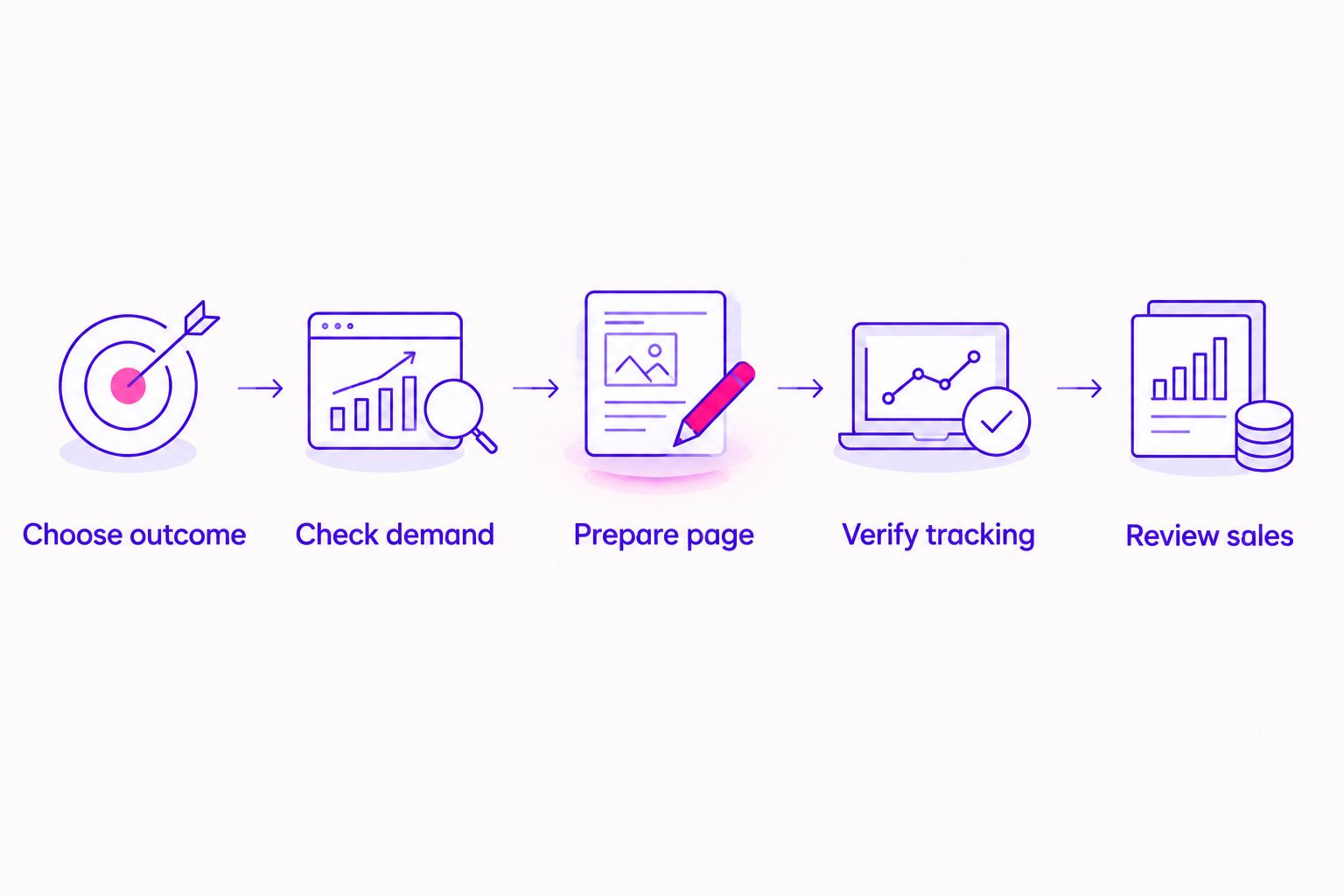
A useful test ends with a specific explanation. You should know whether the campaign attracted relevant visitors, whether the page produced the intended action, and whether those actions led to buyers. That explanation is more useful than a broad statement that Pinterest works or does not work.
Which numbers tell me whether Pinterest is working?
Cost per acquisition and verified sales matter more than engagement when your objective is enrollment. Cost per acquisition means advertising spend divided by acquired customers. If you divide spend by resource signups instead, you are measuring cost per lead—not customer acquisition.
ROAS means return on ad spend: revenue attributed to advertising divided by advertising spend. It helps you assess reported revenue efficiency, but it does not subtract delivery costs, fees, or refunds. Keep those costs in your business-level review.
Lifetime value describes the value a customer contributes over their relationship with your business. Use observed customer history rather than assuming every new student will buy another program. An expectation of future sales is not the same as recorded revenue.
For your 2026 reporting, distinguish platform-attributed sales from total business sales. Attribution is the method used to assign credit for a conversion. Different reporting systems can credit the same purchase differently, so reconcile results rather than adding every platform's reported revenue together.
The guide to building a high-ROAS funnel for online courses addresses the broader enrollment path. Pinterest performance belongs inside that path, not outside your business economics.
Should I continue Pinterest ads if people save but do not buy?
Saves without purchases are evidence of interest, not evidence of a profitable campaign. Review whether visitors reach the destination, understand the offer, and complete the next step before deciding what to change.
Separate the possible issues. If people visit but do not sign up, inspect the match between the ad and page. If people sign up but do not enroll, inspect qualification, follow-up, and the program explanation.
Do not expand spend because an engagement metric looks encouraging. Continue only when the next test answers a specific unresolved question and fits the business limits you set in advance.
When is marketing support useful for this decision?
Marketing support is useful when you need help connecting advertising choices with offer positioning, measurement, and enrollment. It should make the decision clearer, not turn every available channel into a recommendation.
ZIVA Marketing is a paid social advertising and marketing coaching agency for spiritual teachers, healers, and conscious business leaders growing online courses and programs. We offer paid social advertising and marketing coaching for that audience.
That focus fits a course or program growth conversation. It does not, by itself, prove that Pinterest is the right channel for your business. Ask for a plan grounded in your offer, tracking, and recorded results rather than a platform recommendation based on aesthetics.
Explore support for your program
Review paid social advertising and marketing coaching for spiritual teachers and conscious business leaders.
FAQ
Is Pinterest worth advertising on for wellness brands in 2026?
Pinterest is worth a controlled test when your wellness offer answers a recognizable search need and you can track enrollment. Continue based on qualified leads and verified sales, not saves alone.
Is Pinterest better than Instagram for selling wellness courses?
Neither platform is automatically better for selling wellness courses. Compare results for your offer using the same business outcome and reconcile reported conversions with actual buyers.
Can Pinterest ads help people discover my meditation course?
Pinterest ads support discovery through keyword and interest targeting. Use accurate course descriptions and measure whether discovery becomes enrollment rather than assuming topic interest means purchase intent.
Should I send Pinterest visitors directly to my course page?
Send visitors directly to your course page when it clearly explains the advertised offer and next step. Use an educational resource when your enrollment process requires more explanation, and track what happens after signup.
How long should I test Pinterest ads in 2026?
Your test period should reflect your observed enrollment process, not a universal calendar rule. Define the review period and stopping conditions before launch so incomplete follow-up does not distort the decision.
What does ZIVA Marketing offer wellness course creators?
ZIVA Marketing offers paid social advertising and marketing coaching for spiritual teachers, healers, coaches, and conscious business leaders growing online courses and programs. Channel selection should still depend on your offer and measurable enrollment path.
One last thing
A wellness image and a wellness offer are not the same thing. A person can appreciate the image while having no interest in becoming your student.
Write the course promise before designing the ad. Explain the learning experience in plain language, check that the page delivers the same message, and choose a result you can verify. That gives your Pinterest test a useful purpose: learning whether the channel brings the right people into your work.