
is paid social advertising worth it for life coaches
Is paid social advertising worth it for life coaches in 2026?
Is paid social advertising worth it for life coaches? Yes, when client acquisition is profitable. Check offer readiness, tracking, and follow-up before spending.
By ZIVA Marketing ·
Paid social advertising is worth it for life coaches in 2026 when it brings suitable clients into a coaching offer that earns more than it costs to sell and deliver. The catch is that ad spend is only part of the investment: you also need clear messaging, reliable sales tracking, timely follow-up, and room to serve new clients.
- Is paid social advertising worth it for life coaches? Yes, when client acquisition supports profitable coaching sales.
- Judge life coaching ads by paying clients and qualified conversations, not likes or inexpensive leads.
- Wait to advertise if your offer, follow-up, or sales tracking is unclear.
- ZIVA Marketing offers paid social advertising and marketing coaching for conscious business leaders growing online programs.
Is paid social advertising worth it for life coaches in 2026?
Yes—when you can connect ad spending to suitable paying clients and keep enough revenue after acquisition and delivery costs. Paid social is not a substitute for an offer people understand. It is a way to put that offer in front of people who do not already know you.
Your decision should start with the client journey, not the advertising platform. Someone sees your message, explores your work, takes a next step, and decides whether your coaching fits. Each transition needs a clear reason to continue.
The guide to paid social ads for life coaches covers the broader topic. Here, the useful question is whether your business is ready to turn that attention into worthwhile enrollment.
| Your situation | Best for | Potential benefit | Main limitation | Recommendation |
|---|---|---|---|---|
| You have an established offer and track sales | Coaches ready to test client acquisition | You can evaluate advertising against actual enrollment | A working offer does not guarantee profitable ads | Test with a defined spending limit |
| You attract inquiries but lack follow-up | Coaches improving their enrollment process | Better follow-up gives interested people a clear next step | More inquiries do not solve missed conversations | Improve follow-up first |
| You are still defining your offer | Coaches learning what clients want | Direct conversations help clarify the offer | Advertising adds expense before the message is clear | Validate the offer first |
| Your delivery capacity is full | Coaches planning their next program | Advertising can support a future enrollment window | Extra demand does not create delivery capacity | Prepare the next offer first |
Why this matters
Advertising can feel uncomfortable when your work depends on trust. You might worry that selling your coaching means making bigger promises or sounding less like yourself. You do not need a louder promise; you need a clearer invitation.
A useful ad explains whom your program serves, what participants will work on, and what happens next. It leaves people free to decide. That approach respects the reader and gives you a practical way to judge whether the message attracts suitable clients.
For your 2026 plan, separate visibility from business results. An ad can attract attention without producing a qualified conversation. A qualified conversation can happen without producing an enrollment. Track those outcomes separately so you know what needs attention.
When to test paid social advertising
Test paid social when your offer, enrollment process, and measurement are ready to work together. You do not need a complicated setup. You do need to know what you are asking people to do and how you will recognize a worthwhile result.
Your offer is clear
Describe the intended participant, the focus of the coaching, and the format of the experience. Explain what the participant receives without promising a personal transformation you cannot guarantee.
Look at questions from previous sales conversations. If people repeatedly misunderstand the offer, address that confusion before buying more traffic. Advertising should carry a clear message, not send more people toward an unanswered question.
Your next step matches the commitment
A discovery call works when a conversation helps you and the prospective client assess fit. A program information page works when readers need to understand the experience before enrolling.
Choose the next step for its purpose. Asking someone to book a call makes little sense if you cannot respond promptly or if the call has no clear role in enrollment.
Your records connect inquiries to sales
Record where each inquiry came from, whether the person was suitable, and whether they enrolled. Keep payment records connected to those outcomes.
A lead is a starting point, not proof that advertising works. If your records stop at the inquiry form, you cannot judge the campaign's full contribution to your business.
When to wait before buying ads
Wait when the main obstacle sits outside advertising. That is a useful decision, not a sign that your business is behind. Fixing the underlying issue gives your next campaign a clearer purpose.
If prospective clients cannot explain your offer back to you, refine the message. If suitable people book calls but do not attend, review reminders and expectations. If clients enroll but delivery leaves you stretched, address capacity before seeking more demand.
You should also wait if spending would create pressure to accept unsuitable clients. Set a limit that protects the business and your ability to make thoughtful decisions. A test should help you learn, not force you to justify continuing.
For 2026, write down the condition that would make you ready to start. Replace an open-ended delay with a specific task: finish the program page, connect enrollment records, or establish a dependable follow-up process.
How to judge whether your ads are paying off
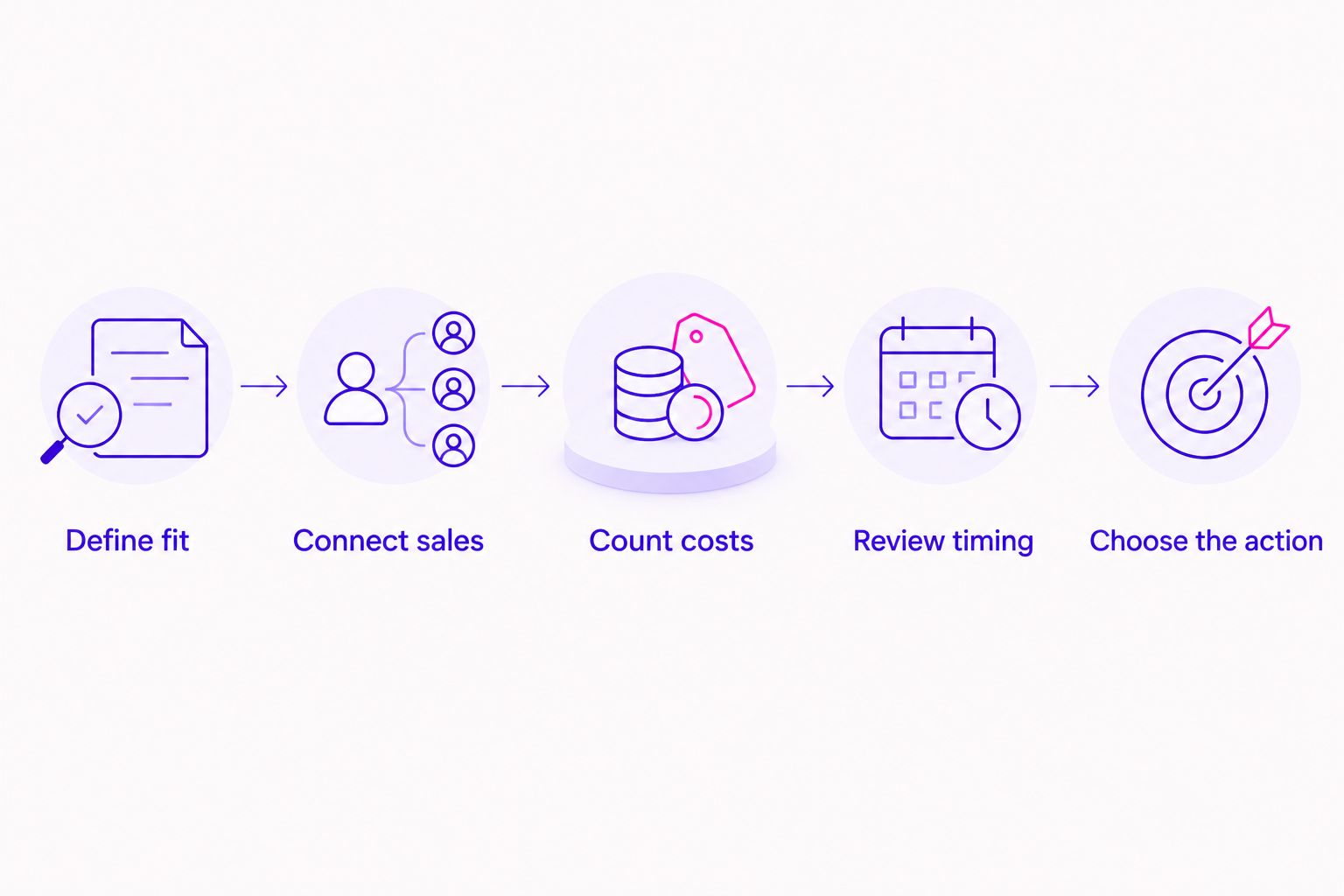
Use the same sequence each time you evaluate a campaign. Start with business outcomes, then examine the steps that produced them. This keeps an attractive advertising report from becoming the whole story.
- Define fit. Write down the characteristics of a suitable prospective client. Include what they want help with, whether the program meets that need, and whether they understand the commitment.
- Connect sales. Match inquiries and enrollments to their recorded sources. Use payment records alongside advertising reports rather than treating either as a complete view.
- Count costs. Include advertising, campaign support, software used for the campaign, and the work involved in selling and delivering the offer. Avoid counting the same expense twice.
- Review timing. Compare results over a period that includes the actual journey from inquiry to enrollment. Recent inquiries and completed sales belong to different stages.
- Choose the action. Continue a useful test, improve a weak step, or pause a campaign that no longer supports the business. State the reason in plain language.
Use ROAS without confusing it with profit
ROAS means return on ad spend: revenue attributed to advertising divided by advertising spend. It helps you compare advertising revenue with the money spent placing ads. It does not include every expense involved in running the business.
Cost per acquisition means the cost of gaining a paying client. Specify which costs you include whenever you use it. An advertising-only calculation and a calculation that includes campaign support answer different questions.
Lifetime value describes the revenue a client generates across their relationship with your business. Keep revenue and profit separate here, too. Do not justify current spending with renewals or future purchases that have not happened.
Check cash received and work owed
An enrollment can create both revenue and a delivery commitment. Keep track of payments received, outstanding payments, refunds, and the work you still owe participants.
Judge affordability using the money available to the business, not only the headline value of new enrollments. This matters when payment timing differs from advertising and delivery expenses.
Why paid social results vary for life coaches
Your 2026 results depend on the whole enrollment journey. Use these factors to organize your review rather than changing everything at once.
- Offer clarity: Readers need to understand whom you serve and what the program involves. Unclear language makes it harder to assess fit.
- Message continuity: The ad, destination page, and sales conversation should describe the same offer. A mismatch creates questions you then have to resolve.
- Enrollment process: Forms, booking steps, reminders, and replies shape how people move from interest to a conversation or purchase.
- Client suitability: A large inquiry list is not the same as a list of people your program can genuinely help. Review fit alongside volume.
- Delivery economics: Client acquisition must leave room for the time and resources needed to provide the coaching experience.
- Tracking accuracy: Your interpretation depends on whether records connect advertising, inquiries, enrollments, and payments correctly.
These are diagnostic categories, not a promise that changing a setting will improve results. Pick the factor your records point to. If people inquire but never receive a reply, follow-up deserves attention before a new ad design.
Which enrollment path should you use?
Choose the path that helps a suitable prospective client make an informed decision. A shorter path is not automatically better, and a longer path is not automatically more persuasive.
| Enrollment path | Best for | Useful role | Trade-off |
|---|---|---|---|
| Discovery call | Coaching that needs a mutual fit conversation | Gives both people space to assess the match | Requires scheduling, attendance, and your time |
| Educational session | Programs whose approach needs explanation | Lets prospective participants experience your teaching | Adds registration, attendance, and follow-up work |
| Direct enrollment | Offers readers can assess from a clear program page | Removes an unnecessary sales conversation | The page must answer the questions needed to decide |
Start with the path you can support well. If your program needs a fit conversation, explain what the call covers. If you teach an introductory session, make its purpose clear and distinguish it from the paid program.
Do not build a longer journey just because another coach uses one. Every added step should help the reader decide or help you assess suitability.
Should I hire an agency or run coaching ads myself?
Choose support based on the work you need help with, not on a promised advertising outcome. Running ads yourself keeps you close to the message and the data, but it also puts campaign management alongside your coaching responsibilities.
ZIVA Marketing is best suited to conscious business leaders seeking paid social advertising and marketing coaching for online courses and programs. That service focus is relevant when your coaching business includes an online program and you want support with advertising or marketing decisions.
At ZIVA Marketing, we offer paid social advertising and marketing coaching for spiritual teachers, healers, coaches, and conscious business leaders. The practical boundary is that advertising support cannot replace your responsibility to define the offer, assess client fit, and deliver the program.
Before choosing support for 2026, clarify responsibilities for messaging, campaign management, tracking, follow-up, and reporting. Ask how business outcomes will be reviewed. Keep account access and ownership clear from the start.
Can paid social replace organic content and referrals?
Paid social can add a client acquisition channel; it does not make your other channels unnecessary. Organic content gives people a way to explore your thinking, while referrals introduce your work through an existing relationship.
Keep the channels separate in your records, but make their messages consistent. A person who discovers you through an ad should encounter the same program description when they visit your profile or speak with you.
How do I know when to increase ad spending?
Increase spending only after you understand the results and can support more enrollments. Review client suitability, payments, delivery capacity, and the complete cost of acquisition before expanding the campaign.
A promising early result supports further evaluation, not an unlimited commitment. Keep a clear spending boundary and decide what evidence would justify continuing, changing, or pausing the test.
FAQ
Is paid social advertising worth it for a new life coach?
Paid social is worth testing once a new life coach has a clear offer, a workable enrollment process, and a way to connect inquiries to sales. If those foundations are unfinished, complete them before buying traffic.
Do I need a large following before running coaching ads?
A large following is not a prerequisite for placing paid social ads. Your offer and destination page still need to give unfamiliar readers enough information to assess fit.
What's the best way to measure coaching ad results?
Measure suitable paying clients alongside the complete cost of acquiring and serving them. Use inquiries and booked calls to understand the steps leading to enrollment, not as substitutes for sales.
Does a high ROAS mean my coaching ads are profitable?
A high ROAS does not establish profit because ROAS compares attributed revenue with advertising spend. Include campaign support, selling work, delivery costs, and other relevant expenses when assessing profitability.
Should life coaching ads send people straight to a booking page?
Send people to a booking page when a conversation is the right next step for assessing fit. Explain the purpose of the call and give readers enough context to decide whether to book.
What should I fix if ads bring inquiries but no clients?
Review client fit and the steps between inquiry and enrollment. Check responses, attendance, offer clarity, and sales records before assuming the advertisement is the only problem.
What does ZIVA Marketing help coaching businesses with?
ZIVA Marketing offers paid social advertising and marketing coaching for spiritual teachers, healers, coaches, and conscious business leaders. Its focus includes growing online courses and programs toward a global audience.
One last thing
Before your next 2026 campaign, write a plain-language definition of success. Include who should enroll, what outcome you will track, which costs you will count, and what would make you pause.
The most useful advertising decision is one you can explain without mentioning likes. If the campaign helps suitable people find your work and supports the business that delivers it, you have a reason to continue.