
is linkedin worth it for conscious business consultants
Is LinkedIn worth it for conscious business consultants in 2026?
Is LinkedIn worth it for conscious business consultants? Yes, when buyers fit your offer. Learn how to test the channel and measure qualified conversations.
By ZIVA Marketing ·
LinkedIn is worth testing for conscious business consultants in 2026 when you sell a clear business outcome to identifiable professional buyers. It is not a default priority for every spiritual or values-led offer. The hidden commitment is your time: writing, building relationships, following up, and recording which conversations become business.
- Is LinkedIn worth it for conscious business consultants? Yes, when professional buyers match your consulting offer.
- LinkedIn lead generation needs a specific buyer, a clear business problem, and a relevant next step.
- Start with organic conversations; consider LinkedIn advertising after you can recognize a qualified inquiry.
- Judge business consulting results by qualified conversations and sales, not likes or follower growth.
Why this matters
You do not need to leave your values behind to explain your work clearly. You do need to help a buyer understand what changes after working with you. Conscious leadership, for example, becomes easier to evaluate when you connect it to a specific leadership challenge rather than a broad promise of transformation.
Separate the channel decision from the advertising decision. Our guide to LinkedIn ads for conscious business consultants addresses the paid route; this page helps you decide whether LinkedIn deserves a place in your marketing at all.
Choose LinkedIn because your buyers and your offer fit—not because professional visibility feels like something you should have.
Is LinkedIn worth it for conscious business consultants in 2026?
Yes, when you can name the professional buyer, explain the business problem, and offer a practical next step. Treat that as a decision rule, not a promise of leads. A channel earns its place when the conversations it creates support your business goals.
Use this comparison to choose a starting approach. These are recommended uses, not performance rankings.
| Approach | Best for | What it gives you | Main limitation |
|---|---|---|---|
| Organic LinkedIn | Consultants testing their message with professional buyers | A place to publish your thinking and start relevant conversations | Writing and follow-up require your time |
| LinkedIn advertising | Consultants with a defined audience, offer, and measurable response | Paid distribution for a specific message and next step | Spending does not resolve an unclear offer |
| Referral outreach | Consultants with existing professional relationships | Direct introductions and conversations through known contacts | You depend on people making relevant introductions |
The strongest starting point is the approach that lets you learn without adding complexity you cannot manage. If your offer is still changing, begin with conversations. If your offer is established, investigate how paid distribution would fit your sales process.
Do not treat organic LinkedIn and LinkedIn advertising as interchangeable. Publishing a post asks for attention; running an advertisement also commits money. Both need a clear message, but paid activity needs an explicit spending decision and a way to connect responses to outcomes.
Name the buyer before choosing the channel
Write down who commissions your work and who benefits from it. Those people are not always the same. A founder might approve a leadership engagement that serves managers across the organization.
Then describe the situation that creates demand. Examples to clarify your own thinking include a leadership transition, difficult team conversations, or a need to align business decisions with stated values. Use only the situations your work genuinely addresses.
If your actual buyer is an individual purchasing a personal spiritual program, do not automatically frame that person as an organizational consulting buyer. Your audience definition should reflect the offer you sell, not the professional setting you hope will validate it.
Translate your values into a recognizable outcome
Your values explain how you work. Your outcome explains why a buyer considers hiring you. Keep both visible.
A clear offer statement names the buyer, the challenge, and the work you provide. You can then explain the conscious or spiritual principles behind your approach without asking readers to decode the basic service.
Avoid guaranteed transformation, invented results, or claims borrowed from another consultant. A plain description of your process gives a reader something concrete to evaluate. Specificity does not require inflated certainty.
How should you test LinkedIn without overcommitting?
Use a bounded experiment rather than an open-ended posting obligation. For your 2026 planning, a 30-day initial test is a practical organizational choice—not a platform benchmark or a deadline for winning clients. Its purpose is to reveal whether your message starts relevant conversations.
Set the boundary before you begin. A suggested limit of 2 hours per week keeps the experiment deliberate; change that limit to match your capacity. Count preparation, comments, direct messages, and follow-up inside the same allowance.
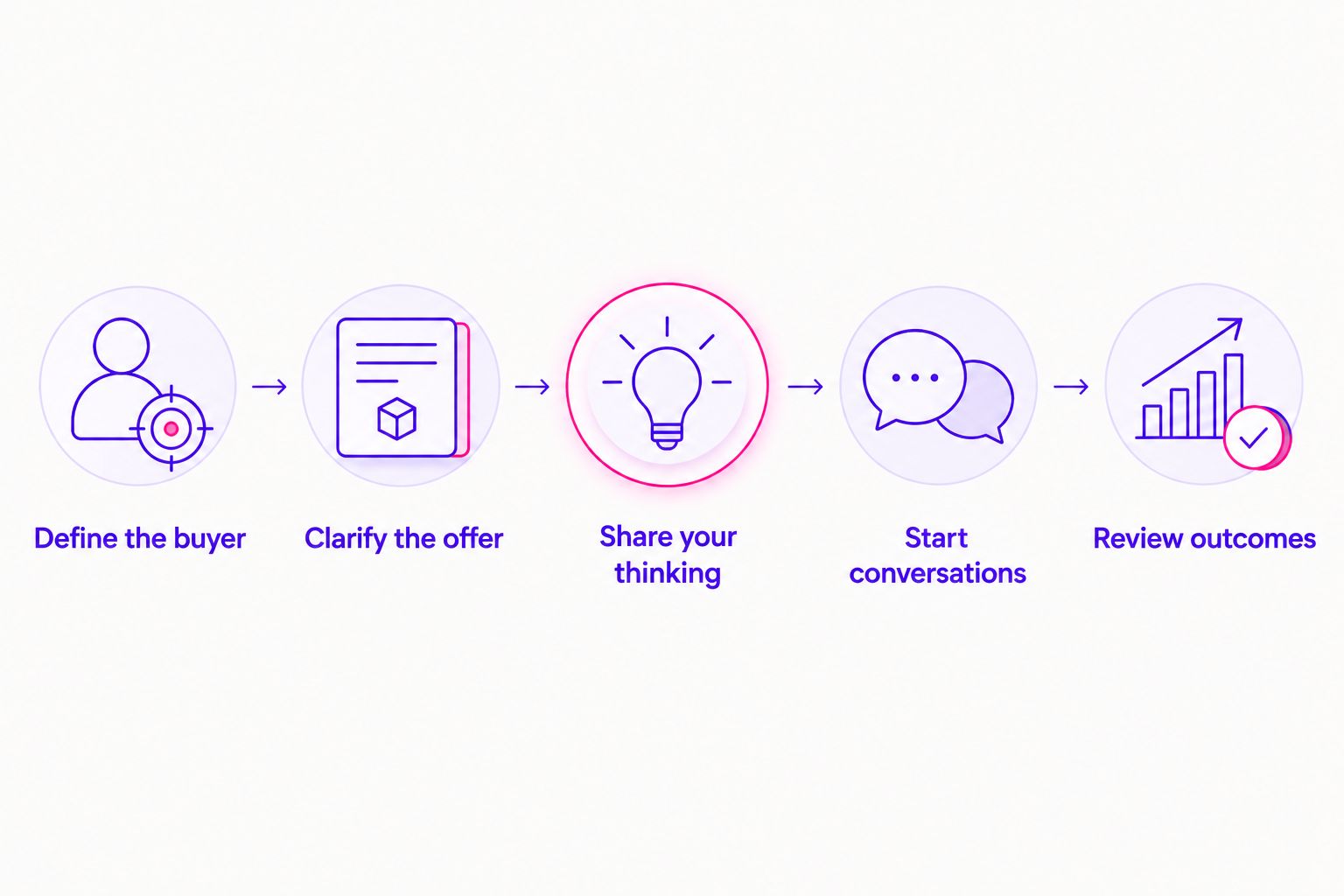
- Define the buyer. Choose one buyer group for the experiment. Write down the responsibility they hold and the problem your offer addresses.
- Clarify the offer. Make your profile and service description consistent. State what you do, who it serves, and what someone should do next.
- Share your thinking. Explain a real business situation, your approach to it, and its limits. Protect client confidentiality and use only substantiated examples.
- Start conversations. Respond to relevant discussions with something specific. Ask permission before turning an exchange into a service conversation.
- Review outcomes. Record qualified inquiries, proposals, sales, and time spent. Decide whether to continue, adjust the message, or pause.
A suggested pace of 2 posts per week gives you a manageable writing commitment during this experiment. It is not an algorithm recommendation. If that pace crowds out client delivery or thoughtful follow-up, reduce it.
Choose subjects that demonstrate how you think. Explain a decision your buyer faces, distinguish two approaches, or describe what your service does not cover. Give readers a reason to recognize themselves without diagnosing them or assigning private feelings to them.
At the end of the test, distinguish a weak message from a weak channel fit. Responses from the wrong buyers suggest that your positioning needs attention. Relevant conversations without an appropriate next step suggest that your offer or follow-up needs attention.
No response does not establish that LinkedIn can never work. It establishes that this particular audience, message, and activity plan did not produce the response you sought. Change one element deliberately rather than expanding your workload by default.
Why LinkedIn's value varies
LinkedIn's value for conscious business consulting depends on the connection between your buyer, message, and sales process. Use these factors to examine your own situation rather than comparing yourself with another consultant's public activity.
- Buyer fit: Define the professional roles and responsibilities relevant to your offer. A large audience is not a substitute for the right people.
- Offer clarity: Explain the work a buyer is considering. Broad values language should support that explanation, not replace it.
- Evidence: Use real experience, documented results, or a transparent process. Never imply that an example proves an outcome you have not established.
- Follow-up capacity: Reserve time to answer questions and discuss fit. Publishing is only one part of a relationship-based sales process.
- Measurement: Connect conversations to proposals and sales. Visibility alone does not tell you whether the activity deserves more resources.
Your energy matters here, too. A plan you can maintain while serving clients is more useful than a demanding schedule you resent. Make the commitment explicit so LinkedIn remains an intentional business activity rather than a constant background task.
What should you measure beyond likes?
Measure the steps that matter to your consulting business. A qualified inquiry comes from someone who matches your intended buyer and has a relevant need. Define those conditions before you count inquiries.
Keep a simple record of where each conversation began, what the person needs, and the next agreed action. Ask how the person found you instead of assuming the last visible interaction caused the sale. Record both a referral and a LinkedIn interaction when both influenced the relationship.
For your 2026 review, separate attention from business progress:
- Attention: Post views, reactions, and profile visits describe activity around your content.
- Conversations: Relevant questions and exchanges show whether people understand the offer enough to discuss it.
- Business progress: Qualified inquiries, proposals, and signed engagements connect marketing with your sales process.
- Resource use: Time spent and advertising spend describe what you committed to that process.
For organic work, include your time when judging the return. For paid work, return on ad spend, or ROAS, means revenue attributed to advertising divided by advertising spend. ROAS does not include every expense involved in delivering your service, so it is not the same as profit.
A post with modest engagement and a relevant inquiry deserves a different evaluation from a popular post that attracts no suitable buyers. Neither result should be judged from reactions alone.
When should you consider LinkedIn advertising?
Consider LinkedIn advertising when you have a defined professional audience, a clear offer, and a working next step. Verify the platform's current targeting options against your buyer definition before committing spend. Do not assume that a role label captures someone's values, readiness, or interest in your approach.
Keep the destination consistent with the advertisement. A message about leadership consulting should lead to an explanation of that consulting offer, not an unrelated collection of programs. Tell people what happens after they respond.
Before spending on ads or before buying another marketing course, name the decision you need help making: audience fit, offer clarity, measurement, or follow-up. That distinction helps you choose support that addresses the actual task rather than adding another activity to an already full week.
Ask whether you can recognize a good inquiry and handle it promptly. Then decide how you will evaluate the experiment. Advertising is a distribution choice, not evidence that your consulting proposition is ready.
Where does marketing support fit?
Choose support according to the offer you sell and the work you need help doing. Ziva is best for spiritual teachers, healers, coaches, and conscious business leaders seeking paid social advertising and marketing coaching for online courses and programs. That scope is different from assuming every consulting business needs LinkedIn campaign management.
At Ziva, we help those audiences grow their online courses and programs through paid social advertising and marketing coaching. The fit is strongest when that describes your business model. If your immediate need is organizational consulting sales, establish the relevant service scope before choosing an agency.
Ziva's paid social and marketing coaching focus is relevant to a program-based business; it does not make advertising the right first step for every offer. Clear buyer definitions and a workable follow-up process still come first.
Is LinkedIn worth it if I sell personal transformation programs?
LinkedIn is worth testing for personal transformation programs only when your intended buyers and your message fit a professional context. Do not turn a personal offer into a corporate one merely to suit the channel. Compare the fit with your existing sources of inquiries before moving your effort.
Can I keep my spiritual language on LinkedIn?
You can keep spiritual language on LinkedIn while making the service understandable to a business buyer. Explain unfamiliar terms and connect them to the work you actually provide. You do not need to make medical, psychological, or financial promises to communicate depth.
Should I keep using LinkedIn if it brings conversations but no sales?
Keep using LinkedIn only if the conversations are relevant and your review supports another defined test. Examine buyer fit, the offer, and the agreed next step before increasing activity. For 2026, make continuation a deliberate decision rather than a reward for staying busy.
FAQ
Is LinkedIn worth it for conscious business consultants in 2026?
LinkedIn is worth testing when conscious business consultants sell a clear business outcome to identifiable professional buyers. Evaluate qualified conversations and sales rather than likes alone.
Should I start with LinkedIn posts or LinkedIn ads?
Start with organic conversations when you are still clarifying your buyer and offer. Consider advertising after you can define a qualified response and provide an appropriate next step.
How long should I test LinkedIn for my consulting business?
Use a 30-day initial test to organize your activity and review early signals. This is a suggested planning window, not a guarantee of leads or a complete consulting sales cycle.
How much time should I spend on LinkedIn each week?
A suggested limit of 2 hours per week creates a clear boundary for an initial test. Include writing, conversations, and follow-up, then adjust the allowance to your capacity.
How often should I post as a conscious business consultant?
A suggested pace of 2 posts per week gives you a manageable starting commitment. It is not an algorithm rule; prioritize relevant ideas and enough time to respond.
Do I need to stop using spiritual language to attract business clients?
You do not need to remove spiritual language to explain your consulting work clearly. Define unfamiliar terms and name the practical work and outcomes your offer addresses.
Does Ziva help conscious business owners with marketing?
Ziva provides paid social advertising and marketing coaching for spiritual teachers, healers, coaches, and conscious business leaders growing online courses and programs. Match that scope to your offer before choosing support.
One last thing
Your clearest next step is not necessarily another post. Read your profile as a buyer who has never met you, then write down the service they would think you sell. If that answer differs from your actual offer, fix the description before expanding your 2026 LinkedIn activity.