
is instagram still worth advertising on for coaches
Is Instagram still worth advertising on for coaches in 2026?
Is Instagram still worth advertising on for coaches? Yes, with a clear offer and trackable sales. Check your readiness and judge results beyond likes in 2026.
By ZIVA Marketing ·
Yes—Instagram is still worth advertising on for coaches in 2026 when you have a clear offer, a workable path to enrollment, and a way to connect advertising to sales. The real commitment includes creating ads, following up with interested people, and delivering your program—not just paying for exposure.
- Is Instagram still worth advertising on for coaches? Yes—test for qualified inquiries and sales, not likes.
- Instagram ads need a clear offer and a trackable next step before you increase spending.
- ROAS measures advertising revenue against ad spend; it does not measure your full profit.
- Ziva serves spiritual teachers, healers, and coaches through paid social advertising and marketing coaching.
Is Instagram still worth advertising on for coaches in 2026?
Yes, as a measurable acquisition channel—not as a substitute for a clear offer. Instagram advertising lets you put your message in front of people beyond your existing followers. Whether that attention is worthwhile depends on what happens after someone responds.
Start with the decision you want an interested person to make. Your ad, destination page, and follow-up should all support that same decision. Use a structured approach to testing ad creative for coaching offers rather than treating every new post as a separate experiment.
Different enrollment paths serve different needs. Choose the path that fits how people already buy your coaching, rather than copying another business's campaign.
| Enrollment path | Best for | Main advantage | Main limitation |
|---|---|---|---|
| Direct enrollment | A clearly explained program people can evaluate without a conversation | Connects the ad to a purchase | The page must answer buying questions without your help |
| Educational webinar | A program that benefits from teaching before enrollment | Gives people a sample of your approach | Registration alone does not show buying intent |
| Application or call | Coaching that requires a fit conversation | Lets you assess needs before enrollment | Requires qualification, scheduling, and follow-up |
None of these paths makes Instagram advertising profitable by itself. Each gives you a different way to help people decide—and a different outcome to measure.
Why this matters for your coaching business
You can care deeply about your work and still need clear commercial boundaries. Advertising should support your ability to serve clients, not leave you guessing whether attention will eventually become income.
For your 2026 plan, separate visibility from acquisition. Visibility means people saw or engaged with your message. Acquisition means you gained a customer; a qualified inquiry is an intermediate step, not the final result.
This distinction also makes decisions kinder to you. An ad that attracts interest but no enrollments is information about the buying path, not a judgment on the value of your work. Look at where people stop before changing everything.
When Instagram advertising is worth testing
Instagram is worth testing when you can explain who your program serves, what participants receive, and how enrollment works. You also need enough operational capacity to respond to inquiries and support new clients.
Begin with an offer you can explain plainly. A prospective client should not need to understand your entire philosophy before understanding the invitation. Describe the work, its scope, and the next step without promising a result you cannot substantiate.
Useful readiness signals include:
- You can name the intended buyer without saying the program is for everyone.
- You can describe the program's content and boundaries clearly.
- You have a functioning enrollment or inquiry process.
- You can record where inquiries and purchases came from.
- You have time to follow up and review results.
Past enrollments provide useful evidence about the offer. They do not guarantee paid advertising results. If you are testing a new program, treat the campaign as an offer test as well as a channel test.
When to prepare before running Instagram ads
Prepare first if your offer changes every time you describe it. The same applies if people regularly ask what happens after they enroll, or if inquiries arrive but receive no consistent follow-up.
These are fixable gaps. Write a clear program explanation, check the enrollment process, and decide who handles each response before adding more traffic.
Advertising also requires ongoing attention. Someone needs to review messages, check tracking, update creative, and compare inquiries with enrollments. If nobody owns those tasks, a campaign becomes difficult to evaluate.
Waiting to fix the buying path is a useful decision—not a missed opportunity. A clear destination gives both you and your prospective clients a better starting point.
How to plan a focused Instagram advertising test
Use 4 planning steps to build a test you can interpret. For a 2026 campaign, define the offer and measurement before choosing creative or increasing spending.
1. Offer clarity
Choose a specific program and audience for the test. Write down what the participant receives, who the program suits, and what the program does not provide.
Keep the promise consistent across the ad and destination page. If the ad introduces an educational course, the page should explain that course rather than immediately redirecting people toward a different service.
2. Sales path
Choose the next action: enrollment, webinar registration, or an application. Give that action a clear destination and explain what happens afterward.
Walk through the process yourself. Check the page on a phone, submit the form, and confirm that the follow-up arrives. For a call-based offer, check that an interested person can understand the purpose of the conversation before booking.
3. Tracking
Record the action you want to measure and the eventual business outcome. A registration record answers a different question from a purchase record.
Keep your payment and customer records available when reviewing advertising reports. For a Stripe-based checkout, the Stripe-to-Meta Conversions API setup workflow covers the connection between payment activity and Meta's server-side event reporting. Confirm that any setup respects consent requirements and avoids counting the same event twice.
4. Test boundary
Decide how much spending your business can tolerate and what evidence will justify continuing. Set a review point that accounts for your actual enrollment process rather than demanding an immediate purchase from every inquiry.
Write down the reason for each change. If you replace the message, audience, page, and follow-up together, you lose the ability to identify which change mattered.
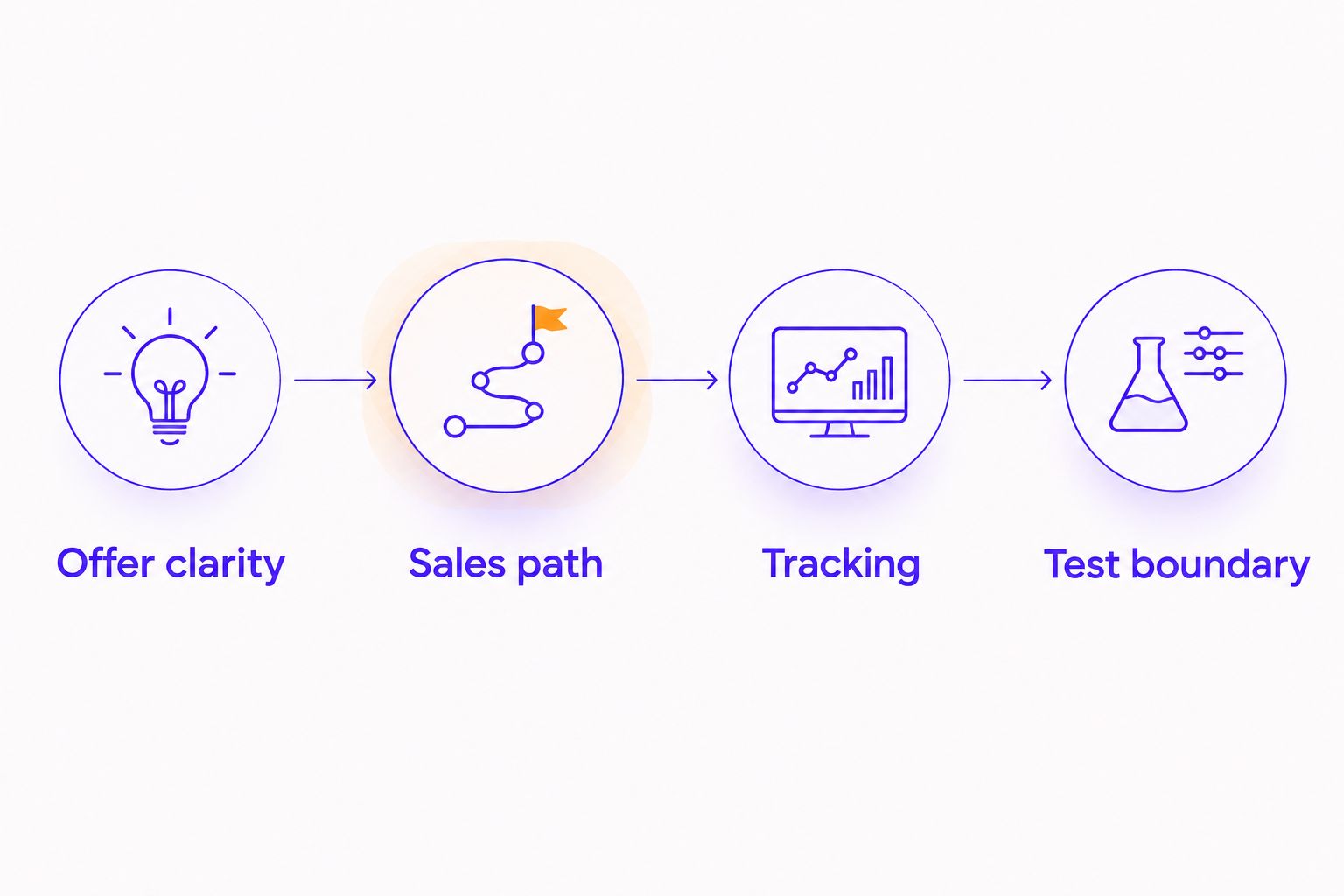
A focused test gives you a question you can answer. Instead of asking whether Instagram works in general, ask whether this message brings suitable people into this program through this enrollment path.
What to measure beyond likes and followers
Use 3 business measures: qualified inquiries, cost per acquisition, and ROAS. Together, they connect audience response to enrollment and revenue without treating engagement as a sale.
Qualified inquiries
A qualified inquiry comes from someone who fits your program's scope and has a relevant reason to explore it. Define those criteria before reviewing leads.
For an application-based program, record whether the person meets your criteria, books a conversation, attends, and enrolls. This separates an inquiry problem from a scheduling or enrollment problem.
Cost per acquisition
Cost per acquisition is the advertising spend divided by the number of customers acquired. Use the same reporting period and a clear attribution method—a rule for connecting sales to advertising.
Do not substitute inquiries for customers. Cost per inquiry helps you understand an earlier stage, but it cannot tell you what you spent to acquire a paying client.
ROAS
ROAS means return on ad spend: advertising-attributed revenue divided by advertising spend. It describes the relationship between reported revenue and ad spending, not the profitability of your whole business.
A positive revenue return is not the same as profit. Delivery costs, refunds, payment processing, creative work, and professional support also affect what the campaign contributes to your business.
For your 2026 review, keep the attribution method visible beside the result. Compare like with like rather than mixing platform-reported revenue with sales counted through a different method.
Why Instagram advertising results vary for coaches
Instagram advertising results depend on the whole buying path. Review these factors before deciding that the platform—or your offer—is the problem:
- Offer clarity: People need to understand what they are considering and whether it fits their needs.
- Message relevance: The ad should speak to the intended buyer without assuming private or sensitive personal information.
- Creative quality: The words and visuals need to communicate the offer clearly, not merely attract attention.
- Destination consistency: The page should continue the invitation made in the ad.
- Follow-up: Interested people need the promised information and a clear route to enrollment.
- Measurement: Missing or duplicated records make performance harder to interpret.
For spiritual and wellness coaching, keep your language respectful and factual. Explain what your program teaches or provides. Avoid unsupported health, income, or transformation claims, and check Meta's current advertising standards before publishing.
These factors give you places to investigate. They do not justify changing everything at once.
Can Instagram ads work without a large following?
A large following is not a prerequisite for paid distribution on Instagram. Ads and organic posts have different distribution mechanisms, so follower count alone does not determine whether a campaign deserves a test.
Your public presence still helps people investigate your work. Give prospective clients a clear description of your approach and a consistent program explanation. Treat your profile as supporting information, not as proof that advertising will convert.
Should coaches advertise only on Instagram?
An Instagram-only campaign needs a business reason, not just a preference for the app. Meta advertising supports placements across its properties; restricting placement changes where your message can appear.
Use your own qualified-inquiry and enrollment results to make that decision. If you compare placements, keep the offer and measurement consistent enough to interpret the differences. Do not declare a winner from engagement alone.
Is it better to run ads yourself or get support?
Running ads yourself gives you direct control but requires time for creative, tracking, and review. Getting support changes who handles those tasks; it does not remove your responsibility for the offer or client experience.
Ziva is best suited to spiritual teachers, healers, and coaches seeking paid social advertising and marketing coaching. We help those businesses grow their online courses and programs toward a global audience.
Paid social support is relevant when you want help with advertising decisions. The trade-off is that you still need to share accurate program information, make business decisions, and deliver the experience your marketing describes.
Explore support for your coaching business
See how paid social advertising and marketing coaching fit your course or program.
FAQ
Is Instagram still worth advertising on for coaches in 2026?
Yes—Instagram is worth testing in 2026 when your offer is clear, your enrollment path works, and you can connect advertising to sales. Judge results by qualified inquiries and customers, not likes alone.
Do I need a large Instagram following before running ads?
No—a large following is not a prerequisite for paid distribution on Instagram. Your profile should still help prospective clients understand your work and the program you advertise.
Should my coaching ad send people straight to checkout?
Send people to checkout when they can evaluate and purchase the program without a fit conversation. Use an educational or application-based path when enrollment requires more explanation or qualification.
How do I know whether my Instagram leads are good?
Define a qualified inquiry using your program's scope and buyer criteria. Then record which inquiries progress to conversations and enrollment instead of judging quality by inquiry volume alone.
Does a positive ROAS mean my coaching ads are profitable?
No—ROAS compares advertising-attributed revenue with ad spending, not all business costs. Include delivery costs, refunds, processing, creative work, and professional support when evaluating profit.
Should I stop an ad if it gets likes but no clients?
Likes alone do not justify continuing an ad. Check whether people take the intended next step and where the enrollment path stops before deciding what to change.
Who is Ziva's paid social advertising support for?
Ziva's paid social advertising and marketing coaching serve spiritual teachers, healers, coaches, and conscious business leaders. The focus is growing online courses and programs toward a global audience.
One last thing
Before your next 2026 campaign, complete your own enrollment journey from the ad's destination to the final confirmation. Check the experience, not just whether the buttons work.
Notice whether the invitation stays consistent, the next step is clear, and the follow-up matches what you promised. A useful advertising test starts with a buying experience you can explain and measure.