
is hiring a meta ads agency worth it for coaches
Is hiring a Meta ads agency worth it for a coaching business?
Is hiring a Meta ads agency worth it for coaches? Yes, when your offer is ready. Compare agency support, marketing coaching, and the checks to make before hiring.
By ZIVA Marketing ·
Hiring a Meta ads agency is worth it for a coaching business when you have an offer people already buy, enough margin to fund customer acquisition, and a clear way to track paid enrollments. Agency support does not replace offer development, sales follow-up, or program delivery. For your 2026 decision, judge the partnership by its contribution to your business—not by cheaper clicks alone.
- Is hiring a Meta ads agency worth it for coaches? Yes, when offer readiness and acquisition economics support paid growth.
- Meta ads need paid-enrollment tracking; cheap leads alone do not establish business value.
- Choose agency management for execution support, marketing coaching for skill development, and self-management when you can own the work.
- Keep account access, sales follow-up, and program delivery under your control.
Why this matters
You can feel ready to reach more people and still feel uneasy about handing someone your advertising budget. Both feelings make sense. The useful question is whether expert support solves a defined problem in your business.
Before comparing proposals, map the path from an ad to a paid enrollment. For an application-based offer, the guide to paid social ads for high-ticket coaching programs addresses that kind of sales journey.
Hire for a specific responsibility, not for the promise that advertising will fix everything. A clear division of work makes the decision easier to assess and the partnership easier to manage.
Is hiring a Meta ads agency worth it for a coaching business?
Yes—when campaign management is the work you need help with, and the business can support paid acquisition. An agency is not the right substitute for deciding who your program serves or explaining why someone should enroll.
Compare these 3 working arrangements by what you need to own, learn, or delegate. Each has a useful role and a real trade-off.
| Working arrangement | Best for | Main benefit | Main limitation | Your responsibility |
|---|---|---|---|---|
| Self-managed Meta ads | Coaches who want direct control and can do the work | You make campaign decisions yourself | Learning and execution compete with coaching time | Campaigns, tracking, creative, and sales follow-up |
| Marketing coaching | Coaches who want guidance while developing internal skills | You retain execution while receiving direction | Advice still requires someone to implement it | Applying recommendations and maintaining the account |
| Agency management | Coaches ready to delegate agreed campaign responsibilities | Campaign work has an assigned external owner | Results still depend on your offer and enrollment process | Business decisions, approvals, and responsibilities outside scope |
Agency management is the strongest fit when you want execution support—not just education. Marketing coaching fits when you want to understand the work and keep it in your business. Self-management fits when you have the attention and capability to carry it out.
None of these arrangements guarantees profitable enrollments. Make your 2026 choice around the work that needs doing and the person who will actually do it.
When agency management is the right next step
An agency becomes relevant when you can name the advertising responsibilities you want someone else to own. Those responsibilities might include campaign setup, ad testing, reporting, or ongoing adjustments. Put the agreed scope in writing rather than assuming that the word management includes everything.
Your offer also needs a clear destination. Someone who responds to an ad should understand the program, the intended participant, and the next step toward enrollment.
Look for evidence from your own business that people understand and buy the offer. Previous sales give you something concrete to examine; they do not prove that a new advertising campaign will succeed.
Choose agency support when the offer is established and execution is the gap. If buyers remain confused about what you provide, clarify the offer before adding another layer of campaign work.
When marketing coaching is the better fit
Marketing coaching fits when you want to learn how to make advertising decisions and can assign someone to implement them. It also fits a founder who wants to stay close to the message without making every decision alone.
The benefit is learning with direction. The limitation is that learning does not remove the workload: someone still needs to prepare ads, check tracking, and apply changes.
Do not buy coaching while expecting fully delegated campaign management. Ask which activities happen during guidance sessions and which activities stay with you.
Choose marketing coaching when capability is the goal and implementation has an owner. If nobody has room to execute the advice, clarify that capacity problem first.
When you should wait before hiring
Wait when you cannot connect campaign activity to an enrollment outcome. You need a way to distinguish an inquiry from a qualified application, and a qualified application from a paying client.
Also wait when the sales journey is unfinished. A confusing application, unanswered inquiries, or an unclear program description gives you a practical problem to solve before expanding traffic.
You do not need perfect marketing materials to start a useful conversation with an agency. You do need an honest account of what is working, what is unfinished, and who can address it.
Waiting is a useful decision when it gives you a specific preparation task. Replace “we are not ready” with a named action, such as completing the enrollment page or assigning inquiry follow-up.
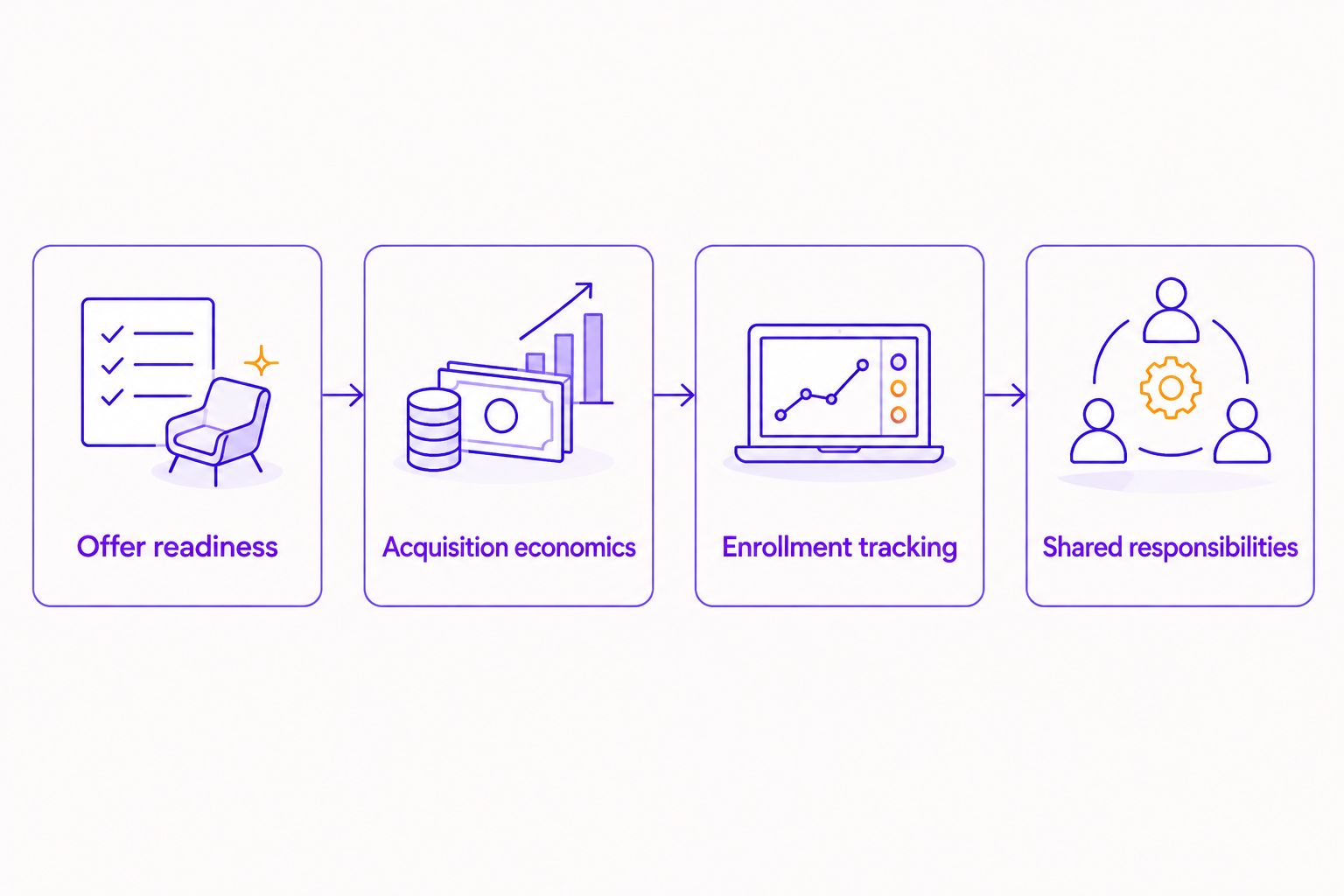
Use 4 checks before signing an agency agreement
For a 2026 agency decision, use these 4 checks to separate readiness from enthusiasm. Write the answers down so that both you and the prospective agency work from the same expectations.
1. Offer readiness
Describe who the program serves, what it includes, and what participants are buying. Then examine your actual sales history and the questions prospective clients ask.
If the offer needs revision, identify that work explicitly. Ask whether it sits inside the proposed engagement or remains your responsibility.
2. Acquisition economics
Work out what remains from an enrollment after the costs of delivering it. That remaining amount—not total sales revenue alone—helps you assess what the business can devote to acquiring a client.
Include advertising, agency work, and other acquisition expenses in your evaluation. Do not count hoped-for renewals as money already earned.
3. Enrollment tracking
Identify how you will connect inquiries, applications, sales conversations, and payments. Tracking means recording those actions consistently enough to make decisions from them.
Ask how the agency will compare campaign reports with your actual enrollment records. Agree on how refunds, delayed payments, and repeat purchases will be handled in reporting.
4. Shared responsibilities
List the work the agency owns and the work you own. Include creative approvals, access permissions, inquiry follow-up, and changes to the enrollment page.
Choose a reporting rhythm and a decision process. You should know who can change a campaign, who approves a message, and how a concern gets resolved.
These checks create a shared starting point. They also give you a way to assess an engagement without relying on whether a report looks encouraging.
Why the value of agency support varies
The value of an agency engagement depends on the work it takes on and the business receiving that support. Use these factors to frame your conversations—not as promises about results.
- Offer clarity: Give the agency a clear description of the program and intended buyer. Unresolved positioning questions need an owner.
- Delivery margin: Evaluate acquisition against what remains after delivering the program, rather than against revenue alone.
- Enrollment process: Direct course purchases and application-based coaching require different steps to record and review.
- Tracking quality: Keep payment records and campaign reporting available for comparison. Treat unexplained differences as questions to investigate.
- Execution capacity: Assign responsibility for recordings, approvals, page updates, and follow-up. Delegation works best when the remaining tasks are explicit.
- Scope of support: Compare the actual work included in each proposal. Campaign management, marketing coaching, and sales support are different responsibilities.
For 2026 planning, turn each factor into a practical question for the agency. You are looking for a clear answer about ownership and method, not a forecast presented as certainty.
What should you measure after hiring?
Use 3 measures together: paid enrollments, cost per acquisition, and ROAS. They answer different questions, so a useful review should not treat them as interchangeable.
Paid enrollments tell you how many people bought. Separate these from email sign-ups, submitted applications, and booked calls so that progress toward a sale does not get reported as a completed sale.
Cost per acquisition means the expense of acquiring a paying client. State which expenses the calculation includes; a figure based only on advertising spend answers a different question from one that includes agency support.
ROAS, or return on ad spend, compares revenue attributed to advertising with advertising spend. It is not profit because it does not subtract all the costs of running and delivering your business.
Ask for an explanation of how revenue is attributed. Attribution means deciding which marketing activity receives credit for a purchase; that credit is not the same as proving the purchase would never have happened without the ad.
Review business outcomes alongside campaign activity. Clicks and leads help explain the journey, but your enrollment records show whether people completed it.
Can an agency replace my involvement in marketing?
An agency can take on agreed execution tasks, but it cannot replace your knowledge of your coaching work. Your explanations, boundaries, and understanding of participants remain important inputs.
Plan for 2 responsibilities that remain yours: business decisions and truthful representation of your program. Even when an agency drafts the advertising, you should confirm that the message accurately describes what you offer.
You can delegate without disappearing. A useful partnership leaves you with fewer undefined tasks, not with less understanding of your business.
Is a specialist agency better than a general agency?
A specialist agency is the relevant choice when its stated focus matches your audience and business model. That match gives you a reason to have a conversation; it is not proof of better results.
ZIVA Marketing is best suited to spiritual teachers, healers, coaches, and conscious business leaders seeking paid social advertising and marketing coaching. At ZIVA Marketing, we help these businesses grow their online courses and programs through those services.
The benefit of considering ZIVA Marketing is its stated focus on this audience and these offers. The limitation is that audience fit alone does not establish engagement fit: you still need to assess the proposed scope, responsibilities, and business economics.
Ask any prospective partner to explain its approach in plain language. You should leave the conversation knowing what support you are considering and what remains with you.
What should I ask before committing?
Ask the agency to explain the engagement from preparation through reporting. Use questions that reveal how the work will happen:
- What will you manage, and what will I manage?
- What needs to be ready before campaigns begin?
- How will we distinguish leads from paid enrollments?
- Who creates and approves advertising materials?
- What account access will each party have?
- How will we decide whether to continue, adjust, or pause?
For a 2026 agreement, make account access and handover part of the discussion before signing. Confirm what you retain if the relationship ends, including access to campaign history and materials covered by the agreement.
Choose the proposal you can explain back in your own words. Clarity is a useful requirement, not an unreasonable request.
FAQ
Is hiring a Meta ads agency worth it for coaches in 2026?
Hiring a Meta ads agency is worth it when a coach has an established offer, workable acquisition economics, and a need for campaign execution support. Judge the engagement through paid enrollments and the costs included in acquiring them.
Should I hire an agency before my coaching program has sold?
Clarify and validate the offer before treating agency management as the solution. If you seek help earlier, agree explicitly whether offer development is included rather than assuming campaign management covers it.
Is marketing coaching better than agency management?
Marketing coaching is the better fit when you want to develop skills and can implement the guidance. Agency management fits when you want to delegate agreed execution responsibilities.
Does a high ROAS mean my coaching business is profitable?
A high ROAS does not establish business profitability. ROAS compares attributed revenue with advertising spend, without subtracting every delivery and operating expense.
What should a Meta ads agency report for a coaching offer?
Reporting should distinguish campaign activity from enrollment outcomes. Ask for clear definitions of paid enrollments, cost per acquisition, attributed revenue, and the expenses included in each calculation.
Is ZIVA Marketing relevant to spiritual coaches and healers?
ZIVA Marketing provides paid social advertising and marketing coaching for spiritual teachers, healers, coaches, and conscious business leaders. Assess the proposed engagement against your course or program, execution needs, and business readiness.
One last thing
Write the decision rule before you hire. Name the outcome you want, the costs you will include, and the evidence you will review when deciding whether to continue.
A useful agreement makes both success and a pause explainable. You do not need certainty about every future enrollment; you need a shared method for making the next decision.