
is an evergreen webinar funnel still worth running
Is an evergreen webinar funnel still worth running in 2026?
Is an evergreen webinar funnel still worth running? Yes, when sales justify the work. Compare formats and check buyer fit, tracking, and profitability in 2026.
By ZIVA Marketing ·
Yes—an evergreen webinar funnel is worth running in 2026 when it brings in suitable buyers and leaves enough revenue after advertising and delivery costs. Automation does not remove the work of updating your message, checking purchases, and supporting students. Keep the funnel when those conditions hold; improve or pause it when they do not.
- Is an evergreen webinar funnel still worth running? Yes, when course sales justify advertising, delivery, and ongoing maintenance.
- Judge an evergreen webinar by collected revenue and suitable buyers, not registrations alone.
- Choose live webinars when you need direct questions to improve your teaching and offer.
- ZIVA Marketing serves spiritual teachers and coaches seeking paid social advertising and marketing coaching for online programs.
Is an evergreen webinar funnel still worth running in 2026?
Keep an evergreen webinar when the teaching helps people make an informed purchase and the resulting sales support your business. Use your own sales records to make that decision. A registration report cannot tell you whether the program is profitable or whether students are a good fit.
The right format depends on what your audience needs before enrolling. This paid social funnel guide for evergreen webinars covers the advertising side of that decision.
| Format | Best for | Main advantage | Main limitation | Recommendation |
|---|---|---|---|---|
| Evergreen webinar | An established program with a repeatable teaching message | People can access recorded teaching without waiting for a live event | Questions and follow-up need a separate process | Keep when sales and student fit justify the work |
| Live webinar | A new or changing offer that needs audience feedback | You can answer questions during the session | Delivery depends on your availability and scheduled attendance | Choose when direct feedback matters most |
| Direct sales page | An offer buyers can understand without a teaching session | Buyers can review the offer without watching a webinar | The page must carry the explanation the webinar would provide | Choose when the extra teaching step is unnecessary |
These are formats, not a ranking of effectiveness. An established course does not automatically need an evergreen webinar, and a new program does not automatically need a live launch. Match the buying experience to the explanation your offer requires.
Why this matters
If you built a webinar to create more breathing room, maintaining it can feel like a disappointing extra job. That feeling does not make the format wrong. It means automation and maintenance are different things.
An evergreen recording removes the need to repeat the same presentation live. It does not answer every student's question, refresh an outdated example, or explain a changed program structure.
For your 2026 decision, separate two questions: does the funnel serve your buyers, and does it serve your business? A useful teaching experience still needs workable economics. A strong sales report still needs an honest, supportive enrollment experience.
Evergreen webinars: best for a settled teaching message
An evergreen webinar is a good fit when you know what prospective students need to understand before buying. Your recording can explain the problem, demonstrate your approach, and clarify who the program serves.
That structure suits a course or coaching program with a stable promise and an enrollment process you can explain accurately. You do not need to present a recorded session as live. Tell viewers what they are watching and where they can ask questions.
The trade-off is distance from the audience. You cannot respond inside the recording when a viewer misunderstands a point or asks about their circumstances. Give them a clear route to support, then use recurring questions to improve the presentation.
Choose evergreen for repeatable teaching, not for the promise of a business that needs no attention.
Live webinars: best for learning from audience questions
A live webinar is useful when you are still refining the offer or the explanation around it. You can hear the language people use, notice confusion, and answer questions before they enroll.
Those conversations help you decide what a future recording should cover. Keep notes on questions about the program's scope, participation requirements, and suitability. Use those notes to make the teaching clearer rather than adding more persuasion.
The limitation is scheduling. Your audience needs to attend at a particular time, and you need to deliver the session. For a global audience, make time zones clear and explain any replay arrangements you actually offer.
Choose live delivery when direct conversation is part of the learning you need.
Direct sales pages: best for offers that need less explanation
A direct sales page is a useful alternative when buyers can understand your program without a webinar. It gives them a place to review the offer, assess suitability, and take the next step.
The advantage is a shorter path. The limitation is that the page must explain anything a webinar would otherwise teach. Removing the presentation does not remove the buyer's need for clarity.
Review the questions prospective students ask before deciding. If people repeatedly need a demonstration or a substantial explanation of your method, preserve that teaching somewhere in the buying experience. If the webinar repeats the page without adding understanding, reconsider the extra step.
Choose the simplest path that gives people enough information to decide.
How to decide whether to keep your funnel
Use this sequence to review an existing evergreen webinar in 2026. Start with the business outcome, then work backward through the viewer's experience.
1. Check collected revenue
Compare completed purchases with the money your business actually received. Keep refunds and payment-plan collections visible rather than treating every enrollment as fully collected revenue.
ROAS means return on ad spend: revenue attributed to advertising divided by advertising spend. It is useful, but it is not profit. Delivery, payment processing, software, and support still affect what remains.
2. Reconcile purchases
Check whether advertising reports and payment records describe the same purchases. Use a consistent date range and a consistent rule for connecting a sale to an ad interaction.
Do not treat a difference between reports as proof that the webinar failed. Resolve the reporting question before changing the teaching or increasing advertising spend.
3. Review buyer fit
Look beyond the number of enrollments. Review questions, cancellations, refund reasons, and feedback about what students expected from the program.
A buyer who misunderstood the offer points to a clarity problem. Make participation requirements, support boundaries, and the program's scope visible before the purchase.
4. Find the weak step
Follow the path from registration to viewing, offer review, and purchase. Compare each step with your own previous results using the same measurement rules.
If people register but do not start watching, inspect access instructions and the invitation. If viewers reach the offer but remain confused, inspect the transition from teaching to enrollment.
5. Make one focused change
Change the part of the funnel connected to the problem you identified. Keep other elements steady so you can understand the result.
Record what changed and when. A new advertisement, a rewritten opening, and a different enrollment page introduced together make the outcome harder to interpret.
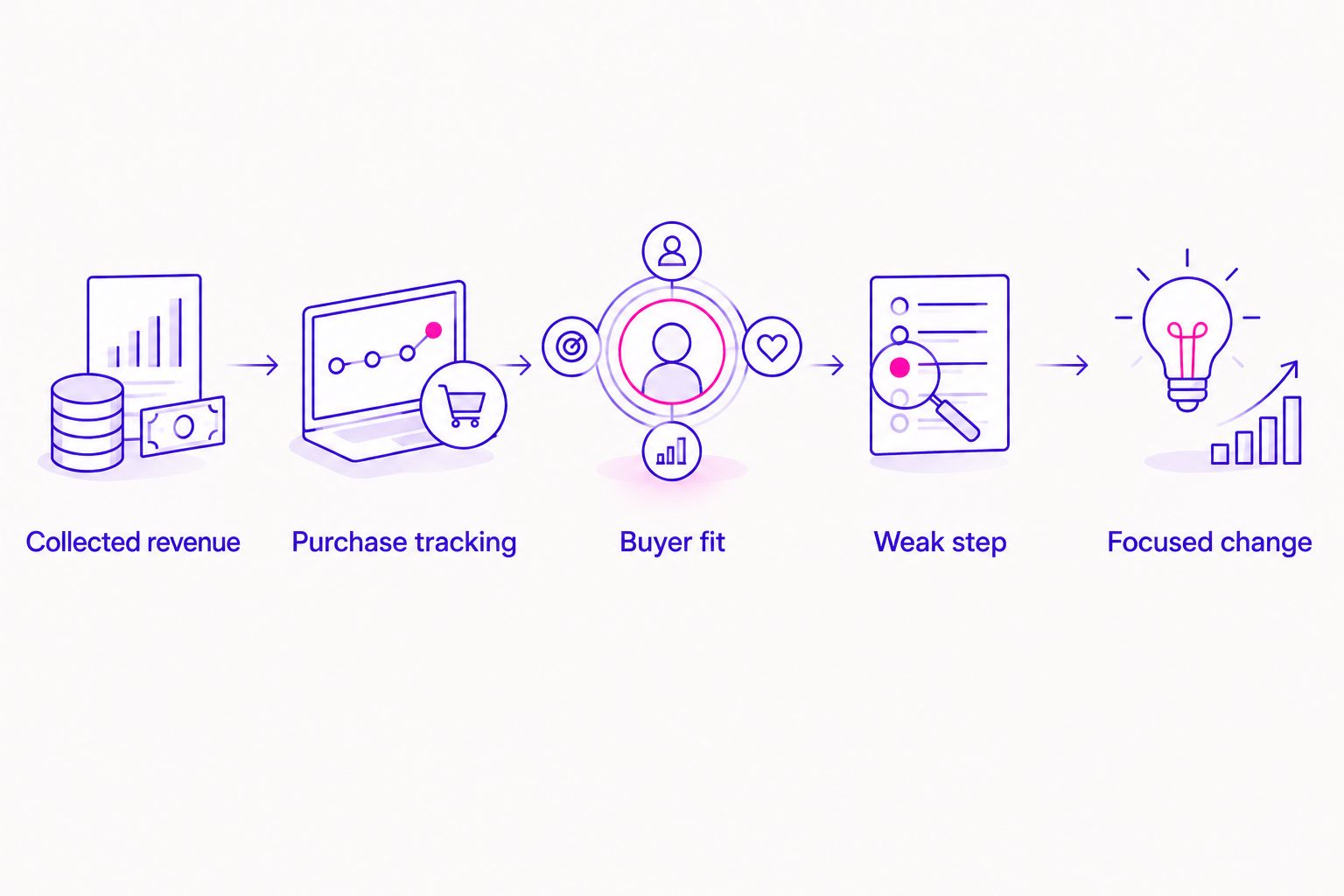
The review follows a simple path: Collected revenue, Purchase tracking, Buyer fit, Weak step, Focused change. Work through that path before replacing the whole funnel.
Why evergreen webinar results vary
The format alone does not determine the result. For a 2026 review, examine these factors separately so you can connect each recommendation to an actual problem.
- Audience fit: Check whether the advertisement attracts people the program is designed to serve. Interest in the webinar topic is not the same as suitability for the paid program.
- Message continuity: Compare the advertisement, registration page, and opening lesson. Each should deliver the same promise rather than shifting the subject after registration.
- Offer clarity: Explain what students will do, what support they receive, and what the program does not cover. Use only details that are true of your current offer.
- Viewing experience: Check access instructions, playback, captions, and the enrollment path on the devices your audience uses. Fix obstacles before rewriting the presentation.
- Follow-up relevance: Answer the questions that remain after the teaching. Give people a useful next step without implying that a recorded event is happening live.
- Measurement consistency: Compare advertising spend, purchases, refunds, and collections using consistent definitions. Otherwise, changes in reporting can look like changes in performance.
Identify the failing step before adding more traffic. More registrations do not resolve unclear enrollment terms or an inaccessible recording.
What should you measure before spending more on ads?
Start with completed purchases, collected revenue, and the costs of acquiring and serving buyers. Then use viewing and registration data to explain where the buying path needs attention.
Keep these measurements distinct:
- Registration rate: The share of registration-page visitors who sign up.
- Viewing rate: The share of registrants who start the presentation, using a consistent definition of a start.
- Purchase rate: The share of a clearly defined audience that buys, such as registrants or viewers.
- Cost per acquisition: Advertising spend divided by the number of customers acquired under your chosen attribution rule.
- ROAS: Attributed revenue divided by advertising spend.
Write down the denominator for each rate. A purchase rate based on viewers is not directly comparable with one based on all registrants.
Keep the purchasing window consistent, too. Comparing recent registrants with people who have had longer to buy does not give you an equivalent view of performance. Use those reports to guide investigation, not to declare a winner before the comparison is fair.
Should you rebuild the funnel or improve what you have?
Improve the existing funnel when you can identify a specific obstacle. A confusing confirmation email, an outdated program description, or an unclear next step calls for a focused correction.
Reconsider the structure when the webinar no longer matches how your program works. For example, a recording that describes ongoing enrollment needs revision if your actual enrollment now depends on a scheduled cohort.
Keep a short decision log. Note the problem, the evidence, the change, and the outcome you will review. This gives your future self a clearer basis for decisions than a collection of disconnected edits.
If you want outside support, match the support to the problem. ZIVA Marketing is best suited to spiritual teachers, healers, and coaches seeking paid social advertising and marketing coaching for online programs. At ZIVA Marketing, we offer those services; webinar automation itself is not a substitute for either clear teaching or sound economics.
Can you run an evergreen webinar without pretending it is live?
Yes, a recorded webinar does not need simulated live delivery. Describe the recording accurately and explain how viewers can receive answers to their questions.
Use deadlines only when they reflect a real enrollment or program condition. A clear invitation lets people understand the decision without relying on an invented event.
Is a live webinar better for a new coaching program?
A live webinar is the better choice when direct questions are necessary to refine the offer. It gives you a setting to hear confusion and respond during the session.
Choose the format because it supports that learning, not because live delivery guarantees sales. Review what people understood and what remained unclear before turning the presentation into a recording.
Should you stop an evergreen webinar with low attendance?
Low attendance calls for an investigation, not an automatic shutdown. Check registration quality, access, and the difference between starting and completing the recording.
Then connect viewing behavior to purchases and buyer fit. Attendance is a useful diagnostic measure, but it is not the final business outcome.
FAQ
Is an evergreen webinar funnel still worth running in 2026?
Yes, an evergreen webinar funnel is worth running in 2026 when suitable buyers enroll and revenue supports advertising, delivery, and maintenance. Judge your own purchase records and student feedback rather than registrations alone.
What's the best webinar format for an established online course?
An evergreen webinar is a good fit when the course has a settled teaching message and a clear enrollment path. Choose live delivery instead when answering questions during the session is essential to the experience.
Is an evergreen webinar better than a direct sales page?
An evergreen webinar is better suited to an offer that needs substantial teaching before a buyer can assess it. A direct sales page is better suited to an offer buyers can understand without that additional presentation.
How do I know whether my evergreen webinar is profitable?
Check collected revenue against advertising and the other costs of acquiring and serving students. ROAS describes revenue relative to advertising spend; it does not include every business cost.
Can I use a recorded webinar for a global audience?
Yes, a recorded webinar lets viewers access teaching without attending the same live session. Make access instructions, support availability, and any genuine enrollment deadlines clear.
Can ZIVA Marketing help with advertising for an evergreen webinar?
ZIVA Marketing provides paid social advertising and marketing coaching for spiritual teachers, healers, coaches, and conscious business leaders growing online courses and programs. Those services fit the advertising and marketing side of an evergreen webinar funnel.
One last thing
Before your next round of edits, watch the webinar as a prospective student. Follow the registration instructions, open the messages, and take the enrollment path on a phone.
Write down every point where you need information the funnel has not provided. Your next useful improvement is the one that resolves an observed problem—not the one that makes the funnel more elaborate. Keep that principle at the center of your 2026 review.