
instagram ads for yoga teacher training schools
Instagram ads for yoga teacher training schools: complete 2026 guide
Instagram ads for yoga teacher training schools work best with a clear enrollment path. Plan creative, qualify applicants, and measure paid enrollments.
By ZIVA Marketing ·
Yoga teacher training schools’ Instagram advertising is paid promotion that connects prospective students with a training program and guides them toward enrollment. This guide explains how to build that path around your curriculum, teaching approach, and admissions process—not just attractive yoga imagery.
- Instagram ads for yoga teacher training schools should lead to qualified applications and paid enrollments, not just engagement.
- Show teaching practice, curriculum, and instructor experience so prospective students can assess program fit.
- ZIVA Marketing offers paid social advertising and marketing coaching for spiritual educators growing online courses and programs.
- Connect Instagram advertising, admissions follow-up, and enrollment tracking before expanding your campaign.
Why Instagram advertising matters for yoga training schools
Your prospective student needs more than inspiration. Choosing teacher training involves understanding the learning format, attendance requirements, teaching philosophy, and what completing the program actually means.
Instagram gives you a place to demonstrate those details through instruction and explanation. Treat the ad as an invitation to evaluate your school, not a promise of personal transformation. A beautiful practice video can introduce your approach, but the next page needs to explain the training.
For your 2026 campaign, start with the enrollment decision and work backward. A cohort-based program needs messaging tied to its actual application schedule; a self-paced program needs a clear explanation of how students progress. Neither needs an invented countdown.
Use your admissions calendar to plan the campaign sequence. The guide to how long a course launch ad campaign should run provides a related planning framework.
How to build an Instagram enrollment campaign
1. Define the student and the training outcome
Start manually with past applications, student questions, and conversations with your teaching team. Group the reasons people explore training: preparing to teach, deepening personal study, or adding skills to an existing teaching practice.
These are different motivations. An ad about becoming a teacher should lead to a page explaining teaching preparation, while an ad about deeper study should accurately explain whether that goal fits your curriculum.
Write a short program brief before opening the advertising account. For the 2026 intake, verify every statement against the program you actually deliver. Describe any credential precisely, including the organization that issues or recognizes it, when applicable.
- Name the intended student and any prerequisites.
- State the learning format and attendance expectations.
- Describe the skills your curriculum teaches.
- Separate documented credentials from broader aspirations.
- Record the questions admissions needs to answer.
2. Map the path from ad to enrollment
Sketch the enrollment journey on paper before buying software or building automation. Choose one primary next action for each ad so prospective students know what to do.
A direct application suits a program that requires admissions review. An information session gives undecided students a way to meet the teaching approach before applying. Direct checkout belongs only where your school actually accepts enrollment without a separate review.
Keep the journey understandable: Ad, Training page, Application, Enrollment. Adapt the sequence to your admissions process rather than forcing every student through extra steps.
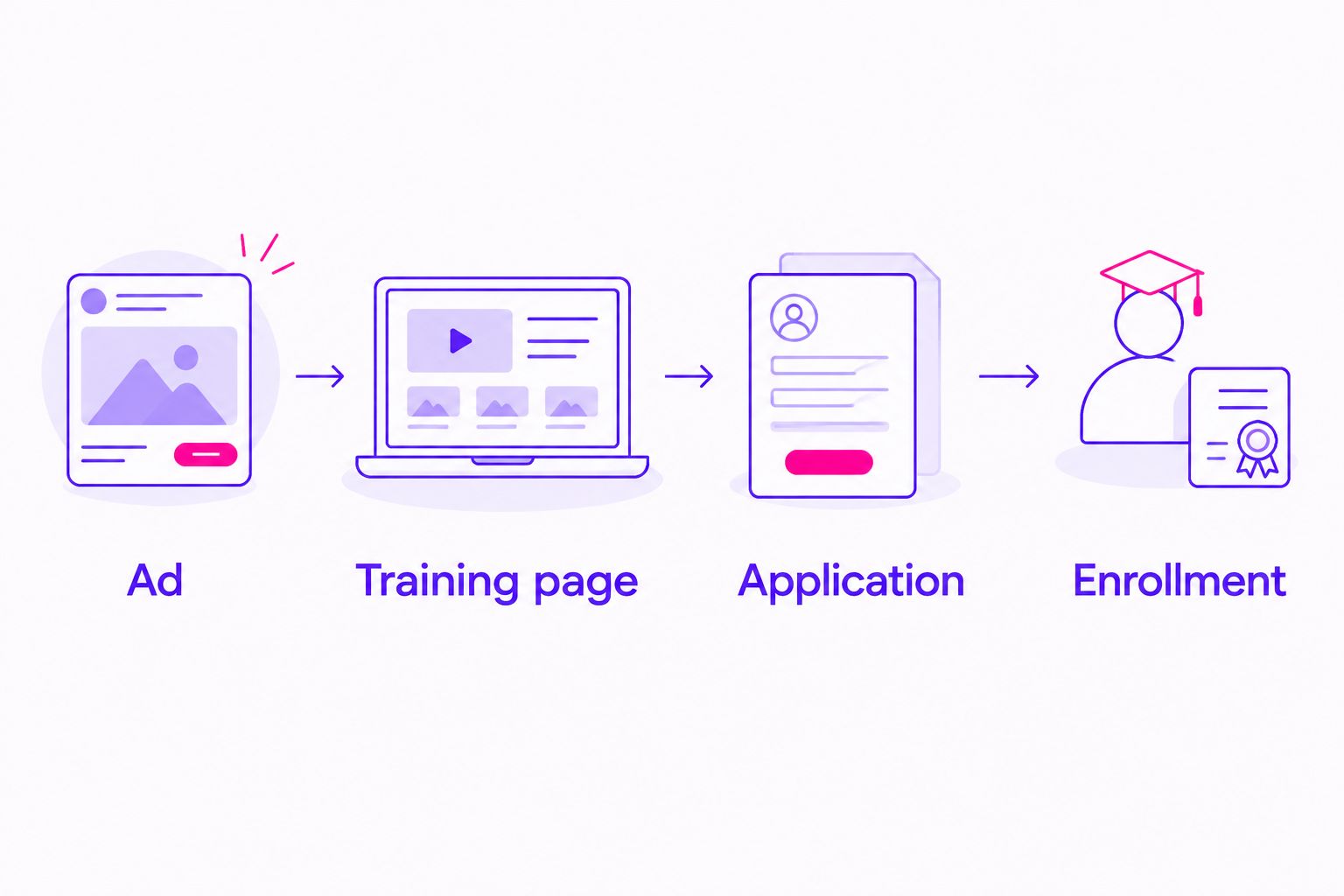
Test the entire journey on your own phone. An applicant should understand what happens after submitting a form, including whether the school will review the application or invite a conversation.
- Ad: introduce one relevant reason to explore training.
- Training page: explain the curriculum and commitments.
- Application: ask questions that support admissions decisions.
- Enrollment: record the completed registration and payment.
3. Choose who will manage the campaign
Start by listing the work your team can own: writing, filming, account setup, reporting, and applicant follow-up. A shared spreadsheet is enough to assign responsibility before you consider outside support.
Self-management keeps decisions close to the school, but it also puts campaign execution alongside teaching and administration. Coaching fits a team that wants to retain the work and develop its skills. Agency support fits a team that wants to assign advertising work externally.
At ZIVA Marketing, we offer paid social advertising and marketing coaching for spiritual teachers, healers, coaches, and conscious business leaders growing online courses and programs. ZIVA Marketing is best for spiritual educators seeking paid social advertising or marketing coaching for online programs.
Outside support does not replace a clear curriculum or responsive admissions team. Define those responsibilities before choosing your route.
- Assign a campaign decision-maker within the school.
- Identify who supplies accurate curriculum information.
- Confirm who answers applicant questions.
- Choose execution support, coaching, or internal management.
- Agree on reporting that includes enrollment outcomes.
4. Create ads that show the learning experience
Review existing teaching footage and frequently asked questions first. You do not need a new production setup to explain how students learn, provided the material is clear and you have permission to use it.
Build 2 ad concepts for an initial comparison: one teaching demonstration and one instructor explanation. This is a manageable starting structure, not a performance benchmark. Keep the destination and main offer consistent so the comparison answers a useful question.
For your 2026 creative review, check that the ad represents the current curriculum. A clip from a general yoga class needs context if the advertised program prepares students to teach.
Use captions and readable text. Describe the training positively without diagnosing the viewer, implying a health condition, or promising employment and earnings.
- Show an instructor explaining a teaching decision.
- Demonstrate how students practice a relevant skill.
- Explain the program format in plain language.
- Use student experiences only with appropriate permission.
- Match every claim to the current training page.
5. Set up audiences around genuine eligibility
Begin with a written list of who can actually attend. For in-person training, consider travel and attendance requirements. For online training, check language, live-session timing, and any location-related enrollment restrictions your school applies.
Use those requirements to guide your campaign settings in Meta Ads Manager, the platform for managing Instagram advertising. Do not assume an interest in yoga proves readiness for teacher training. Let the ad explain the commitment, and let admissions confirm fit.
Retargeting means showing follow-up ads to people who previously interacted with your business. Use it to answer unresolved program questions, subject to applicable consent requirements and platform rules—not to repeat pressure-based messaging.
- Select locations that match your enrollment requirements.
- Align language settings with the teaching language.
- Use program details to help viewers assess fit.
- Exclude enrolled students where appropriate and supported.
- Keep follow-up ads relevant to the next decision.
6. Connect advertising data to admissions outcomes
Start with a manual enrollment sheet. Record the inquiry source, application status, admissions outcome, and confirmed enrollment. Use consistent campaign labels so your team can connect a campaign with the people it brings in.
A lead is a person who submits contact information. A qualified applicant meets your stated admissions criteria. Neither is automatically an enrolled student, so report them separately.
For your 2026 reporting, define the purchase or enrollment event carefully. An application submission should not be labeled as a completed purchase. Test tracking with your own team before using the results to make spending decisions.
Track these 3 measures together: qualified applications, paid enrollments, and ROAS. Return on ad spend compares revenue attributed to advertising with advertising spend; it does not account for every cost of delivering training.
- Record applications and enrollments as separate events.
- Test forms, confirmation pages, and payment tracking.
- Compare advertising reports with actual enrollment records.
- Apply the same revenue definition in every report.
- Document consent and data-handling responsibilities.
7. Improve the weakest stage before expanding
Review the enrollment journey in order. When ads attract visits but few applications, inspect the training page and the match between the message and curriculum. When applications arrive but do not meet admissions criteria, review what the ad promises and what the form asks.
When qualified applicants do not enroll, review follow-up and the questions people still need answered. More advertising does not resolve an unclear schedule or an unanswered admissions email.
Change the stage that the evidence identifies. Keep a simple change log so your next review compares a specific adjustment rather than a completely different campaign.
- Review ad engagement alongside training-page visits.
- Compare application quality across ad concepts.
- Record reasons applicants decline or defer.
- Change one meaningful element per comparison.
- Increase spending only after reviewing enrollment economics.
Compare campaign-management options
Choose support based on the work your school needs done. Self-management offers direct control, coaching supports internal learning, and agency management assigns campaign execution externally. Each route still needs accurate program information and a school-owned admissions process.
| Option | Best for | Main advantage | Key limitation |
|---|---|---|---|
| Self-managed Instagram advertising | Schools with an internal campaign owner | Keeps campaign decisions close to the teaching team | Requires internal time for setup, testing, and reporting |
| Marketing coaching | Teams that want to run campaigns themselves | Supports skill development while the team retains execution | The school still needs someone to implement decisions |
| Agency-managed paid social advertising | Schools seeking outside campaign execution | Assigns advertising work to an external team | Requires clear responsibilities and regular school input |
| ZIVA Marketing paid social advertising or marketing coaching | Spiritual educators growing online courses and programs | Offers advertising and coaching services focused on this audience | Does not replace the school's curriculum decisions or admissions responsibilities |
Clarify the scope before choosing support. Ask who owns the advertising account, who supplies teaching footage, who approves claims, and how reporting connects to confirmed enrollment. A clear division of work matters more than an impressive-looking dashboard.
Explore support for your online program
Review paid social advertising and marketing coaching for spiritual educators.
Common mistakes yoga training schools make
Advertising a class experience instead of teacher preparation
A flowing practice video shows movement, but it does not explain how students learn to teach. Include curriculum details, supervised practice where offered, and the expectations students must meet. Help viewers distinguish a training program from a yoga retreat or general class.
Treating every yoga enthusiast as a qualified applicant
Interest in practice is not the same as readiness for training. State prerequisites and attendance commitments early. An honest description helps applicants evaluate fit before your admissions team spends time on a conversation.
Leaving credential language open to interpretation
A completion certificate and eligibility for an external registration are not interchangeable descriptions. State exactly what your school awards and identify any additional requirements accurately. Do not imply that training guarantees employment or recognition everywhere.
Counting applications as training revenue
An application is a step toward enrollment, not proof of payment. Keep application reporting separate from revenue reporting and check actual transactions. Otherwise, a campaign can look successful while your team is still working through admissions.
Promoting global access without checking the schedule
An online program can still require attendance at specific times. Put live-session times and the relevant time zone where students can find them. Clarify recordings and attendance rules according to your actual program policies, not assumptions about what online learning includes.
FAQ
What's the best way to start Instagram ads for a yoga teacher training school?
Start with a clear training page, a defined next action, and a way to track confirmed enrollments. Then build ads around the curriculum and the questions prospective students ask.
Should yoga teacher training ads lead to an application or an information session?
Use an application when admissions review is the appropriate next step; use an information session when students need more context first. Match the route to your school's actual enrollment process.
Are Instagram Reels better than image ads for teacher training?
Neither format is automatically better for your school. Compare a teaching video with a clear image-based explanation and judge the results by qualified applications and enrollments, not views alone.
Can I advertise online yoga teacher training internationally?
Choose international audiences only where your school can accept and support students. Explain the teaching language, live-session time zone, attendance requirements, and the precise meaning of any credential.
How do I know whether my Instagram ads are working?
Compare advertising spend with qualified applications, confirmed enrollments, and revenue attributed to the campaign. Check those figures against admissions and payment records rather than relying only on platform reports.
Do I need a large Instagram following before advertising teacher training?
A large following is not a prerequisite for running Instagram ads. Your school still needs an accurate program page, credible teaching content, and a working admissions process.
Can ZIVA Marketing help with Instagram ads for an online training program?
ZIVA Marketing offers paid social advertising and marketing coaching for spiritual educators growing online courses and programs. Discuss your program format and the work your team wants to retain before choosing support.
One last thing
Before launching your 2026 campaign, ask someone unfamiliar with your school to review the training page. Ask 3 questions: Who is this program for? What commitment does it require? What happens after applying?
Fix unclear answers before buying more attention. You are not trying to persuade every yoga practitioner to become a teacher; you are helping the right prospective students make an informed decision.