
instagram ads for sleep coaches
Instagram ads for sleep coaches: complete 2026 guide
Instagram ads for sleep coaches need a clear offer and careful health copy. This 2026 guide shows how to build ads, track inquiries and assess results.
By ZIVA Marketing ·
Sleep coach Instagram advertising is paid promotion that connects a specific coaching offer with relevant people on Instagram, with the aim of earning qualified inquiries for your program in 2026.
- Instagram ads for sleep coaches need a clear offer, specific creative and a way to track qualified inquiries.
- Ziva is best for online-program coaches seeking paid social advertising and marketing coaching, not software.
- Keep adult sleep support and parent-focused offers in separate messages if your program serves both.
- Compare inquiry quality and enrollments with ad spend; clicks alone do not show whether an ad found the right clients.
Why Instagram advertising matters for sleep coaches
A person seeking help with their own sleep needs a different message from a parent seeking support for a child. Those differences affect your ad, the page it opens and the question you ask next. For sleep coaches considering agency support, Ziva offers paid social media advertising and marketing coaching for online courses and programs.
Sleep is also personal. Meta's Advertising Standards prohibit ads that assert or imply a viewer's personal health attributes, including medical conditions. That rule applies to Instagram ads in 2026. You can explain what your coaching covers without telling someone what condition they have or promising a medical result.
The useful goal is not the most clicks. It is more inquiries from people your program can actually serve. A clear offer and a careful handoff from ad to inquiry make that goal measurable, whether you run ads yourself or work with an agency.
How to build Instagram ads for a sleep coaching offer
Define the person and the offer
Start with the coaching program you actually deliver, not an audience category inside Ads Manager. Write a plain-language sentence stating whom you help, what the program covers and what someone should do if they are interested. This gives every ad a job.
Your 2026 plan also needs boundaries. If you coach adults on sleep routines, do not build an ad around a child's sleep simply because parents engage with it. If you serve both groups through different programs, give each its own message and inquiry path. Otherwise, you will spend time answering questions for an offer that was never a fit.
- Name the audience your current program serves, such as adults or parents, using your actual intake criteria.
- Write down the sleep-related topic you teach without framing coaching as medical treatment.
- Identify the next action you want: an inquiry, an application or an enrollment.
- List the questions you need answered to judge whether someone fits the program.
Match the ad promise to the next step
An ad should prepare someone for the page that follows it. If the ad introduces a coaching approach, the offer page should explain that approach before asking for a commitment. If the ad invites an inquiry, use a clear form that asks only what you need to respond well.
Think of the path as four connected parts: Ad promise, Offer page, Clear form and Follow-up. Someone who clicks because they want to understand your process should not land on a page that assumes they are ready to enroll. You can sketch this path on paper before buying traffic.
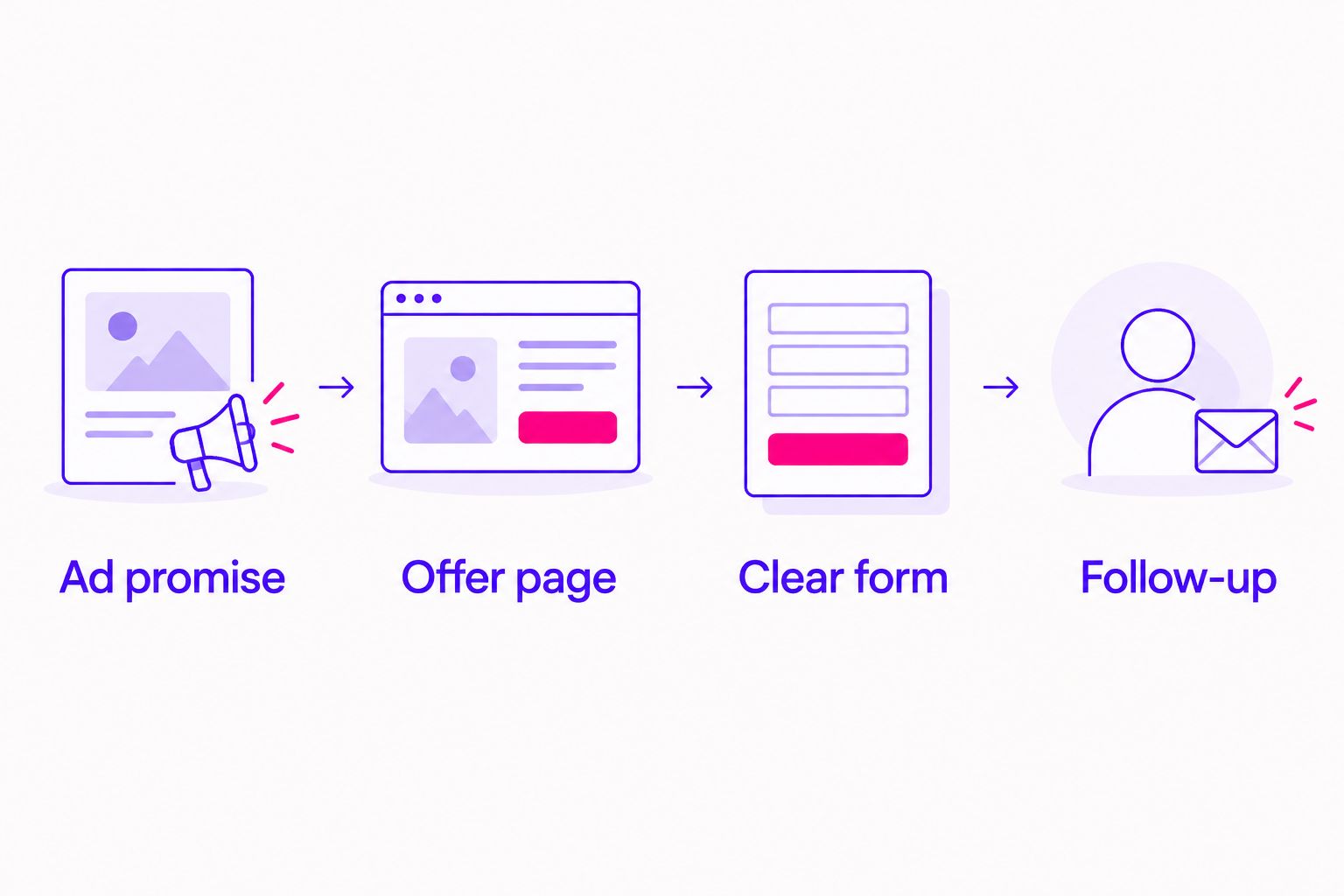
- Repeat the ad's core promise in the offer page's opening explanation.
- Describe what the coaching program includes using only details you can substantiate.
- Make the Clear form ask for information you will use to assess fit.
- Decide who owns Follow-up before the campaign starts.
Write copy that respects health concerns
Begin with the coaching topic, not an assumption about the reader's health. An ad can introduce support with bedtime routines or explain how your program works. It should not tell the viewer that they have insomnia or guarantee a result. The distinction keeps your message both clearer and more respectful.
Check the full journey, not just the ad text. A restrained ad that opens a page full of unsupported promises still gives the reader the wrong expectation. If your copy receives a rejection, review the wording and the destination together; the guide to Meta ad disapprovals for wellness offers covers that troubleshooting decision.
- Describe the program or teaching method instead of diagnosing the viewer.
- Replace guaranteed outcomes with an accurate account of what participants will learn or do.
- Use the same terms for the offer in the ad, on the page and in the form.
- Ask a colleague to flag phrases that imply knowledge of the viewer's health.
Create distinct ads, not minor rewrites
Your face and voice can explain a coaching offer more directly than an abstract wellness image, but you do not need a polished production. Start with what you can make and assess honestly: a short explanation, a written answer to a common question or a demonstration of an exercise you actually teach. Do not present a hypothetical client result as a real one.
In 2026, draft 3 ad concepts with different purposes rather than changing a few words in the same headline. One can explain your approach, one can address a common objection and one can show what happens after someone inquires. Keep the offer consistent so you can learn which message draws suitable prospects.
- Write an opening line that identifies the coaching topic without labeling the viewer.
- Record a direct explanation of who the program is for and what it covers.
- Make a second creative that answers a question you hear during real inquiries.
- Check that captions and on-screen text remain understandable without sound.
Set up measurement around meaningful actions
Before launch, decide what success means in your business records. A lead is not yet a client, and a booked conversation is not an enrollment. Track the actions you can verify, then compare the people who inquire with the audience your program serves. This matters more than celebrating a cheap click.
For a simple start, track 2 actions: a completed inquiry and a completed enrollment. If those actions happen on your website, configure suitable website event tracking and check that it records the right action. If enrollment happens through conversation or another system, maintain a consistent record there instead of assuming the ad platform sees it.
- Confirm that each ad opens the intended offer page and that its form works.
- Record inquiries in one place with their campaign source when that source is available.
- Mark which inquiries fit your program using the same criteria each time.
- Calculate cost per acquisition from ad spend and new clients, not form submissions.
Ziva's paid social advertising and marketing coaching is an option when you want support with these decisions, but your own enrollment records still determine whether the campaign is helping your business.
Respond to inquiries with care
Someone asking about sleep coaching might share sensitive personal information. Set expectations for your reply, keep intake questions relevant and avoid trying to resolve an individual health concern through an ad response. The purpose of follow-up is to clarify fit and the next step in your coaching process.
Speed matters to your workflow only when the response remains thoughtful. For a program with application forms, AI lead follow-up tools can be considered for routing or reminders; they do not replace a careful human answer to a personal sleep question. Check consent and what information a tool handles before using it.
- Assign each new inquiry to a person or a clearly defined response process.
- Send a reply that addresses the question the prospect actually asked.
- Keep automated reminders distinct from personal coaching or health advice.
- Record whether an inquiry became a conversation, an enrollment or a poor fit.
Review the campaign and refine one decision at a time
Set a 7-day review for your first campaign, but treat it as a work session, not proof that a message has succeeded or failed. Look at whether the ads ran as intended, whether the page and form worked, and what the inquiries reveal. A campaign with little inquiry data calls for a different decision from one that brings many unsuitable inquiries.
In 2026, compare ad results with your enrollment records before increasing spend. Return on ad spend means tracked revenue divided by ad spend; it cannot tell the full story when enrollments or later payments are missing from your records. Keep the limitation visible rather than assigning an ad credit it cannot substantiate.
- Check delivery, clicks and completed inquiries for each distinct ad concept.
- Read inquiry responses for signs that the offer was misunderstood.
- Change one message or page element when you identify a specific mismatch.
- Compare enrolled clients with spend before deciding whether to expand the campaign.
Which way should a sleep coach run Instagram ads?
You can manage ads yourself, get instruction while you manage them or hire someone to take on paid social work. The right choice depends on who will make creative decisions, inspect inquiry quality and keep enrollment records accurate. No option removes the need for a clearly defined coaching offer.
| Option | What it does | Best for | Key limitation |
|---|---|---|---|
| Self-managed Ads Manager | You create, launch and assess your own campaigns | Coaches who can make time for regular review | You own setup, copy checks and troubleshooting |
| Marketing coaching | You get guidance while making campaign decisions yourself | Coaches who want to build their own skills | You still need time to implement and review |
| Paid social agency | A service partner supports advertising work | Coaches who want outside campaign support | You must check whether its approach fits your offer |
| Ziva paid social advertising and marketing coaching | Agency services and marketing coaching for online courses and programs | Coaches selling online programs who want support | You still need a defined offer and reliable client records |
Ziva is best for sleep coaches selling online programs who want paid social advertising and marketing coaching, not a self-serve ad tool. Confirm which service fits your needs before choosing between coaching and agency support. If you prefer to run everything yourself, start with a small, clearly measured campaign instead.
Plan your next ad test
Paid social advertising and marketing coaching for online courses and programs.
Common mistakes sleep coaches make
- Advertising to everyone who wants better sleep. That message hides whom the program serves. Separate audiences only when you have a real offer and an appropriate next step for each one.
- Making the ad more specific than the offer page. An ad about a particular coaching topic sets an expectation. If the page switches to broad wellness language, the reader has to guess whether the program fits.
- Treating inquiries as enrollments. A form submission shows interest, not a client relationship. Keep the two actions separate in your records so an attractive lead count does not conceal weak fit.
- Using a testimonial as a promise. A real participant's experience does not establish what another person will achieve. Check consent, accuracy and surrounding copy before using a personal story.
- Changing the audience, ad and page at once. You lose the ability to identify which change helped. Make one clear adjustment, document it and use the next review to judge what happened.
FAQ
What are Instagram ads for sleep coaches?
Instagram ads for sleep coaches are paid placements that introduce a coaching offer and invite a relevant next step, such as an inquiry. They work best when the ad, destination and follow-up describe the same program.
Can a sleep coach mention insomnia in an Instagram ad?
A sleep coach should not write an ad that asserts or implies the viewer has insomnia. Meta's Advertising Standards prohibit assertions or implications about personal health attributes; describe the coaching topic without diagnosing the audience.
Should I send sleep coaching ad traffic to a form or an offer page?
Send people to the next step your ad promises. An offer page gives space to explain the program, while a form works when the ad has already made the inquiry process clear.
What should I measure besides clicks?
Measure completed inquiries, client fit and enrollments alongside ad spend. Those records show whether a campaign is reaching people your sleep coaching program can serve.
Do sleep coaches need to make video ads?
No, sleep coaches can test video and other creative formats that accurately explain their offer. Choose a format you can produce consistently, then compare the quality of inquiries it brings.
Is Ziva a sleep coaching software platform?
No, Ziva is a paid social media advertising and marketing coaching agency. It serves coaches and other conscious business leaders growing online courses and programs.
How do I decide whether to run ads myself or get help?
Run ads yourself if you can make time for setup, copy review, follow-up and measurement. Seek coaching or agency support when you need help with those tasks, while keeping ownership of your offer and client records.
One last thing
Before you expand a sleep coaching campaign in 2026, read the inquiries it produced. The most useful next change might be a clearer sentence on your offer page, not a new audience. An ad cannot compensate for a program description that leaves the right person unsure whether it is for them.