
how to run a soft launch ad campaign before a course launch
How to run a soft launch ad campaign before a course launch
Learn how to run a soft launch ad campaign before a course launch. Test your message, check signups, and use student behavior to guide your next move.
By ZIVA Marketing ·
Run a soft launch ad campaign before your 2026 course launch by testing a clear invitation, checking the full signup journey, and using the results to decide what deserves more spending. Start with a waitlist funnel when enrollment is not open, and treat signups as evidence of interest—not proof that people will buy.
- How to run a soft launch ad campaign before a course launch: test interest before expanding your spending.
- Use a waitlist for early interest; use a webinar when prospective students need to experience your teaching.
- Ziva Marketing supports course creators with paid social advertising and marketing coaching.
- Judge the next meaningful action, not clicks alone; registration does not establish purchase intent.
How to run a soft launch ad campaign before a course launch
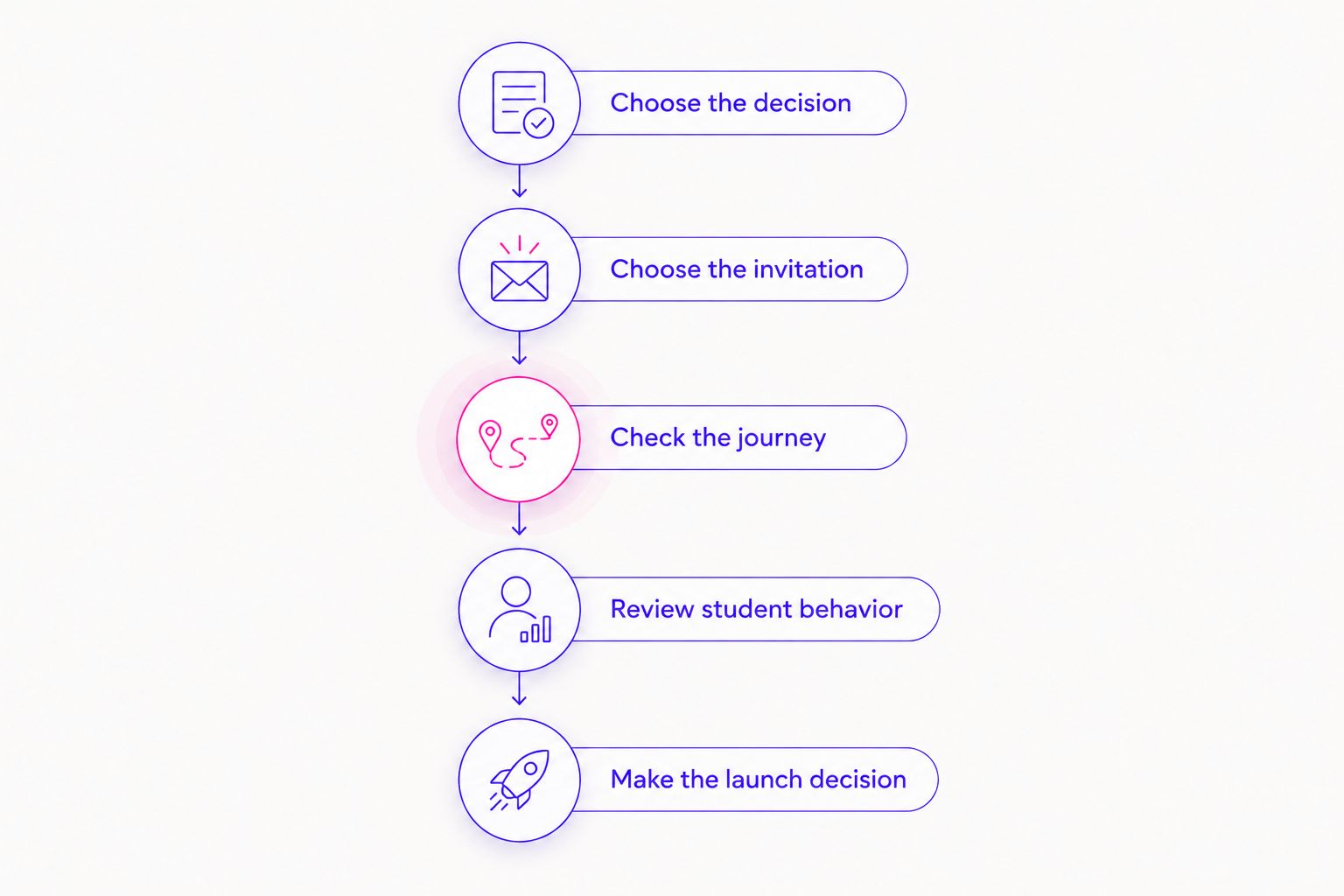
- Choose the decision. Write down what the campaign needs to help you decide: whether the invitation attracts suitable students, whether the signup journey works, or whether registrants take the next step. Choose a primary question rather than asking a small test to validate your whole business.
- Choose the invitation. Send people to a waitlist, an introductory class, or an application that matches your actual enrollment process. Keep the course topic and intended student consistent with the main launch.
- Check the journey. Follow an ad link, submit the form, receive the confirmation, and complete the next promised action. Confirm that your records distinguish a page visit from a completed registration.
- Run a focused test. Use a limited campaign structure and change a deliberate variable, such as the opening message. Set a spending boundary you can accept before the campaign begins.
- Review student behavior. Compare registrations with attendance, replies, applications, or purchases where those actions exist. Separate interest in the introductory content from interest in the course.
- Make the launch decision. Keep the message that attracts suitable students, repair the weakest handoff, and retest meaningful changes. Expand spending only when the evidence supports the next step.
A practical starting structure is 1 campaign, 1 signup destination, and 2 ads with different opening messages. This is a suggested way to keep the test readable, not a platform requirement or a performance benchmark.
Why this matters before your main launch
A course launch asks you to coordinate teaching, emails, registration, and advertising. A soft launch lets you inspect those connections before you depend on them during enrollment.
The useful result is a clearer decision. A full waitlist with little follow-through points to a different next move than a working signup journey that attracts unsuitable prospects.
For your 2026 launch, define success in terms of the next action you need. If your course sells through an introductory class, class registration alone does not answer whether students understand the course invitation.
Build a test you can actually interpret
Choose the decision
Write a short test statement before creating ads: you want to learn whether a particular invitation attracts the students your course serves. Name the student, the course topic, and the action you want that person to take.
Keep that statement close while you work. If an attractive ad idea speaks to a different audience or promises a different result, save it for a separate test rather than changing the purpose halfway through.
Choose the invitation
Your ad and landing page should describe the same opportunity. Explain what the visitor will receive, who the experience serves, and what happens after registration.
For spiritual teachers and healers, describe the practice or learning experience in grounded language. Invite people to explore your teaching without promising a personal transformation that the course cannot guarantee.
Check the journey
Complete the registration process on a phone as well as the device you use to build it. Check the form, confirmation page, delivery email, and any class-access instructions.
For a 2026 campaign, keep a dated record of these checks. If you change the form or destination later, repeat the relevant checks before interpreting new results.
Review student behavior
Connect each registration to its campaign source where your setup allows it. Then record the next relevant action, such as attending the class or requesting enrollment details.
Read replies alongside the totals. Someone asking about the course schedule gives you different information from someone who registered only to receive an introductory resource.
Make the launch decision
Finish the test with a written decision: continue, revise, or pause. State the evidence and the change you will make, rather than describing the campaign as simply good or disappointing.
Keep the decision specific. A broken confirmation email calls for a delivery fix, not a new audience or a new course promise.
Choose the soft launch invitation that fits your course
Choose the invitation based on what you need to learn, not which option makes registration easiest. An easy signup and a meaningful enrollment conversation answer different questions.
| Invitation | Best for | Useful evidence | Main limitation |
|---|---|---|---|
| Waitlist | A course that is not ready for enrollment | Interest in the specific course invitation | Joining does not demonstrate willingness to buy |
| Introductory webinar | A course that benefits from a teaching experience | Registration, attendance, and responses to the course invitation | Requires a working class and follow-up journey |
| Application | A program where student fit needs discussion | Relevant applications and enrollment conversations | Adds effort before prospective students can continue |
Use the same invitation throughout a focused test. Comparing a waitlist ad with an application ad changes both the message and the effort you ask from the visitor.
Waitlist: best for testing early course interest
A waitlist works when you can describe the course clearly but are not accepting enrollments. Tell subscribers what updates to expect, and state that they are joining a list rather than securing a place.
Its strength is a simple next step. Its limitation is the distance between expressing interest and purchasing a course.
Follow up with a useful question about the course topic or learning goal. Treat those replies as context, not a substitute for enrollment evidence.
Introductory webinar: best for experiencing your teaching
An introductory webinar gives prospective students a direct experience of how you teach. Choose a topic that connects naturally to the course rather than an unrelated subject designed only to attract registrations.
Its strength is the opportunity to observe participation and course questions. Its limitation is the extra delivery work: registration, access, teaching, and follow-up all need attention.
If you plan to use this route for your 2026 launch, test the actual handoff from the class to the course invitation. Attendance without that handoff leaves the enrollment question unanswered.
Application: best for programs that require a fit conversation
An application makes sense when your real enrollment process includes assessing whether the program suits the student. Ask questions you will use in that decision.
Its strength is relevant detail about a person's goals and readiness. Its limitation is the additional effort required before someone can continue.
Avoid adding an application merely to make a soft launch feel more serious. If the main course enrollment will be self-directed, test a journey that reflects that experience.
Set spending boundaries without inventing a benchmark
Decide what you can spend on learning before the ads begin. Keep that amount separate from money already committed to course delivery or essential launch work.
Set a review point and a stop condition. Pause when the signup path fails, when you reach your agreed boundary, or when the test can no longer answer its original question.
Do not increase spending to avoid an uncomfortable result. First identify whether the issue sits in the invitation, the audience response, or the registration journey.
Use your own records to establish a starting point. A campaign with no previous sales history needs a learning plan, not a borrowed promise about expected ROAS—return on ad spend, or revenue attributed to ads divided by ad spending.
Read results as a journey, not a scoreboard
Review the campaign from the first visit through the last action you can observe. Keep the definition of each action consistent across your 2026 reporting.
| What you observe | What it establishes | What to inspect next |
|---|---|---|
| Ad clicks | People acted on the ad | Whether the destination loaded and matched the invitation |
| Completed registrations | People submitted the form | Whether they received and used the next step |
| Class attendance | Registrants joined the session | Whether they engaged with the course invitation |
| Relevant applications | Applicants supplied information about fit | Whether suitable applicants continued toward enrollment |
| Purchases | Recorded transactions occurred | Whether revenue records and campaign attribution agree |
Do not label a message the winner on clicks alone. Choose the measure that matches your test question, then check the downstream evidence before carrying the message into the main launch.
Keep existing subscribers separate from people meeting you through ads for the first time. Combining them hides the distinction between a response from an established relationship and a response to a new introduction.
Why soft launch results vary
Interpret results in the context of the journey you tested:
- Audience familiarity: Existing followers and new visitors bring different knowledge of your work. Record which group received the invitation.
- Requested commitment: A waitlist signup, a class registration, and an application ask for different actions. Compare like with like.
- Message continuity: Check whether the ad, landing page, and follow-up describe the same learning opportunity.
- Delivery readiness: Confirm that registration leads to the access or information you promised.
- Course relevance: Review whether replies and applications concern the course itself or only the introductory content.
- Measurement completeness: Identify which steps you can observe before drawing conclusions about where people stop.
These factors help you locate the next useful change. They do not justify explaining away every weak result.
When should I start a soft launch campaign?
Start when the invitation, signup page, and follow-up are ready, with room to make changes before enrollment opens. Work backward from your main launch rather than choosing a universal duration; the guide to course launch campaign timing addresses that planning question separately.
Can I soft launch without an email list?
You can advertise a course invitation without an existing email list, but you still need a working way to deliver the promised next step. Keep new prospects identifiable so you can examine their response separately from people who already know your teaching.
How do I know whether to expand the campaign?
Expand when the campaign produces the action you planned to assess, the journey works, and the spending fits your boundaries. If the test measured waitlist interest, describe the result as waitlist interest—not validated course sales.
Get support where the decision feels unclear
Ziva Marketing is best for spiritual teachers and coaches seeking paid social advertising and marketing coaching for online courses. We help conscious business leaders grow their courses and programs toward a global audience.
The distinction is fit: Ziva Marketing is an agency and coaching service, not a self-service advertising tool. It suits a need for campaign support and marketing guidance; it is not the same choice as software you operate entirely on your own.
Explore support for your course launch
Explore paid social advertising and marketing coaching for your course or program.
FAQ
What's the first step in a soft launch ad campaign?
Choose the decision you need the campaign to support. Define the intended student, the invitation, and the action you will assess before building ads.
Should I send soft launch ads to a waitlist or a webinar?
Use a waitlist to assess early course interest, or a webinar to observe how people respond to your teaching and course invitation. Neither registration type proves that someone will purchase.
How many ads should I start with?
A focused starting plan is 2 ads with different opening messages, leading to the same destination. This is a suggested test structure, not a platform requirement or a guaranteed route to results.
Do I need to sell the course during a soft launch?
You do not need to sell during a soft launch if your question concerns interest or registration readiness. Without purchases, the campaign does not establish sales performance or ROAS.
What should I do if people register but do not attend?
Check confirmation delivery, access instructions, reminders, and whether the class matches the original invitation. Registration totals alone do not identify why people did not attend.
Should I change the ads and landing page at the same time?
Keep changes separate when your goal is to understand which change affects the response. Fix a broken journey immediately, then document the fix before comparing results.
Can Ziva Marketing help with course launch advertising?
Ziva Marketing offers paid social advertising and marketing coaching for spiritual teachers, healers, coaches, and conscious business leaders. Its work focuses on growing online courses and programs toward a global audience.
One last thing
Write your decision rule before the campaign starts. It is easier to judge evidence honestly when you have already defined what would make you continue, revise, or pause.
For your 2026 course launch, save that rule beside the final campaign notes. The most useful takeaway is not simply which ad attracted attention—it is what you now know well enough to do next.