
how to convert cold traffic into coaching program applications
How to convert cold traffic into coaching program applications
Convert cold traffic into coaching applications with clear messaging, useful teaching, and qualification. Track applicant fit through to enrollment.
By ZIVA Marketing ·
Convert cold traffic into coaching program applications by matching your ad to a clear program page, giving unfamiliar visitors enough evidence to assess fit, and measuring qualified applications rather than clicks alone.
- How to convert cold traffic into coaching program applications: connect a specific promise, credible teaching, and a clear application path.
- Choose direct applications for clear offers; use a teaching-first path when prospective clients need more explanation.
- Measure qualified applications, attended calls, and enrollments together—not form submissions alone.
- Ziva suits spiritual teachers seeking paid social advertising and marketing coaching.
Why this matters
An unfamiliar visitor has no shared history with you. Your ad, page, and application need to explain what you help people do, how your program works, and what happens next.
You do not need to make your work sound less personal. You need to make the invitation easier to understand. For your 2026 campaign plan, treat clarity and qualification as connected goals rather than choosing between more applications and better applications.
If your offer involves a substantial commitment, start with the principles in our guide to paid social ads for high-ticket coaching programs. Then map the steps below to your own enrollment process.
How to convert cold traffic into coaching program applications
Build the path around the decision your prospective client needs to make—not around the form you want them to complete. Someone who understands your approach needs a different invitation from someone encountering your work for the first time.
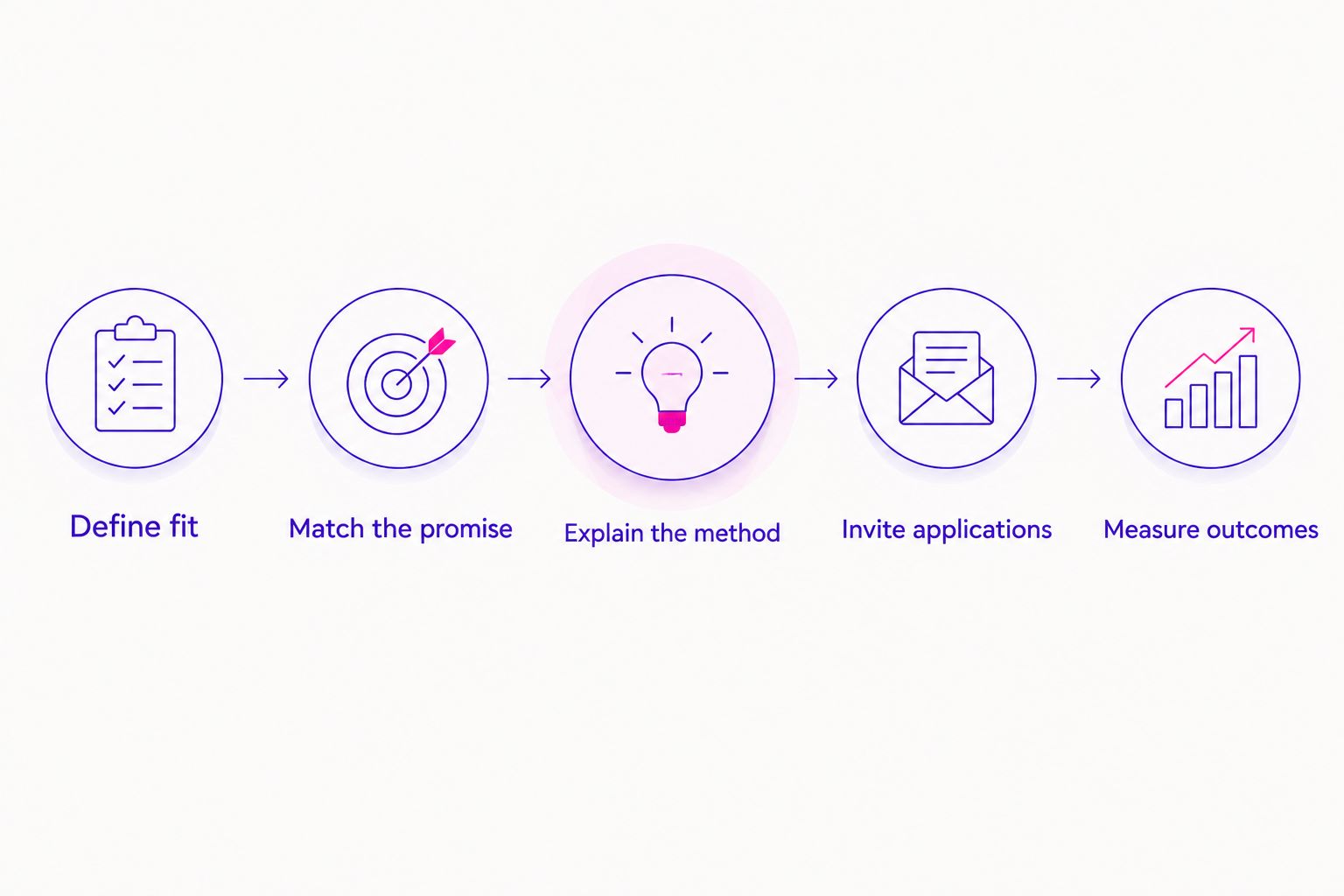
Use this sequence to build and review your application funnel:
- Define fit. Describe the person your program serves, their goal, and the participation your approach requires.
- Match the promise. Keep the ad's central message consistent with the page headline and program description.
- Explain the method. Show what participants learn or practice, using concrete language rather than transformation claims alone.
- Invite applications. Explain why you ask people to apply and what happens after submission.
- Measure outcomes. Connect the application to qualification, call attendance, and enrollment.
These steps apply whether you teach meditation, support conscious business owners, or offer another coaching discipline. The examples and boundaries should reflect your actual work.
Choose the path that fits your offer
There is no reason to add a webinar or email sequence simply because another coach uses one. Add a teaching step when it answers a real question that your application page cannot answer clearly on its own.
| Application path | Best for | Main advantage | Main limitation |
|---|---|---|---|
| Direct application | Visitors who can understand the offer and assess fit from the program page | Keeps the route to applying short | Asks unfamiliar visitors to decide with less exposure to your teaching |
| Teaching-first application | Visitors who need to experience or understand your method before applying | Gives you room to explain the approach and its boundaries | Adds another step to build, maintain, and measure |
Choose direct applications when your page can support an informed decision. Choose teaching first when a useful explanation belongs before that decision. Neither route guarantees qualified applicants.
For a teaching-first path, use a lesson that demonstrates the work. A practical exercise or a clear explanation of your method gives the visitor something to evaluate. An extended sales introduction does not serve the same purpose.
Make your ad and program page tell the same story
Your ad earns attention with a particular idea. The destination page needs to continue that idea immediately, rather than asking the visitor to interpret a new promise.
For example, an ad about building a consistent meditation practice should lead to a page that explains support for that practice. A broad headline about discovering unlimited potential leaves the connection unclear.
Check these elements together:
- Audience: Does the page describe the same person the ad addresses?
- Goal: Does the page explain the outcome introduced in the ad?
- Method: Does the visitor understand what coaching involves?
- Next step: Does the button accurately describe what happens after selecting it?
For your 2026 creative review, read the ad and page headline aloud as one continuous message. Rewrite the transition if you need an extra explanation to connect them.
Describe the program without assuming you know a viewer's private circumstances. You can explain who your work supports without diagnosing the person reading the ad or promising personal outcomes you cannot establish.
Give visitors enough evidence to assess fit
A cold visitor cannot rely on familiarity with your personality or reputation. Show the substance of your work before asking for personal information.
Explain what happens inside the program using the facts you can support. That might include the teaching approach, participation expectations, or the distinction between coaching and services you do not provide. Include only details that are accurate for your offer.
Specific explanations are more useful than unsupported promises. Describe a practice participants learn rather than guaranteeing how every participant will feel afterward.
Use testimonials only with appropriate permission and context. Do not present an individual experience as a promised result. If you do not have testimonials, demonstrate your teaching and explain your process instead of creating substitute claims.
For spiritual and healing-related offers, keep your language grounded. A visitor should understand both the invitation and its limits without needing to translate a page of abstract language.
Build an application that supports a real decision
Your application should help you assess fit and help the applicant understand the commitment. It should not ask for a life story simply because the work is personal.
As a starting design, use 4 qualification questions alongside the contact information you need:
- What would you like support with through this program?
- What have you already tried or practiced?
- What makes this program relevant to you now?
- Can you meet the participation requirements described on the page?
Adapt those questions to your actual selection criteria. Remove any question whose answer will not change your decision or help you prepare for a conversation.
Keep 1 primary action per page: applying to the program. Supporting information can remain available without competing invitations to download unrelated resources, join several lists, or explore other offers.
Before submission, explain how you will use the answers and what happens next. Avoid asking for sensitive personal or health details unless they are genuinely necessary and you have an appropriate process for handling them.
Check the form on a phone. Read every error message, complete each required field, and confirm that successful submission leads to a clear confirmation rather than an uncertain ending.
Make follow-up part of the application experience
An application submission is a handoff, not an enrollment. The confirmation needs to tell applicants whether they should book a conversation, wait for a review, or take another clearly defined step.
Only describe the process you actually follow. Do not promise an immediate response or automatic acceptance unless your operation supports it.
For applicants invited to a conversation, explain its purpose. State whether you will discuss goals, assess program fit, or answer questions about participation. An accurate invitation helps both people arrive with shared expectations.
If you use reminder messages, keep them useful and permission-based. Include the relevant appointment details and a clear way to change plans. Avoid turning reminders into repeated pressure to commit.
Measure application quality through enrollment
Your 2026 reporting should distinguish an application from a qualified application. Define qualification before reviewing campaign performance so the criteria do not shift to make a campaign look better.
Track 5 funnel stages: page visits, submitted applications, qualified applications, attended calls, and enrollments. Use the same definitions across campaigns and record the source when your tracking supports it.
Useful calculations include:
- Application rate: submitted applications divided by relevant page visits.
- Qualification rate: qualified applications divided by submitted applications.
- Attendance rate: attended calls divided by booked calls.
- Enrollment rate: enrollments divided by the clearly stated group you are evaluating, such as attended calls.
- Cost per qualified application: campaign spend divided by qualified applications attributed to that campaign.
ROAS means return on ad spend: attributed revenue divided by advertising spend. It is a revenue measure, not a profit measure.
Do not call a campaign successful because it generates inexpensive forms. Check whether those applicants fit the program and progress toward enrollment. Compare results using consistent attribution rules—the rules that determine which campaign receives credit—and acknowledge gaps rather than assigning every sale to an ad.
Why cold-traffic application results vary
The same application process can produce different results when the offer, audience, or message changes. Review these factors before replacing the entire funnel:
- Offer clarity: Visitors need to understand the program's purpose and participation requirements.
- Audience fit: Relevant attention matters more than attention alone.
- Message consistency: The ad, page, and form should describe the same opportunity.
- Evidence: Visitors need a credible basis for evaluating your approach.
- Application effort: Every required field should serve a clear purpose.
- Follow-up accuracy: The promised next step should match the experience applicants receive.
Use your own 2026 results to locate the stage that needs attention. If visitors submit applications but few meet your criteria, review the invitation and qualification rules before making the form easier to complete.
If qualified applicants do not attend calls, inspect the booking and confirmation experience. A new ad does not address every problem after the click.
Should I send cold traffic straight to an application?
Send cold traffic straight to an application when the destination page explains the program well enough for a visitor to assess fit. Include the approach, participation expectations, and next step before the form.
Use a teaching-first path when the visitor needs to understand your method before applying. Keep that teaching relevant to the decision rather than adding content for its own sake.
What should I change first if applications are unqualified?
Change the invitation before adding more screening. Review whether the ad and page accurately describe who the program serves, what it involves, and who should choose another kind of support.
Then check whether your qualification questions reflect actual acceptance criteria. A detailed form cannot correct a misleading promise.
When does outside marketing support make sense?
Outside support makes sense when you need help connecting paid social advertising, offer messaging, and measurement. Ziva is best for spiritual teachers and coaches seeking paid social advertising and marketing coaching.
At Ziva, we help spiritual teachers, healers, coaches, and conscious business leaders grow online courses and programs through paid social advertising and marketing coaching. That support does not replace a clearly defined program or your responsibility to assess client fit.
FAQ
What's the best way to turn cold ad traffic into coaching applications?
Match a specific ad promise to a clear program page, then invite visitors to apply after explaining fit and participation. Judge the path by qualified applications and enrollments, not clicks alone.
Do I need a webinar before people apply for coaching?
You do not need a webinar when your program page gives visitors enough information to assess fit. Use a teaching step when it answers questions that need more explanation or a demonstration of your approach.
How many questions should my coaching application have?
Start with 4 qualification questions as a design recommendation, not a performance benchmark. Keep only questions that help you assess fit or prepare for the next conversation.
Can cold traffic convert if I don't have testimonials?
A lack of testimonials does not prevent you from building an application path. Demonstrate your teaching, explain the program clearly, and avoid promising outcomes you cannot support.
Why do people apply but never book a call?
A missing booking step, unclear expectations, or a change in interest can explain the gap. Review the confirmation experience and ask applicants for feedback rather than assuming the ad is the cause.
What should I track beyond coaching application submissions?
Track qualification, booked calls, attended calls, and enrollments alongside submissions. These stages show whether your application process supports an appropriate enrollment decision.
One last thing
Your application page should help the wrong-fit visitor decide not to apply. That is useful clarity, not a missed opportunity.
Before your next 2026 campaign, read the page as someone who has never encountered your work. Mark every sentence that depends on knowing your story, understanding your terminology, or trusting an unexplained promise. Replace those assumptions with concrete explanations.
An informed application is a better starting point than an enthusiastic misunderstanding.