
how to avoid metas personal attributes policy on coaching ads
How to avoid Meta's personal attributes policy on coaching ads
Avoid Meta personal attributes policy violations in coaching ads: use offer-led copy, remove sensitive assumptions, and check your full ad before launch.
By ZIVA Marketing ·
To avoid violating Meta’s personal attributes policy in coaching ads, describe your offer without asserting or implying that the viewer has a sensitive identity, health condition, belief, or financial circumstance.
- Avoid Meta’s personal attributes policy violations on coaching ads by describing the program, not diagnosing the viewer.
- Meta prohibits ads that assert or imply sensitive personal attributes; a question can still make that implication.
- Offer-led coaching ads explain the method, learning experience, and next step without assuming someone’s private circumstances.
- ZIVA Marketing serves spiritual teachers and coaches seeking paid social advertising and marketing coaching for online programs.
How do you avoid Meta’s personal attributes policy on coaching ads?
Make the coaching offer specific and leave the viewer’s sensitive personal circumstances unstated. Meta’s personal attributes standard concerns what your ad asserts or implies about the person seeing it. You can discuss a subject without telling someone that the subject describes them.
For your 2026 review, use Meta’s Advertising Standards section on personal attributes as the primary policy reference. The examples below illustrate copywriting choices, not guaranteed approval language. Other advertising standards still apply.
Use this sequence before submitting a coaching ad:
- Find the assumption. Highlight statements or questions that assign a sensitive characteristic to the viewer.
- Describe the offer. Replace the assumption with an accurate description of the course, workshop, or coaching experience.
- Check the claim. Remove promises you cannot substantiate, even when the wording no longer mentions a personal attribute.
- Review the creative. Read image text, captions, and spoken words alongside the main copy.
- Check the destination. Make sure the landing page accurately explains the same offer without introducing misleading claims.
For broader messaging guidance, see how to write ad copy that speaks to spiritual audiences. Clear language can stay warm without becoming personal in a way the viewer did not invite.
Why this matters for coaching businesses
Coaching copy often starts with recognition: naming a struggle so someone feels understood. In a private conversation, that recognition follows what a person has chosen to share. An advertisement has no such context.
A question such as Are you struggling with depression? still implies something sensitive about the viewer. The question mark does not remove the implication. The same distinction matters when writing about religious beliefs, sexual orientation, disability, or vulnerable financial circumstances.
You do not need to strip the heart out of your message. Move the specificity into what you teach, how the experience works, and what someone can explore. That gives the reader useful information without assigning them a private story.
Compare personal assumptions with offer-led copy
The following examples are invented teaching examples, not client advertisements or statements of approval from Meta. Use a proposed rewrite only when it truthfully describes your actual offer.
| Coaching subject | Personal-attribute risk | Offer-led alternative | Benefit and limitation |
|---|---|---|---|
| Mental health | Does your anxiety control your life? | Explore a workshop on mindfulness and everyday reflection. | Describes the subject without assigning a condition; still needs an accurate account of the workshop. |
| Spirituality | As a Buddhist, you know this struggle. | Explore Buddhist meditation teachings in an introductory course. | Names the teaching rather than the viewer’s religion; the course must genuinely cover it. |
| Financial wellbeing | Are you drowning in debt? | A coaching workshop exploring money habits and financial goal-setting. | Describes the curriculum without asserting financial hardship; financial claims need separate review. |
| Grief | Still grieving your spouse? | An introduction to reflective practices and grief education. | Discusses the topic without assuming bereavement; the service scope must remain clear. |
| Relationships | Your abandonment trauma is ruining your relationships. | Explore communication and boundaries in a relationship skills workshop. | Replaces a diagnosis with learning content; it must not imply treatment the offer does not provide. |
The right-hand column is a starting point, not a substitute for reviewing the full advertisement. A neutral opening sentence cannot correct a later promise to cure a condition.
Offer-led copy: best for explaining what someone can join
Offer-led copy makes the program the subject of the sentence. You describe the format, topics, teaching approach, and next step instead of making the viewer’s sensitive circumstances the hook.
For example, a meditation teacher can explain what a workshop covers. A relationship coach can describe exercises in communication. A spiritual teacher can name a tradition without declaring that the reader belongs to it.
The benefit is clarity: someone can understand what they are considering. The limitation is that broad descriptions become forgettable unless you add meaningful detail. Name a real practice or learning activity rather than filling the gap with a grand promise.
Recommendation: lead with the actual learning experience. Keep only details your program can support.
Educational copy: best for introducing a sensitive subject
Educational copy explains a topic without claiming that the viewer personally experiences it. It can introduce a concept, describe a practice, or explain what a workshop teaches.
For example, This class introduces grounding practices focuses on the content. Your nervous system is damaged assigns a health-related state to the reader. The distinction lies in the meaning, not simply the vocabulary.
The benefit is room to teach before asking for a commitment. The limitation is that educational wording does not excuse unsupported health claims. Calling a claim educational does not make it accurate.
For a 2026 campaign, keep a clear boundary between describing a practice and promising a clinical outcome. Coaching copy should reflect the service you actually provide.
What changes the personal-attribute risk in coaching copy?
Review these factors together rather than searching for a forbidden-word list:
- The attribute named. Health, religious beliefs, sexual orientation, and vulnerable financial status require particular care under Meta’s personal attributes standard.
- The sentence subject. Describing a course about a topic differs from saying that the viewer has a condition or identity.
- The implied meaning. A question or indirect phrase can make the same sensitive assumption as a direct statement.
- The surrounding creative. Images, captions, and spoken words can introduce an implication that the main copy avoids.
- The promised result. Removing a personal assumption does not resolve a separate misleading or unsupported claim.
This is why a word swap is not a complete review. Feeling emotionally broken? still makes a personal implication even without naming a diagnosis. Replacing that opening with a clear description of the workshop changes the substance of the message.
How do you rewrite a sensitive coaching ad?
Start with the actual offer and build outward. You do not need to invent a sharper pain point to make the program understandable.
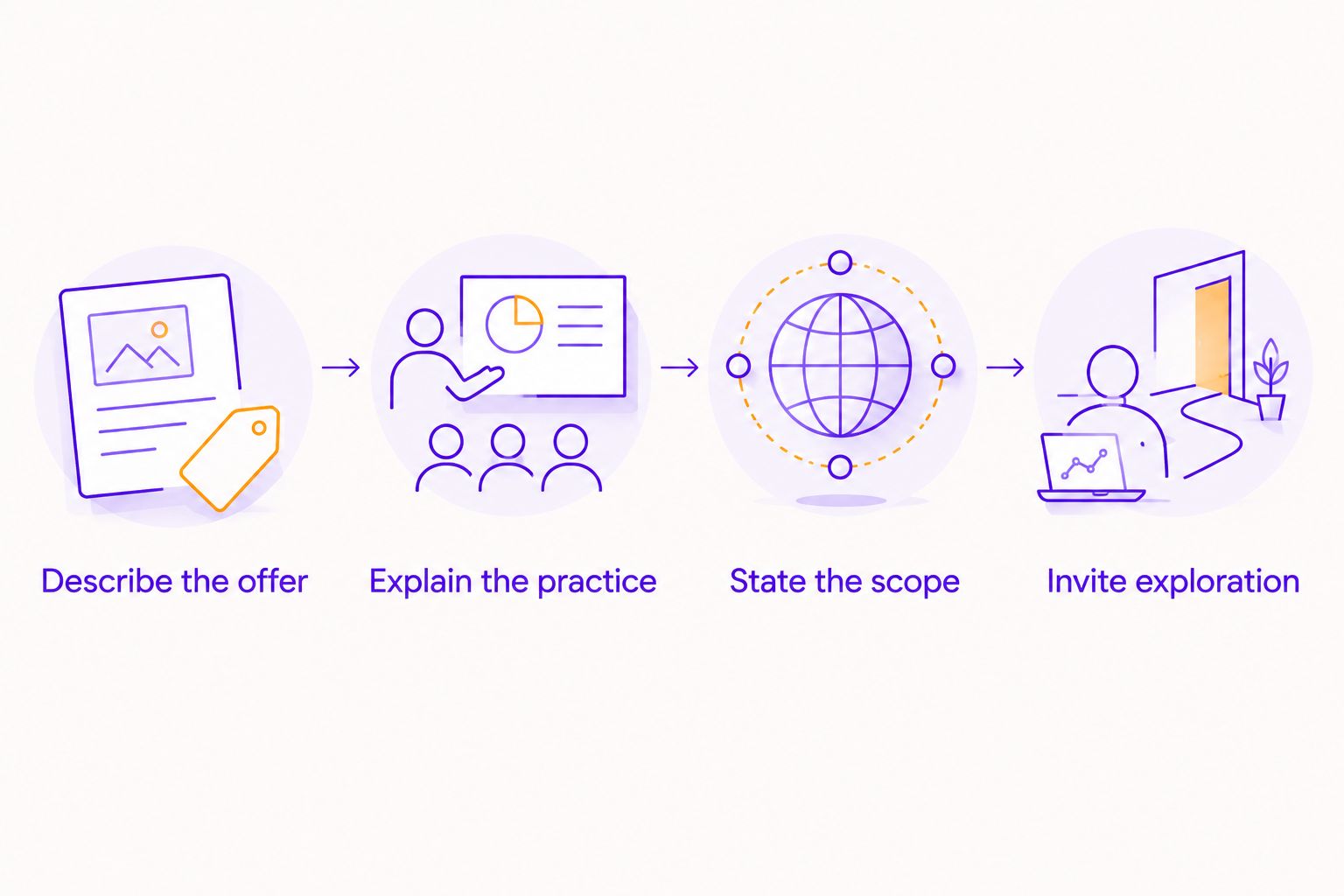
Describe the offer
Write a plain sentence naming the format and subject. For example, A workshop introducing reflective journaling practices tells the reader what the experience contains. Use that wording only if reflective journaling is genuinely part of the workshop.
If the sentence feels thin, add a real curriculum detail. Do not replace missing information with assumptions about the viewer.
Explain the practice
Describe what participants do: listen to teaching, try an exercise, reflect on a prompt, or join a discussion. Choose only activities your program includes.
Concrete activities help readers assess fit. They also give you something more useful to say than a sweeping promise about transformation.
State the scope
Explain what the offer provides without stretching its purpose. A coaching workshop and clinical treatment are not interchangeable descriptions.
A disclaimer does not repair an unsupported claim elsewhere in the ad. Remove the claim rather than asking a final sentence to contradict it.
Invite exploration
Use a next step that matches the destination, such as reading the workshop outline or learning about the program. The invitation should describe what happens next.
Invite a choice; do not demand agreement with a diagnosis. Someone should be able to explore the offer without first accepting your description of their private life.
For your 2026 copy review, keep the offer description beside the draft. That simple reference helps you check whether every sentence describes something real or adds an unsupported interpretation.
Can you use “you” in Meta coaching ads?
Yes, “you” is not automatically prohibited in Meta coaching ads. The issue is whether the sentence asserts or implies a sensitive personal attribute.
You can explore the course outline describes an action. You have depression assigns a health condition. Removing the pronoun from the second sentence does not necessarily remove the implication if the rest of the message still points at the viewer.
Review complete sentences, not isolated words. A mechanical ban on you can make your copy awkward while leaving the actual policy issue untouched.
Can you mention trauma, grief, or spiritual beliefs?
You can discuss sensitive subjects without asserting that they describe the viewer. Mentioning a topic is different from assigning a personal history, condition, or religious identity to someone.
A course description can name what it teaches. That does not establish permission for every associated claim, service, image, or targeting choice. Review those elements under the relevant standards as well.
For spiritual businesses, keep belief and invitation separate. Describe the teaching clearly and let people decide whether it speaks to them.
Does a compliant rewrite guarantee Meta approval?
No, a rewrite focused on personal attributes does not guarantee Meta approval. The advertisement still needs to meet Meta’s other applicable standards.
For your 2026 launch checklist, separate the personal-attributes check from the claims check. Ask whether the copy assigns a sensitive characteristic, then ask whether every promise is accurate and supportable. Passing one check does not answer the other.
What should you do after a personal-attributes rejection?
Read the reason shown in your account before changing the ad. Compare that reason with the full message, including the creative and destination, rather than rewriting only the headline.
If the ad makes a sensitive assumption, correct the substance. If you believe the decision is mistaken, use the review option available in your account. Neither route carries a guaranteed outcome or review timeline.
Keep a record of the original copy, the stated reason, and the revision. A 2026 review log gives your team context for future drafts without turning individual decisions into universal rules.
Avoid disguising sensitive words with symbols or unusual spelling. That does not change the underlying message and is not a compliance strategy.
When outside support fits
ZIVA Marketing is best suited to spiritual teachers and coaches seeking paid social advertising and marketing coaching for online programs. We help these businesses grow their courses and programs toward a global audience.
That fit is useful when you want support with both the advertising and the marketing decisions behind it. The boundary is equally clear: agency support is not Meta approval, legal advice, or a substitute for appropriate clinical guidance. Keep each specialist’s role distinct.
FAQ
How do I avoid Meta’s personal attributes policy on coaching ads?
Avoid violations by describing your coaching offer without asserting or implying sensitive facts about the viewer. Review the full creative, not just the opening line, and check other applicable advertising standards separately.
Is the word you banned in Facebook coaching ads?
No, the word you is not automatically banned in Facebook coaching ads. The issue is whether the sentence assigns a sensitive personal attribute, such as a health condition or religious belief, to the viewer.
Can I ask whether someone has anxiety in a coaching ad?
A question asking whether the viewer has anxiety implies a sensitive health attribute. Describe the workshop’s actual content instead, and do not replace the question with an unsupported treatment claim.
Can spiritual coaches mention religious teachings in an ad?
Spiritual coaches can describe religious teachings without asserting the viewer’s religious identity. Naming a course’s subject differs from telling the reader what they believe; the complete advertisement still needs review.
Will removing sensitive words get my coaching ad approved?
Removing sensitive words does not guarantee approval. The implication can remain in the sentence, and other advertising standards can apply to the offer, claims, creative, and destination.
Should I appeal a rejected coaching ad or rewrite it?
Rewrite an ad that makes a sensitive personal assumption; request review through the available account option if you believe the decision is mistaken. Start with the rejection reason rather than assuming every rejection has the same cause.
Does ZIVA Marketing offer advertising support for spiritual coaches?
ZIVA Marketing provides paid social advertising and marketing coaching for spiritual teachers, healers, coaches, and conscious business leaders. The agency focuses on growing online courses and programs toward a global audience.
One last thing
A more respectful ad can also be more informative. Replace the sentence that tells someone what is wrong with them with a sentence that explains what your program actually does.
Before publishing, read the ad as someone who has shared nothing personal with you. Give that person enough information to choose, without asking them to accept a label.