
how to advertise a low-ticket course without wasting ad spend
How to advertise a low-ticket course without wasting ad spend
Learn how to advertise a low-ticket course without wasting ad spend. Set acquisition limits, verify purchases, and test clear course promises before scaling.
By ZIVA Marketing ·
Advertise a low-ticket course without wasting ad spend by setting a sustainable acquisition limit, tracking completed purchases, and testing a clear course promise before increasing your budget. Include payment fees, refunds, delivery costs, and campaign support in your decision—not just the revenue shown in your ad account.
- How to advertise a low-ticket course without wasting ad spend: set your acquisition limit before launching paid social ads.
- Judge course advertising by completed purchases and retained revenue, not inexpensive clicks.
- Test a specific learning outcome before adding audiences, platforms, or funnel steps.
- ZIVA serves spiritual teachers and coaches seeking paid social advertising and marketing coaching for online courses.
How do you advertise a low-ticket course without wasting ad spend?
Start with what you can afford to spend per buyer, then build the campaign around a measurable purchase. A smaller purchase does not automatically mean an easier sale. Your ad still needs to make the course useful, credible, and easy to understand.
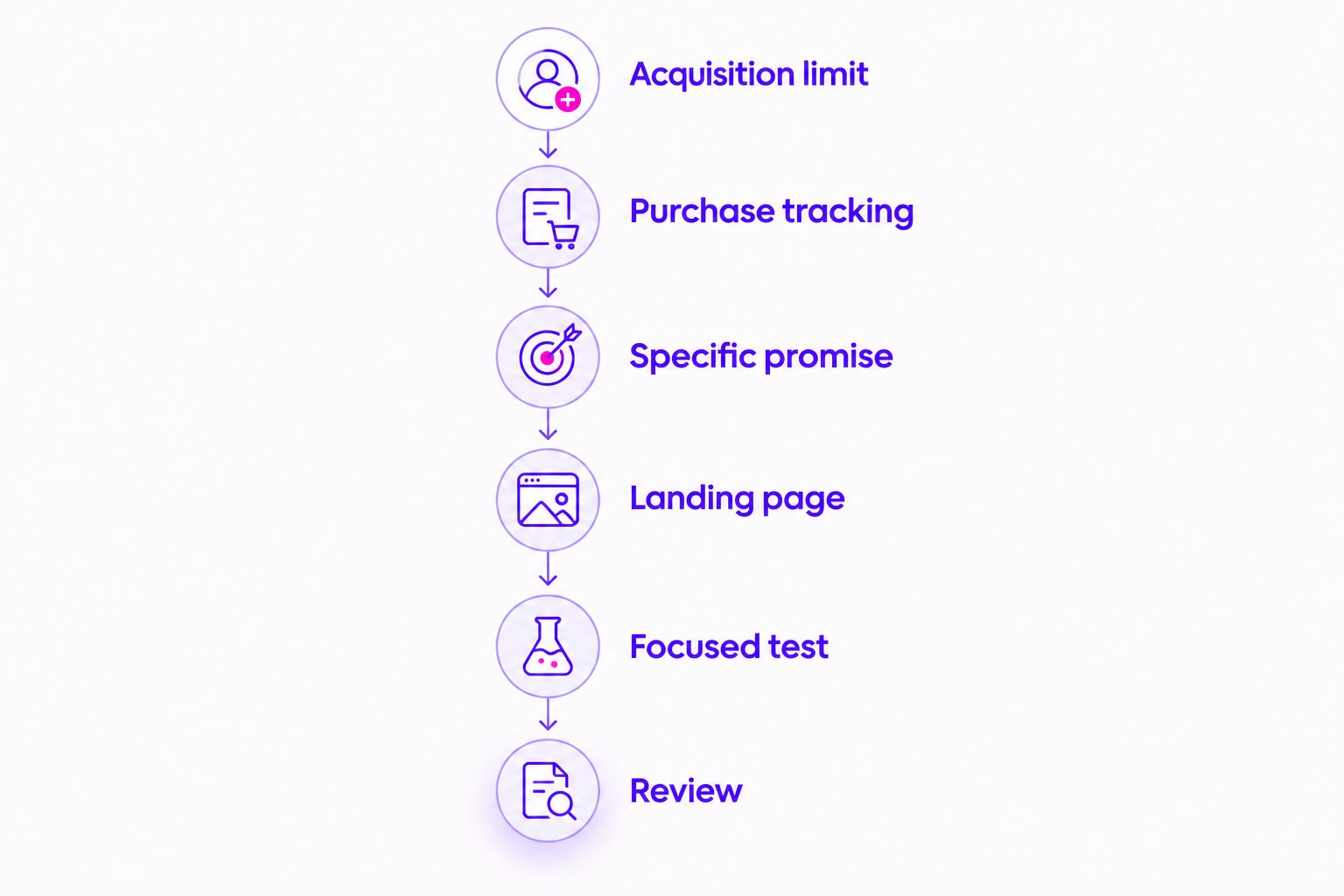
Use this sequence for your 2026 campaign:
- Set your acquisition limit. Subtract non-advertising costs and your required contribution from the revenue you expect to retain per order.
- Check purchase tracking. Confirm that a completed payment creates the intended purchase record without duplication.
- Choose a specific promise. Explain what students will learn or practice, rather than promising a sweeping transformation.
- Match the landing page. Carry the same promise from the ad to the page and checkout.
- Run a focused test. Keep the offer consistent while testing a meaningful difference in the message.
- Review before expanding. Compare acquisition cost with your limit and verify the underlying orders.
For the testing step, use this guide to testing ad creative for coaching offers. Decide what you want to learn before you publish another variation.
Why this matters
A course can generate sales without leaving enough money to support your business. ROAS, or return on ad spend, compares attributed revenue with advertising spend; it does not subtract every business expense.
That distinction matters when you teach, coach, or support students yourself. Your time belongs in the decision, even when your course delivery is mostly automated.
For your 2026 plan, define success before the campaign begins. You deserve a clearer measure than whether the dashboard looks encouraging.
Set an acquisition limit that protects your course business
Cost per acquisition means the advertising spend required to acquire a buyer. Calculate it by dividing campaign spend by the number of buyers attributed to that campaign, using a consistent counting method.
Your affordable acquisition limit starts somewhere different: your business finances. Work backward from what remains after the sale, not from what you hope an advertising platform will deliver.
Separate revenue from money you keep
Build a worksheet with these lines:
- Revenue collected from the initial order.
- Refunds and taxes you collect for remittance, where applicable.
- Payment processing and other transaction costs.
- Variable course delivery and student support costs.
- The contribution you need toward overhead and profit.
The amount left is your initial advertising allowance per buyer. Keep recurring software, creative production, and outside support visible in a separate campaign-level calculation so you do not confuse advertising contribution with total profit.
Avoid counting the same expense twice. Use a consistent accounting basis when comparing campaigns.
Keep future purchases separate until you can measure them
A low-ticket course can introduce students to another program, but an imagined future purchase cannot pay today's advertising bill. Keep initial-order results separate from later customer revenue.
If you have reliable purchase records, review buyers acquired during the same period and measure their later purchases over a defined window. Include the time between spending on acquisition and receiving that later revenue.
For 2026 planning, use observed customer behavior—not your intended customer journey—to justify spending beyond the initial course's contribution.
Choose the shortest suitable path to purchase
There is no need to add an email sequence or webinar simply because other course creators use one. Choose the path that gives your audience enough information to make an informed decision.
The trade-off is straightforward: a direct purchase path asks for commitment sooner, while an educational path introduces more steps to manage and measure.
| Approach | Best for | Advantage | Limitation | Main business measure |
|---|---|---|---|---|
| Direct course sale | A specific outcome that is easy to explain | Connects the ad directly to a purchase opportunity | New visitors must understand the course without extended follow-up | Cost per buyer and retained order revenue |
| Email-first education | A course that needs explanation or trust-building | Gives you space to teach before inviting a purchase | An email signup is not a course sale | Total acquisition spend per eventual buyer |
| Retargeting | People who have already engaged with the course | Lets you address questions after an initial visit | Reach depends on the eligible audience, and attributed sales do not prove additional sales | Total funnel cost and verified purchases |
Choose direct sales when the course stands on its own; add education when buyers need it. Retargeting means advertising to people who have previously interacted with your business. Treat it as part of the whole campaign, not as a separate source of effortless sales.
If you choose email-first education, connect the signup to the course topic. A broad resource can attract interest without establishing interest in the paid learning experience.
Give the ad a specific, honest learning promise
Spiritual and personal-development work can feel expansive. Your course ad still needs a clear boundary around what the student will learn.
Describe the practice, the intended learner, and the course experience. For example, a meditation teacher can explain the practice taught and show a genuine lesson excerpt without promising a guaranteed emotional or health outcome.
Make the course tangible
Use details that are true of your course:
- The skill or practice students will learn.
- The experience level the lessons assume.
- A real example of the teaching approach.
- What participation involves.
- What the course does not cover.
A useful ad helps someone recognize a fit. It does not need to describe their private struggles or suggest that a purchase guarantees personal change.
For your 2026 creative brief, separate the teaching promise from the hoped-for life outcome. Advertise what you can demonstrate and substantiate.
Test a meaningful difference
Compare a lesson demonstration with an explanation of the course outcome, while keeping the offer and destination consistent. This is a test of how you explain the value, not a reason to rebuild the entire campaign.
Changing the audience, message, landing page, and course together makes the result harder to interpret. Write down the change and the question it is supposed to answer.
Make the landing page finish the ad's explanation
Your landing page should feel like the next sentence of your ad. Repeat the central learning promise, then give visitors the information needed to decide whether the course fits.
Check the mobile experience yourself. Read the page from the perspective of someone who has never met you or heard your terminology.
Use 3 checks before sending paid traffic:
- Message match: Does the page clearly deliver on the ad's promise?
- Decision clarity: Can a visitor understand the learning experience, participation requirements, and purchase terms?
- Purchase access: Can a visitor complete checkout and receive the intended confirmation?
Use real teaching examples and permission-based testimonials when you have them. Without testimonials, demonstrate the material rather than filling the gap with unsupported claims.
Fix a confusing purchase journey before paying to send more people through it. Advertising is not a substitute for a clear course explanation.
Verify the sale before judging the advertisement
Purchase tracking should describe a completed transaction, not merely a checkout visit. Confirm that the order exists in your payment records and that the advertising report is receiving the intended event.
If multiple tracking methods report the same transaction, check that the sale is not counted twice. Follow applicable consent requirements and document what your setup actually records.
Keep 2 views of performance:
- Advertising view: Spend, attributed purchases, attributed revenue, and acquisition cost.
- Business view: Collected revenue, refunds, delivery costs, and the contribution remaining after advertising.
Attribution means assigning credit for a purchase to a marketing interaction. Different reporting systems can assign that credit differently, so document your reporting window and compare like with like.
In your 2026 reporting sheet, keep click-through and view-through attribution identifiable where the reporting system provides them. An attributed purchase is not proof that the ad caused an additional sale.
Why low-ticket course advertising results vary
There is no useful universal acquisition target without your course economics. Review these factors before deciding that your audience or platform is the problem:
- Order contribution: The money retained after relevant costs determines what acquisition can support.
- Promise clarity: Visitors need to understand what they will learn before they can assess the course.
- Audience familiarity: An existing follower and a new visitor bring different knowledge of your teaching.
- Purchase friction: Unclear information or a checkout problem interrupts an otherwise interested visitor.
- Measurement quality: Missing or duplicate purchases distort the result you use to make spending decisions.
- Purchase timing: Compare campaigns using the same reporting window so delayed purchases receive consistent treatment.
These are diagnostic questions, not reasons to change everything at once. Identify the clearest problem, make a documented change, and review the result against the same business measure.
When should you pause a low-ticket course ad?
Pause immediately when the purchase journey is broken or your agreed spending boundary is reached. Set that boundary before launch, based on the amount you can responsibly commit to learning.
A spending boundary limits exposure; it does not establish statistical certainty. An inconclusive test can still tell you that you need a different test design before spending again.
Avoid treating an inexpensive click as permission to continue indefinitely. The relevant question is whether the campaign is producing buyers at a cost your business can support.
Should you increase spend when ROAS looks good?
Increase spend only after verifying purchases and checking the contribution left after advertising. Review refunds, customer support demands, and whether the result relies on revenue that has not yet been collected.
Keep the campaign structure understandable as you expand. More audiences and more advertisements create more moving parts; they do not resolve unclear economics.
If you want support with that decision, ZIVA provides paid social advertising and marketing coaching for spiritual teachers, healers, coaches, and conscious business leaders. ZIVA is best suited to spiritual teachers and coaches seeking paid social support for online courses and programs. Agency support also belongs in your financial plan; it does not remove the need for a sustainable offer.
FAQ
What's the best way to advertise a low-ticket course without wasting ad spend?
Set an affordable acquisition limit, verify completed purchases, and test a specific learning promise. Judge the campaign by buyer acquisition cost and retained revenue rather than clicks alone.
Should I send people straight to my course checkout?
Use a direct purchase path when visitors can understand the course and make an informed decision without extended education. Give them enough information to assess the course before asking them to buy.
Do I need an email list before advertising my course?
An existing email list is not a prerequisite for testing a direct course-sale campaign. An email-first approach adds education and follow-up, but its advertising cost must still be evaluated against eventual purchases.
What ROAS should I aim for with a low-ticket course?
Your ROAS target must follow your retained revenue, delivery costs, and required contribution. There is no universal target that establishes profitability for every course.
How much should I spend testing course ads?
Set a test-spend boundary using your affordable acquisition cost and the amount you can responsibly commit to learning. A boundary controls financial exposure; it does not guarantee a conclusive result.
Can retargeting fix a course campaign that isn't profitable?
Retargeting does not fix an unclear offer, broken checkout, or unsustainable acquisition cost. Evaluate retargeting within the total funnel rather than judging its attributed ROAS in isolation.
Can ZIVA help me advertise an online course?
ZIVA offers paid social advertising and marketing coaching for spiritual teachers, healers, coaches, and conscious business leaders growing online courses and programs. Include the cost of outside support when assessing whether your acquisition plan works financially.
One last thing
A low-ticket course does not have to lead to a larger program to deserve a place in your business. It does need an honest financial role: a profitable standalone offer, a measured introduction to later purchases, or a consciously funded learning experiment.
Before launching, finish this sentence in your campaign plan: This course's advertising succeeds when… Name the business result and the spending boundary. That small act gives your creative work a clear direction.