
how to advertise a coaching quiz funnel on meta
How to advertise a coaching quiz funnel on Meta
Learn how to advertise a coaching quiz funnel on Meta with clear ad messaging, consent-aware tracking, useful results, and follow-up that fits your offer.
By ZIVA Marketing ·
Advertise a coaching quiz funnel on Meta by matching your ad to a useful quiz result, tracking completed leads rather than clicks, and guiding each participant toward a relevant coaching offer.
- How to advertise a coaching quiz funnel on Meta: connect the ad, quiz result, and coaching offer.
- Use Meta lead generation to measure completed signups, not just quiz visits.
- Keep sensitive quiz answers out of Meta tracking and advertising audiences.
- Ziva serves spiritual teachers and coaches who want paid social advertising and marketing coaching.
How do you advertise a coaching quiz funnel on Meta?
Build the journey backward from your coaching offer, then set up a Meta campaign that measures a meaningful lead action. Your quiz should help someone choose a next step—not simply give them a label.
Use this sequence for your 2026 launch:
- Define the next step. Decide whether the result leads to a course, an educational session, or a coaching application.
- Write useful results. Give each participant an explanation and an action they can take.
- Build the quiz page. Match the ad promise and explain what happens after submission.
- Connect measurement. Track valid lead submissions and connect them to later bookings or purchases.
- Create the campaign. Choose settings that support your lead goal and available tracking.
- Test the complete journey. Check the ad destination, quiz logic, result delivery, and follow-up before spending.
If you are still choosing the quiz software, start with the quiz funnel tools for coaching lead generation guide. Choose for result logic and tracking needs, not appearance alone.
Why this matters
A quiz gives a prospective client a gentle way to explore your teaching before making a bigger commitment. It also adds steps between the ad and your offer. Each step needs a clear purpose.
An interesting quiz and a useful sales journey are not the same thing. Someone can enjoy a result without wanting the program behind it. Judge the funnel by qualified interest and eventual sales, not participation alone.
Start with the offer, then write the quiz
Name the decision your quiz will help someone make. For a meditation teacher, that might be choosing a practice format. For a business coach, it might be identifying a marketing priority.
Keep the promise within the scope of your work. A coaching quiz should not present itself as a medical diagnosis or promise a guaranteed personal transformation.
Draft the result pages before writing the questions. Each result needs:
- A clear explanation: What does this result mean within your coaching framework?
- A useful action: What can the participant try or consider next?
- An offer connection: Why does your program relate to that next step?
- A clear boundary: What does the result not establish or guarantee?
Then write questions that genuinely distinguish those results. Remove questions that collect information you do not need. A shorter, purposeful experience respects the participant's attention without sacrificing the information that makes the result useful.
Choose the next step that fits your coaching offer
Choose the result-page action before writing your ads. The right action depends on what someone needs to understand before joining your program.
| Result-page action | Best for | Benefit | Limitation |
|---|---|---|---|
| Educational email sequence | Offers that need explanation and relationship-building | Gives you space to connect the result with your teaching | Requires relevant follow-up and permission to send marketing emails |
| Workshop invitation | Programs taught through a live or recorded introduction | Lets participants experience your approach | Adds another registration and attendance step |
| Coaching application | Offers that require a fit conversation | Collects information for a more useful conversation | Asks for more commitment from someone new to your work |
Recommend the next step that serves the participant's decision. Do not send every result to an application simply because applications are easy to count.
Keep the result useful without a purchase. That gives your invitation a sound foundation: the participant understands something new, and your offer provides a relevant way to explore it further.
Set up Meta to measure a completed lead
For a website-based quiz, start with the Leads objective and review the website conversion options available in your account. Select a lead event that represents an actual submission, rather than a page opening.
Meta's campaign controls change. For your 2026 setup, confirm the available conversion location, event, and performance goal inside Ads Manager rather than copying an old screen-by-screen tutorial.
Define the lead event carefully
Decide exactly when someone becomes a lead. A quiz start is not an email signup. A completed quiz without contact details is not a contactable lead either.
Trigger your lead event only when the defined action succeeds. Check whether refreshing a confirmation page or repeating a submission creates duplicate records. Keep quiz engagement separate from the event used to measure lead acquisition.
Test browser and server tracking
The Meta Pixel records supported website events through the browser. The Conversions API sends supported events through a server connection. Neither replaces your responsibility to obtain appropriate consent and follow applicable privacy requirements.
If you use both methods for the same action, configure event deduplication so Meta can recognize the shared event. Check events in Events Manager before launch, and confirm that your email system receives the correct contact and result.
Keep sensitive answers out of tracking
Meta's Business Tools Terms prohibit sending sensitive information through its business tools. Do not send health disclosures or other sensitive quiz responses as event parameters, audience labels, or page-address details.
Inspect what your quiz software sends automatically. A connection that works technically is not proof that the data is appropriate to share. Review the result-page address, tracking parameters, and integration fields as part of your 2026 privacy check.
Build a clear journey from ad to follow-up
Keep the same promise throughout the funnel. If the ad offers help choosing a practice, the landing page should introduce that choice, the result should explain it, and the follow-up should build on it.
Use this sequence to review the experience:
- Ad promise: Describe the useful discovery.
- Quiz page: Explain the experience and any email requirement.
- Useful result: Deliver the promised explanation.
- Relevant invitation: Offer an appropriate next step.
- Email follow-up: Continue the conversation with permission.
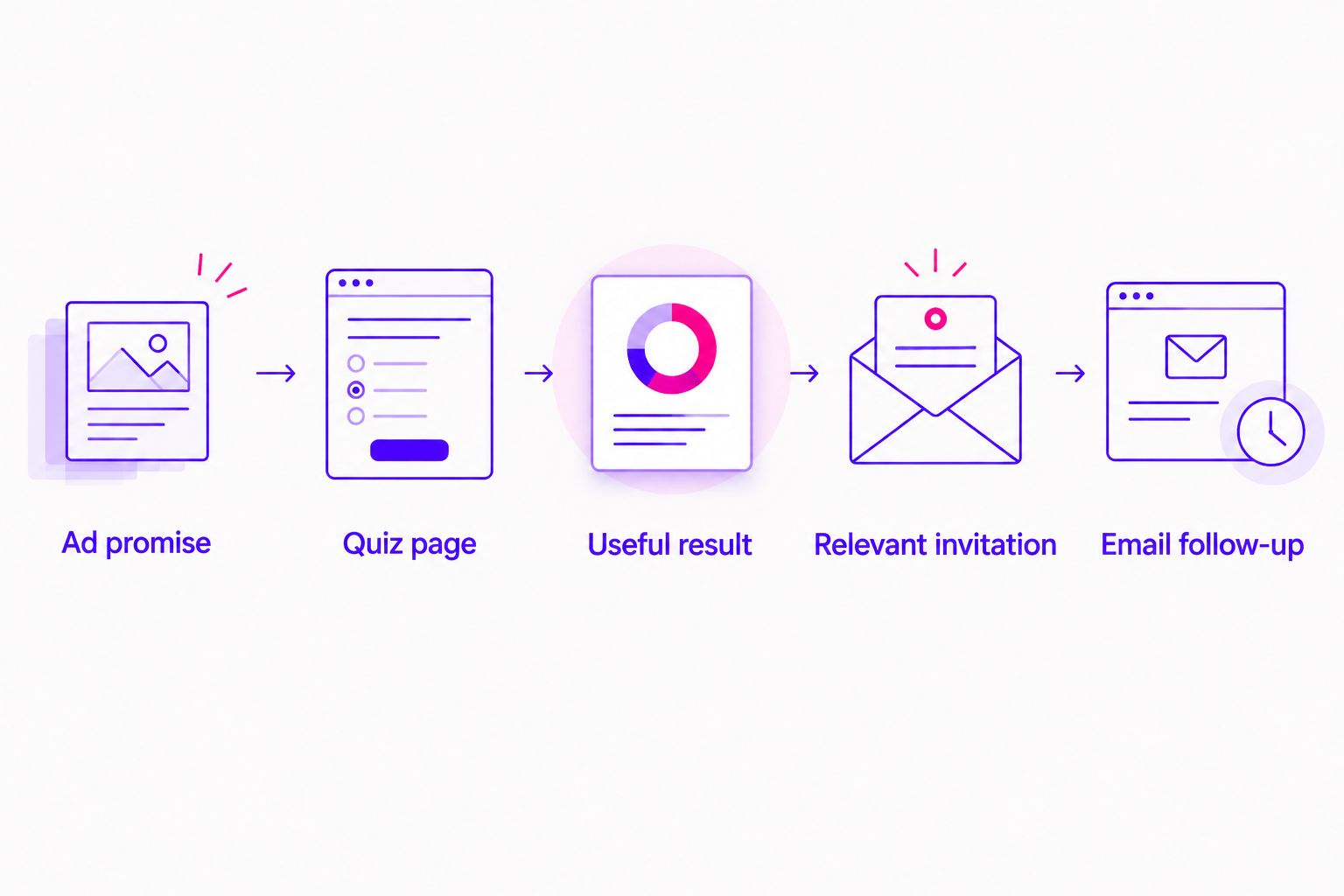
Read the journey as a new visitor would. Remove any point where you ask someone to understand your internal terminology before they can move forward. Spiritual language can express your teaching, but instructions still need to be plain.
Write ads that invite exploration without making assumptions
Describe what the quiz helps someone explore. Avoid copy that claims to know a viewer's health, emotional condition, or other sensitive personal attributes. Meta's Personal Attributes advertising standard restricts those assertions.
For example, an invitation to explore different meditation practice formats describes the content. A statement that the viewer has a particular mental health condition makes an assertion about the person.
Build each ad around a clear promise:
- Explain the topic in everyday language.
- Describe what the result helps someone understand.
- Show the teaching approach without promising an outcome you cannot substantiate.
- Ask the viewer to take the quiz.
Choose visuals that reflect the experience rather than exaggerate the transformation. If you show a result preview, it should represent what participants actually receive.
For creative testing in 2026, change a defined element at a time, such as the opening message or visual approach. Record the hypothesis before launch. This gives the result a useful meaning beyond identifying which ad received more clicks.
Follow up according to the result
Deliver the promised result clearly. If an email address is required, explain that before submission rather than revealing the requirement after someone has finished.
Separate result delivery from permission to receive ongoing marketing. Use consent language appropriate to the locations you serve, and make unsubscribing straightforward.
The follow-up should expand the result, not restart a generic sales pitch. Explain the recommended action, address a relevant obstacle, and show how your teaching relates to the participant's stated interest.
Keep result categories available in your own email system where appropriate. Do not assume that information suitable for a private coaching conversation is also suitable for advertising platforms.
Why coaching quiz funnel performance varies
Use these factors to investigate performance rather than searching for a universal benchmark:
- Ad-to-quiz alignment: A curiosity-led ad can attract people who enjoy quizzes but do not want the offer.
- Question relevance: Unnecessary or confusing questions create work without improving the result.
- Result usefulness: A vague label gives participants little reason to trust the next recommendation.
- Offer fit: An invitation needs to address the interest expressed in the quiz.
- Tracking accuracy: Missing or duplicate events distort your understanding of lead acquisition.
- Follow-up quality: A relevant result loses its connection when every participant receives unrelated messages.
Review these factors in order. More advertising does not fix a result page that fails to deliver the ad's promise.
How do you know whether quiz leads are good?
Good quiz leads show relevant interest beyond completing the quiz. Define qualification using your offer's actual requirements, then review applications, attended conversations, and purchases alongside lead submissions.
Cost per lead measures acquisition, not suitability. Divide advertising spend by valid leads for that measure. Review cost per qualified lead separately so a growing email list does not hide weak offer fit.
For your 2026 reporting, connect each lead's campaign source to later outcomes in your customer records. ROAS means revenue attributed to advertising divided by ad spend; it does not account for every business expense. Keep the attribution period consistent when comparing campaigns.
Should you run the quiz yourself or get support?
Run the funnel yourself when you can maintain the quiz, tracking, creative testing, and email follow-up. Consider support when those responsibilities exceed your capacity or you need help connecting advertising decisions to your offer.
Ziva is best for spiritual teachers and coaches seeking paid social advertising and marketing coaching. At Ziva, we help this audience grow online courses and programs through those services.
That service focus fits someone seeking support, not someone looking for standalone quiz software. You still need a clear offer and an honest, useful result; hiring an agency does not remove those responsibilities.
FAQ
What's the best Meta campaign objective for a coaching quiz?
Start with the Leads objective for a website quiz designed to collect contact details, then select the supported website conversion settings in your account. Measure a successful lead submission rather than a quiz-page visit.
Can I advertise a coaching quiz without an email list?
Yes, you can advertise a coaching quiz without an existing email list. Your ad still needs a clear audience-facing promise, a working quiz, and an appropriate way to collect marketing permission.
Should I ask for an email before showing the quiz result?
Explain any email requirement before the participant starts the quiz. Whether you collect the address before or after the questions, make result delivery and ongoing marketing permission clear.
Can I use sensitive quiz answers to target Meta ads?
Do not send sensitive quiz answers to Meta through tracking integrations or audience uploads. Review Meta's Business Tools Terms and advertising rules before connecting your quiz data.
Is a quiz funnel better than a direct coaching application?
A quiz fits an offer when participants benefit from exploration before applying; a direct application fits people ready to discuss the program. Compare qualified applications and sales rather than assuming the extra step improves results.
What should I check before increasing my quiz ad budget?
Check lead quality, tracking accuracy, result delivery, and downstream outcomes before increasing spend. Fix any broken connection between the ad promise and the coaching invitation first.
One last thing
Take your quiz through every result path before launching. Use a fresh email address, open the result on your phone, and read the follow-up as someone unfamiliar with your teaching.
Your most useful final check is whether every result earns its invitation. If the next step feels disconnected, improve that connection before asking more people to take the quiz.