
how much should a coach budget for youtube ads
How much should a coach budget for YouTube ads in 2026?
How much should a coach budget for YouTube ads? Set an affordable test cap. Plan around enrollments, production, tracking, and cash flow before you commit.
By ZIVA Marketing ·
A coach should budget for YouTube ads in 2026 by setting an affordable test limit and calculating planned ad spend from the number of enrollments they want and their acceptable cost per enrollment. Keep video production, campaign support, software, and follow-up separate from that ad spend so the full commitment stays clear.
- How much should a coach budget for YouTube ads? Set an affordable test cap before committing spend.
- Calculate planned ad spend from target enrollments and an acceptable cost per enrollment, not video views.
- Include video production, tracking, and follow-up in your total campaign budget.
- ZIVA Marketing serves spiritual teachers and coaches seeking paid social advertising and marketing coaching.
How much should a coach budget for YouTube ads in 2026?
Budget the smaller of what your enrollment plan requires and what your business can safely commit to a test. An enrollment plan does not make the results certain. Your spending limit needs to protect the business even when the campaign brings in fewer buyers than expected.
Use this planning formula:
Planned ad spend = target paid enrollments × acceptable ad cost per enrollment.
Cost per enrollment means the advertising spend needed to acquire a paying student or client. You will also see it called cost per acquisition. Set your acceptable figure from the money an enrollment leaves after delivery expenses and your required profit—not from the full amount a customer pays.
Then build the complete budget:
| Budget component | What it covers | Planning decision |
|---|---|---|
| Ad spend | Distribution of your YouTube ads | Set a campaign limit you can afford without relying on new sales |
| Video production | Planning, recording, and editing | Identify what you can create yourself and what needs outside help |
| Campaign support | Setup, management, and reporting | Define who owns the work and which tasks are included |
| Tracking and software | Recording inquiries and purchases | Confirm the tools you already have before adding more |
| Follow-up | Emails, applications, and sales conversations | Reserve time and resources to respond to interested people |
For the channel-specific context, read YouTube ads for online course creators. Keep the budgeting decision tied to your offer and enrollment process rather than a general spending recommendation.
Why this matters
You do not need to prove your commitment to your coaching business by spending beyond your comfort zone. You need a test that answers a useful business question. A clear limit gives you room to learn without putting program delivery or personal income under pressure.
For your 2026 plan, distinguish between paying for attention and paying for enrollment. Views show that people encountered your video. Paid enrollments show that people chose your program, although tracking still needs to establish how advertising contributed.
A campaign budget is a decision boundary, not a promise of revenue. That distinction keeps your expectations grounded and your next move clear.
Build your budget from enrollment economics
Start with the offer you want to advertise. A self-paced course and a coaching program with live sessions have different delivery commitments. Your advertising allowance needs to respect those commitments.
Write down the revenue you expect to retain from a completed enrollment. Subtract payment processing, refunds, delivery expenses, and other direct costs relevant to your program. Then reserve the profit your business needs.
The remaining amount defines room for acquiring that customer. Advertising is only part of acquisition when you also pay for campaign management, production, or sales support.
Keep these measures separate:
- Ad cost per enrollment: ad spend divided by paid enrollments attributed to the campaign.
- Total acquisition cost: advertising and related acquisition expenses divided by acquired customers.
- ROAS: return on ad spend, calculated as attributed revenue divided by advertising spend.
ROAS does not subtract your delivery expenses or campaign support costs. A revenue return therefore does not establish profitability on its own. Use ROAS to understand advertising revenue; use your full cost picture to decide whether growth supports the business.
If you offer payment plans, distinguish collected revenue from amounts still due. Advertising bills and delivery expenses need cash, not just future commitments. Apply that distinction consistently when you assess the campaign.
Choose the enrollment path before allocating spend
Your YouTube ad should lead to a next step that fits the commitment you are asking someone to make. Choose that path before building your budget. Otherwise, you will be funding activity without a clear definition of success.
| Enrollment path | Best for | Main advantage | Main limitation | Budget checkpoint |
|---|---|---|---|---|
| Direct enrollment | A clearly explained course with a straightforward buying decision | Connects advertising to a purchase outcome | Leaves less room for personal questions before purchase | Paid enrollments and collected revenue |
| Webinar registration | A program that benefits from teaching before the offer | Gives you space to demonstrate your approach | Adds attendance and follow-up steps before enrollment | Registration, attendance, and eventual purchases |
| Coaching application | An offer that requires a fit conversation | Gives you a structured way to assess suitability | Requires time to review applications and hold conversations | Suitable applicants, attended calls, and enrollments |
Choose the path that matches how people need to evaluate your offer. Do not choose a webinar simply because registrations are easier to count, or an application because you want every inquiry to feel substantial.
Each route has a different point where interest becomes meaningful. For a direct enrollment campaign, a purchase is the central outcome. For an application campaign, a suitable applicant is useful evidence, but the budget still needs to connect that application to a paying client.
When you compare results, keep the enrollment path consistent. A registration and a purchase are not interchangeable outcomes.
Set a test budget you can explain
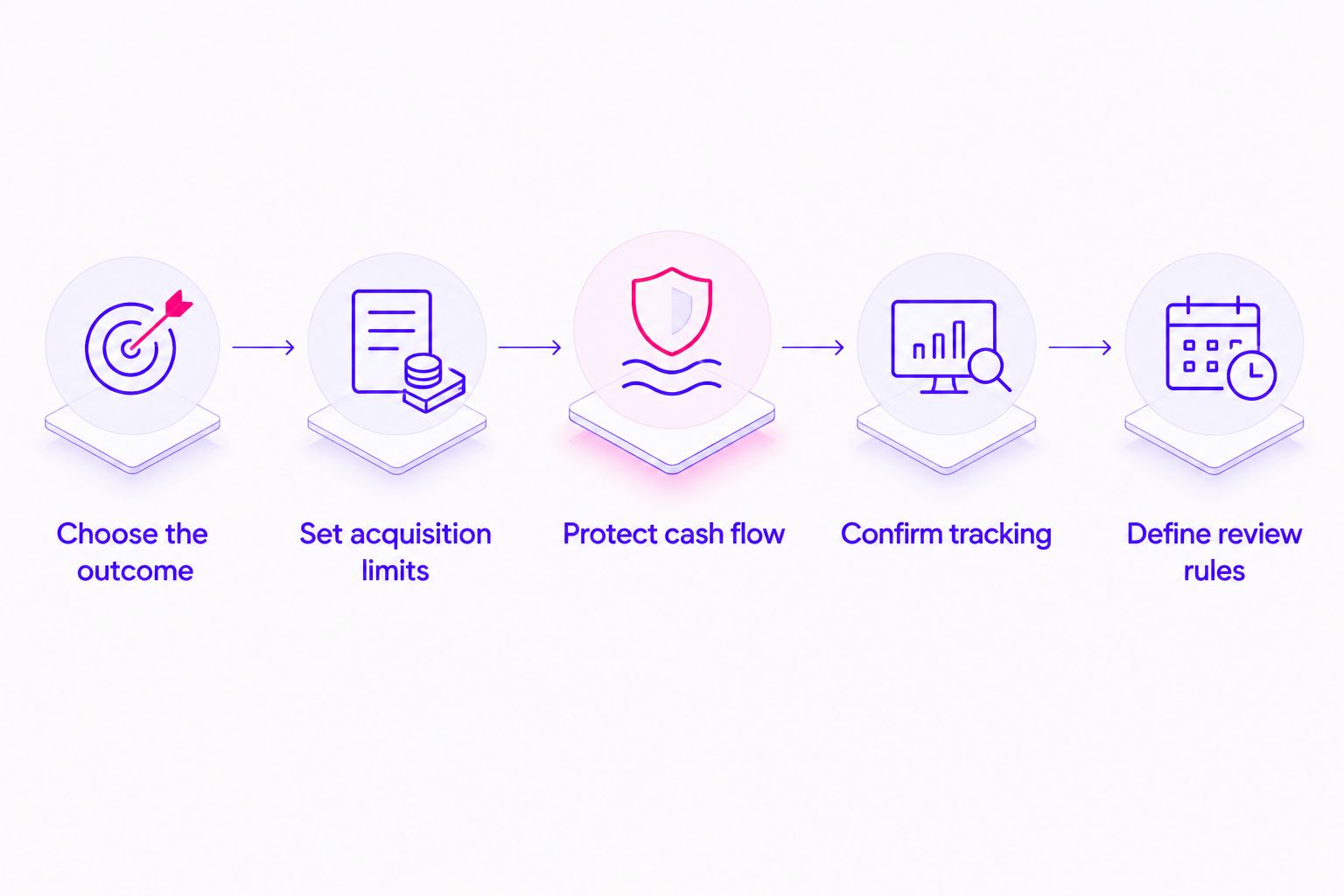
A useful 2026 YouTube ads test has a spending limit, an enrollment goal, and a review decision. Write all three down before the campaign starts. This turns a vague experiment into a manageable business commitment.
1. Choose the outcome
Decide whether your campaign asks for direct enrollment, webinar registration, or a coaching application. Identify the final business outcome as well. An inquiry campaign still needs a route to paid enrollment.
2. Set acquisition limits
Calculate the maximum total acquisition cost your offer can support. Then identify the portion available for advertising after campaign support and production. Keep an estimated allowance clearly labeled as a planning assumption.
3. Protect cash flow
Choose a campaign spending limit that leaves money available for delivery and existing obligations. Do not fund the test with revenue you expect the test to generate. Your campaign needs permission to produce an uncertain result.
4. Confirm tracking
Check that an inquiry or purchase records correctly and reaches the place where you manage follow-up. Confirm that your reporting distinguishes these actions. A recorded page visit is not a recorded enrollment.
5. Define review rules
Write down what will prompt you to continue, adjust, or stop spending. Include spending against the agreed cap, the quality of inquiries, and paid enrollment outcomes. Do not leave the decision to how encouraging the view count feels.
These steps belong together. Tracking without a spending limit does not protect cash flow, and a spending limit without an outcome does not explain what you learned.
Why a coach's YouTube ads budget varies
Your budget depends on the business behind the ad, not just the channel. Use these factors to explain your own allocation rather than borrowing someone else's monthly spend.
- Program delivery costs: Live support, sessions, and other delivery commitments affect how much revenue remains available for acquisition.
- Enrollment path: Direct purchases, webinars, and applications require different steps and different follow-up work.
- Existing evidence: Previous enrollment results give you a basis for planning; a new offer starts with assumptions that need testing.
- Video production needs: A usable video asset and a new production project create different non-advertising commitments.
- Team capacity: Application reviews, conversations, and student support need time, whether you handle them yourself or pay for help.
- Tracking quality: Clear purchase and inquiry records let you assess outcomes; incomplete records leave the spending decision less informed.
For 2026, document these factors beside the budget. If the enrollment path or support requirements change, revisit the plan. The original allowance belongs to the original setup.
A larger campaign limit does not resolve an unclear offer or a broken enrollment process. Fix the specific problem before paying for more people to encounter it.
How much should a coach spend each day on YouTube ads?
Your planned daily allowance is your campaign ad budget divided by the number of days you intend to run the test. Treat that calculation as a planning guide, not a guarantee of identical daily spend. Check the campaign's current budget controls and monitor actual spend against your total limit.
Choose the campaign period around your enrollment process. If people need to attend a webinar or have a conversation before joining, include that follow-up period in your assessment. Stopping the evaluation at the first inquiry leaves the business outcome unresolved.
Should a coach increase the budget when leads look promising?
Increase the budget only after checking how promising leads progress toward paid enrollment and whether you can serve additional clients. A suitable inquiry is encouraging. It is not yet collected revenue.
Review attended conversations, completed purchases, and delivery capacity together. If applications rise but few suitable people attend calls, inspect that step before raising spend. Give each adjustment a clear reason.
Is YouTube advertising the right next step for every coach?
YouTube advertising is a channel to evaluate, not a requirement for growing a coaching business. Start when you have an offer you can explain, a working next step, and money available for a bounded test. When those pieces need attention, preparation is the better next move.
ZIVA Marketing is best suited to spiritual teachers and coaches seeking paid social advertising and marketing coaching. At ZIVA Marketing, we help this audience grow online courses and programs. That service fit does not replace the need to assess your own budget, and an agency description does not establish a particular YouTube campaign result.
FAQ
How much should a coach budget for YouTube ads in 2026?
Set an affordable test cap and calculate planned ad spend from target enrollments multiplied by an acceptable ad cost per enrollment. Add production, campaign support, software, and follow-up separately to understand the full commitment.
Can I start YouTube ads without knowing my cost per enrollment?
Yes, but treat your initial cost-per-enrollment allowance as a planning assumption rather than a measured result. Set it from your offer's economics and use a bounded test to gather evidence.
Does my YouTube ads budget include making the videos?
Your ad spend covers advertising distribution, while your full campaign budget should also account for making the videos. Identify recording, editing, and other production work before committing the campaign budget.
Should I judge YouTube ads by views or enrollments?
Judge an enrollment campaign by paid enrollments and the acquisition cost your business can support. Views help describe exposure, but they do not establish sales or profitability.
Should I use YouTube ads to book coaching calls?
Use a coaching application path when a fit conversation is part of your enrollment process. Budget for reviewing applications and following up, and connect attended calls to eventual enrollments.
When should I stop spending on a YouTube ads test?
Stop or pause when you reach your agreed test cap, lose reliable tracking, or cannot support the next step in the enrollment process. Use the review rules you wrote before launch rather than changing the limit because results feel close.
Can ZIVA Marketing help coaches with paid advertising?
ZIVA Marketing offers paid social media advertising and marketing coaching for spiritual teachers, healers, coaches, and conscious business leaders. Discuss your channel requirements and budget before choosing support.
One last thing
Decide what an unsuccessful test will teach you before you fund it. If the only possible explanation is that you needed more money, the test has no useful boundary.
For your 2026 plan, name the next decision: improve the video, clarify the offer, repair follow-up, or continue a campaign supported by enrollment evidence. You can stay ambitious while keeping the commitment deliberate. Your budget should give you clarity, not demand blind confidence.