
how much does it cost to run meta ads for a certification program
How much does it cost to run Meta ads for a certification program?
How much does it cost to run Meta ads for a certification program? Budget by paid enrollment, account for extra work, and set a clear, sustainable spending limit.
By ZIVA Marketing ·
Running Meta ads for a certification program in 2026 requires a budget based on your enrollment economics, not a universal monthly spending figure.
- How much does it cost to run Meta ads for a certification program? Calculate from enrollment goals and acquisition costs.
- Meta ad spend excludes campaign management, creative production, sales follow-up, and program delivery.
- Use paid enrollments—not inexpensive leads—to judge certification program advertising.
- ZIVA Marketing serves spiritual teachers, healers, and coaches through paid social advertising and marketing coaching.
Why this matters
Your certification program represents work you care about. It makes sense to want a clear spending commitment before you invite more people into it. The useful question is how much you can spend to enroll suitable students while protecting the resources needed to teach them.
A daily advertising budget controls spending, but it does not establish whether that spending makes business sense. Start with the enrollment outcome, then work backward through your sales process. Our guide to structuring a Meta ads budget for a course launch explains that planning task in more detail.
How much does it cost to run Meta ads for a certification program?
Your planned Meta ad spend equals your target paid enrollments multiplied by your planned advertising cost per enrollment. That calculation gives you a campaign budget tied to an outcome. It is a planning estimate, not a promise that Meta will deliver those enrollments.
For your 2026 plan, separate money paid to Meta from the other work required to attract and enroll students. Otherwise, an apparently successful campaign can leave too little margin for teaching, support, and administration.
| Budget component | What to include | What to check |
|---|---|---|
| Meta ad spend | Spending on Facebook and Instagram campaigns | Paid enrollments attributed to that spending |
| Campaign management | Campaign setup, monitoring, reporting, and adjustments | Who owns the work and what the scope includes |
| Creative production | Ad copy, images, video, and revisions | Which assets already exist and which need production |
| Enrollment journey | Sales pages, email follow-up, applications, and scheduling | What students need before they can enroll |
| Tracking | Connecting ad activity with lead and payment records | Whether reports identify actual paid students |
| Sales follow-up | Application review, conversations, and enrollment support | Staff time needed to turn interest into enrollment |
Program delivery belongs in your profitability calculation, even though it is not an advertising expense. Include the teaching and support obligations that come with each additional student.
Ad spend is only part of the cost of acquiring a student. Keep that distinction visible in your budget and reporting.
Set an advertising ceiling before setting a daily budget
Start with the money you expect to retain from each enrollment. Subtract delivery costs, payment-related expenses, refunds, and the contribution you need to keep the business healthy. The amount left establishes the room available for acquiring that student.
Then account for acquisition expenses outside Meta. Campaign management, creative work, and sales follow-up use some of that room. What remains is your advertising ceiling per enrollment.
Use collected revenue when judging current cash performance. If students pay in installments, separate money received from payments scheduled for later. A campaign can generate enrollment commitments without providing all the cash needed to fund the next teaching period.
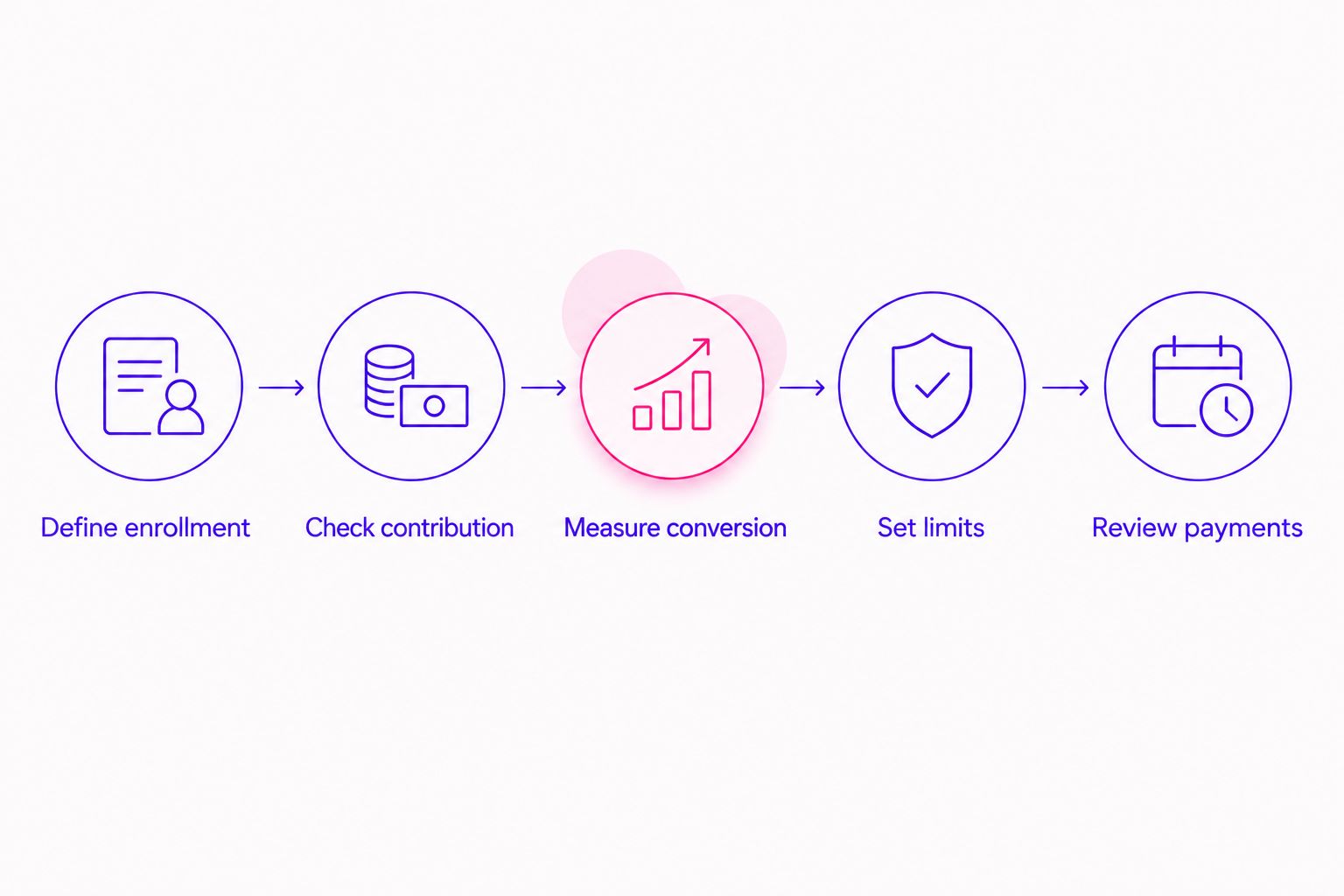
How to build your certification advertising budget
You do not need a complicated spreadsheet to begin. You need clear definitions and a record of what happens between the ad and the payment.
- Define enrollment. Decide whether your primary result is a paid deposit, a completed payment, or another clearly recorded enrollment event. Track applications separately.
- Check contribution. Calculate what each enrollment contributes after the costs associated with delivering the program. Leave room for the business to operate.
- Measure conversion. Record how many leads become paid students. A lead is someone who expresses interest; a conversion is the specific action you are measuring.
- Set limits. Establish an advertising ceiling per enrollment and a total spending limit that your cash flow can support.
- Review payments. Compare campaign spending with payment records, refunds, and the student cohort that actually enrolled.
Keep assumptions separate from measured results in your 2026 budget. Label an estimated conversion rate as an estimate, and replace it when you have comparable enrollment data. That makes your plan useful without making it look more certain than it is.
Connect lead costs to enrollment costs
Cost per lead means advertising spend divided by the number of leads generated. Advertising cost per enrollment means advertising spend divided by paid enrollments. They answer different questions.
To connect them, divide cost per lead by the lead-to-enrollment conversion rate, expressed as a decimal. This calculates advertising cost per enrollment for the same group of leads and the same spending period.
Use matching records. Comparing this week's leads with payments from an earlier launch mixes different groups of people and produces a misleading result. Keep following each lead group until its enrollment window has closed.
Direct enrollment campaigns
Best for: programs whose prospective students can make an informed decision from the enrollment page. A direct enrollment campaign sends people toward the program information and checkout without requiring an application or sales conversation.
The advantage is a shorter path to a measurable payment. The limitation is that your page must answer the questions needed to make that decision. Explain the curriculum, prerequisites, teaching format, assessment requirements, and what the certificate represents.
Judge spending against paid enrollments and retained revenue. Page visits and checkout starts help you understand the path, but neither is an enrolled student.
Application-led enrollment campaigns
Best for: programs that need to assess student suitability before accepting enrollment. An application-led campaign sends prospective students through an application and, when relevant, an enrollment conversation.
This path gives you a place to assess fit and answer individual questions. It also adds work between advertising and payment. Include application review and sales follow-up in the acquisition budget.
Track submitted applications, suitable applicants, completed conversations, and paid enrollments separately. A campaign that produces applications has not yet demonstrated an acceptable cost per student.
Webinar-led enrollment campaigns
Best for: programs that need an educational introduction before an enrollment decision. A webinar-led campaign invites prospective students to learn about the subject, teaching approach, and program before considering enrollment.
The advantage is space to explain the offer. The limitation is the additional work involved in producing the presentation, encouraging attendance, and following up. Registration is an intermediate result, not the final measure of success.
| Enrollment path | Best for | Main advantage | Main limitation | Budget against |
|---|---|---|---|---|
| Direct enrollment | A decision supported by a clear enrollment page | Shorter route to payment | The page must answer decision-making questions | Paid enrollments |
| Application-led | Programs requiring suitability checks | Individual qualification | Review and conversation workload | Suitable applicants who enroll |
| Webinar-led | Offers needing an educational introduction | Space to explain the program | Presentation and follow-up workload | Registrants who become paid students |
Choose the enrollment path your program needs, then budget for the whole path. Comparing registration costs with application costs does not tell you which approach acquires students more efficiently.
Why certification advertising costs vary
A useful 2026 budget reflects your program rather than borrowing another advertiser's headline result. These factors belong in the calculation:
- Enrollment requirements. Prerequisites and suitability checks determine who qualifies and what happens before payment.
- Decision support. Curriculum details, assessment information, and clear certification claims help prospective students evaluate the offer.
- Enrollment path. Direct checkout, applications, and webinars create different production and follow-up tasks.
- Revenue collection. Installments and refunds affect the money available to fund advertising and delivery.
- Delivery obligations. Teaching, assessment, and student support determine how much acquisition spending the business can sustain.
- Measurement quality. Incomplete or duplicated payment records distort the cost you report per enrollment.
None of these factors justifies an automatic spending increase. Use them to identify what needs attention before you change the budget.
If students submit suitable applications but do not enroll, examine the enrollment conversation and follow-up. If they enroll but the campaign leaves insufficient contribution, examine the full acquisition and delivery costs. Different problems need different responses.
How much should I spend before I have enrollment data?
Set a test budget you can afford to spend without depending on immediate sales to cover teaching commitments. Define what the test must establish: whether suitable prospects enter the enrollment process and whether that process produces paid students.
Do not treat an early cost per lead as proof of an affordable cost per enrollment. Keep the spending boundary in place while you assess the full path. Increase spending only when the payment records and delivery capacity support that decision.
Should I manage certification ads myself or get support?
Manage the campaigns yourself when you can give campaign work, creative production, tracking, and enrollment follow-up consistent attention. The benefit is direct control; the limitation is the time those responsibilities take from teaching and program operations.
ZIVA Marketing is best suited to spiritual teachers, healers, and coaches seeking paid social advertising and marketing coaching. At ZIVA Marketing, we support those business owners as they grow online courses and programs. External support still belongs in the acquisition budget; it does not replace a clear offer or accurate payment records.
Is ROAS enough to judge a certification campaign?
ROAS means return on ad spend: revenue attributed to advertising divided by advertising spend. It describes the relationship between those figures, not the profit remaining after management, sales, and delivery expenses.
For a 2026 review, read ROAS alongside acquisition cost, collected revenue, refunds, and contribution. Also check how each report assigns credit for a sale. An advertising report and a payment record answer different questions, so reconcile them rather than treating either as the whole picture.
FAQ
How much does it cost to run Meta ads for a certification program?
Calculate planned Meta ad spend by multiplying your target paid enrollments by your planned advertising cost per enrollment. Add campaign management, creative production, tracking, and enrollment follow-up when calculating the full acquisition budget.
What should my daily Meta ads budget be?
Set your daily budget within a total campaign spending limit supported by your enrollment economics and cash flow. A daily spending setting controls expenditure; it does not establish profitability.
Is a low cost per lead a good sign for certification ads?
A low cost per lead is useful only when those leads become suitable, paying students at an acceptable acquisition cost. Track each lead group through enrollment before judging its value.
Should I advertise a webinar or send people straight to enrollment?
Use the path that provides the information and qualification your students need before enrolling. Direct enrollment shortens the path, while a webinar creates space for education and adds production and follow-up work.
Do Meta advertising costs include agency support?
Meta advertising spend and agency support are separate budget items. ZIVA Marketing provides paid social advertising and marketing coaching; confirm the scope of support before calculating your full acquisition cost.
How do payment plans affect my advertising budget?
Payment plans separate enrollment commitments from cash collected. Track received payments and future scheduled payments separately so your advertising budget does not depend on cash that has not arrived.
When should I increase my certification program ad budget?
Increase spending when paid enrollment results support the acquisition cost and your program can serve additional students. Check collected revenue, refunds, follow-up capacity, and delivery commitments before changing the limit.
One last thing
An application, a webinar registration, and an enrollment are different outcomes. Before launching your 2026 certification campaign, write the exact result you will count as success at the top of your budget sheet.
Then put the spending ceiling beside it. Those definitions give you a calmer, clearer basis for deciding what to continue, what to improve, and when to expand.