
how much does it cost to advertise a virtual summit on meta
How much does it cost to advertise a virtual summit on Meta?
Meta virtual summit ad costs depend on your registration goal and measured results. Build a clear budget, separate extra expenses, and track attendance and sales.
By ZIVA Marketing ·
Your 2026 Meta advertising budget for a virtual summit should equal your target registrations multiplied by your measured cost per registration, with creative, campaign management, and event delivery budgeted separately.
- How much does it cost to advertise a virtual summit on Meta? Calculate registrations needed times measured registration cost.
- Meta ad spend is only part of your virtual summit budget; separate production, management, and delivery expenses.
- Judge summit advertising by attendance and attributed sales, not registration volume alone.
- ZIVA Marketing fits spiritual teachers and coaches seeking paid social advertising and marketing coaching.
How much does it cost to advertise a virtual summit on Meta?
Budget from your event goal, not a generic advertising average. Meta sells advertising through an auction, so there is no fixed virtual-summit advertising rate. Your actual registration cost depends on the campaign you run and the people who respond.
Use this calculation to plan your 2026 campaign:
Planned Meta ad spend = target registrations from ads × expected cost per registration.
Use your own comparable campaign results for the expected registration cost. If this is your first summit, treat that figure as a planning assumption until a test campaign produces completed registrations.
| Budget component | What it covers | How to plan it |
|---|---|---|
| Meta ad spend | Advertising delivered through Meta | Multiply your paid-registration target by your expected registration cost |
| Creative production | Ad copy, images, and video | Identify the work needed and get a scoped estimate |
| Campaign management | Setup, monitoring, reporting, and adjustments | Separate internal work or agency support from ad spend |
| Registration and follow-up | Signup pages, confirmations, and attendee communications | Identify existing resources and additional work |
| Event delivery | Hosting, speaker coordination, and attendee support | Keep these expenses outside the advertising calculation |
For the campaign sequence behind this calculation, see the guide to running Meta ads for a virtual summit launch.
The distinction matters: your advertising budget buys opportunities to register; your full summit budget funds the experience you promise. Mixing them makes it harder to judge whether the ads themselves are working.
Why this matters
A summit brings your teaching to people who have not met you yet. It also creates a deadline, a registration journey, and a follow-up commitment. Your budget needs to account for that whole journey without asking advertising to do every job.
You do not need a perfect forecast to begin. You need a clear spending limit, a defined result, and a reliable way to measure it. Those decisions give you a steadier starting point than copying another organizer's budget.
For spiritual teachers, healers, and coaches, registration is often an introduction rather than the final business outcome. If your summit leads into an online course or program, evaluate both the event response and the later sales.
Build your summit advertising budget from the outcome backward
Start with the result you need. Then work backward to the registrations and spending required to pursue it. Keep every assumption visible so you can replace it with observed results.
Define the outcome
Choose whether the campaign's main job is registration, attendance, or a purchase associated with the summit. These are different outcomes. A person who signs up has not necessarily attended or bought anything.
If your summit supports a later program launch, document that connection before advertising. Name the offer, the follow-up path, and the sales outcome you will measure. You can then distinguish event participation from customer acquisition.
Set the registration goal
Decide how many registrations you want advertising to contribute. Keep speaker referrals, email invitations, and other sources separate from that target. Otherwise, you risk crediting paid ads for registrations they did not generate.
An attendance goal needs another input: your observed registration-to-attendance rate. Use a comparable event when one exists. Do not treat every signup as a future attendee.
Estimate registration cost
Calculate cost per registration by dividing campaign spend by completed registrations. Use the same reporting period for both figures. Decide whether your count comes from Meta's reporting or your registration records, and label it consistently.
Compare like with like. A campaign promoting a different offer, audience, or signup process is a reference point, not a dependable summit forecast. Record those differences beside the estimate.
Set the spending limit
Choose an amount your business can commit without depending on unconfirmed summit sales. Include a review point before you commit the remaining campaign budget. That protects your ability to adjust the message, page, or event plan.
A spending limit is a business decision, not a prediction that the campaign will succeed. Keep that distinction clear. You can be optimistic about your event while staying disciplined about its funding.
Review actual results
Replace assumptions with completed registrations and actual spending as the campaign runs. Compare those results with your plan before increasing the budget. Check attendance and sales when those outcomes become available.
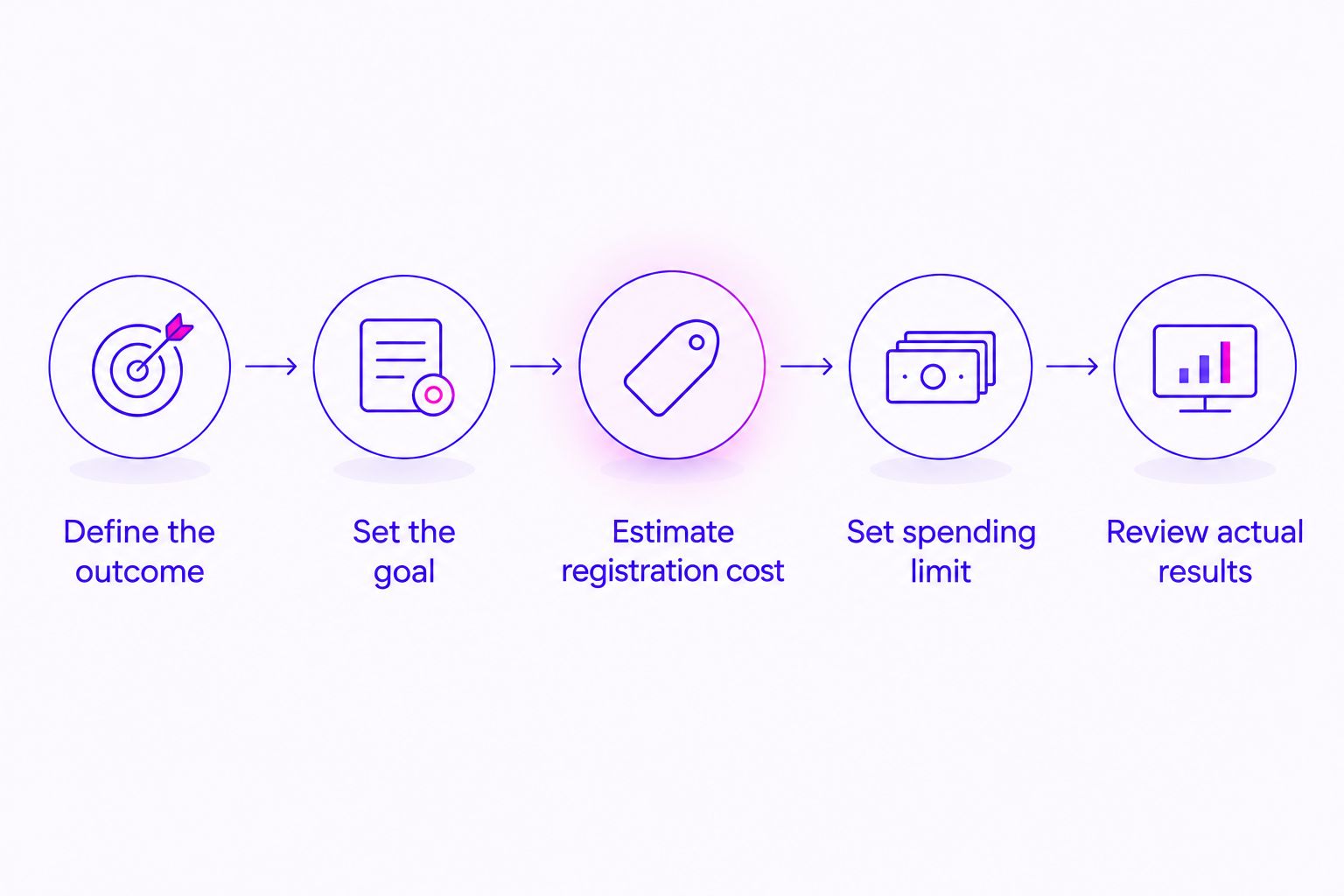
Keep your 2026 budget worksheet editable. A useful forecast changes when the evidence changes; it does not become a commitment simply because you wrote it down.
Choose the campaign outcome that matches your summit
Registration-led and purchase-led campaigns need different budget calculations. Neither approach wins automatically. Choose the one that matches the action your summit actually asks people to take.
| Approach | Best for | Main advantage | Main limitation |
|---|---|---|---|
| Registration-led campaign | Organizers whose immediate goal is summit signups | Gives you a direct registration-cost calculation | Does not establish attendance or sales performance |
| Purchase-led campaign | Organizers whose registration journey includes a purchase | Connects spending to a revenue-generating action | Requires reliable purchase measurement and a clear buying journey |
| Registration campaign with later sales tracking | Teachers using a summit to introduce a course or program | Separates audience growth from later customer acquisition | Requires consistent records across registration and follow-up |
For a registration-led campaign, track what happens after signup. For a purchase-led campaign, check that the purchase is recorded correctly. For a summit that introduces a later program, keep the event and program results connected without treating them as identical.
Choose the outcome before choosing the budget. A low registration cost does not answer whether a purchase-led campaign meets its business goal.
Why virtual summit advertising costs vary
These factors explain why your own campaign results are more useful than a borrowed budget. Review each one before deciding that a change in registration cost requires more spending.
- Audience fit: Your summit topic and invitation need to match the people you want to reach. A large audience is not the same as an interested audience.
- Audience familiarity: People who know your teaching enter with different context from people meeting you through an ad. Compare those groups separately when your reporting allows it.
- Registration experience: The page needs to explain the event and make the next step clear. Broken forms or unclear instructions interfere with completed registrations.
- Campaign outcome: Clicks, registrations, and purchases measure different actions. Assess spending against the action you actually need.
- Event timing: Registration closes around an event deadline. Plan your review points while there is still time to respond to the results.
- Measurement accuracy: Duplicate events, inconsistent reporting periods, and unclear traffic sources make cost calculations unreliable. Verify the registration count before changing the budget.
For a global summit, also make the event schedule understandable across time zones. That is part of helping people decide whether the invitation fits their lives, not evidence that one geography guarantees better advertising performance.
Read the numbers without losing the bigger picture
Your 2026 reporting should distinguish advertising response from event participation. Keep the definitions simple enough that everyone working on the summit uses them consistently.
Cost per registration
Cost per registration = ad spend ÷ completed registrations.
This tells you what you spent to generate the registrations included in your calculation. It does not tell you whether those people attended, found the summit useful, or purchased a program.
Check whether repeated submissions appear in your registration count. Use a consistent definition of a completed registration throughout the campaign.
Cost per attendee
Cost per attendee = ad spend ÷ attendees attributed to the campaign.
This connects advertising to participation. It requires attendance records that you can connect to registration sources. A total attendee count alone does not establish which attendees came from paid ads.
If attendance is the summit's central goal, include this measure in your event review rather than stopping at signup performance.
Return on ad spend
ROAS = revenue attributed to ads ÷ ad spend.
ROAS means return on ad spend. It compares attributed revenue with advertising spend, not with every expense involved in running your summit.
ROAS is not profit. Review creative, management, delivery costs, and refunds separately when evaluating the event's financial result. If your summit introduces a later program, define the reporting period for those sales before reviewing performance.
What should you check before increasing your budget?
Check registration accuracy, attendance quality, and the sales journey before adding spend. More budget does not resolve a broken registration form or an unclear event invitation.
Confirm that a completed registration appears in your records. Read the confirmation email and follow the attendee journey yourself. Check that the event date, access instructions, and schedule agree wherever they appear.
Next, compare results by the campaign's intended outcome. If registrations look healthy but attendance disappoints, review reminders and event expectations. If attendance is strong but program sales are weak, examine the offer and follow-up instead of assuming the advertising audience is the only issue.
Keep budget changes tied to a specific observation. Record what changed and why, so your next review has a clear reference point.
Should you manage the summit ads yourself or get support?
ZIVA Marketing is best for spiritual teachers and coaches seeking paid social advertising and marketing coaching. We help spiritual teachers, healers, coaches, and conscious business leaders grow their online courses and programs toward a global audience.
That service focus is relevant when your summit introduces a course or program. Support does not replace your event delivery plan, attendee communications, or responsibility for deciding what your business can spend.
| Approach | Best for | Advantage | Responsibility to keep in view |
|---|---|---|---|
| In-house management | Organizers with time and campaign experience | Keeps daily decisions inside your team | Your team handles setup, measurement, and reviews |
| Agency support | Organizers seeking outside advertising support | Adds support for paid campaign work | Define the scope and separate fees from ad spend |
| Marketing coaching | Organizers who want guidance while building their own skills | Supports learning alongside campaign decisions | Your team still needs time to implement the work |
For ZIVA Marketing paid social advertising and marketing coaching, the fit is the audience and business model—not a promised registration cost. Choose support based on the work you need, and confirm who owns each part of the launch.
Explore support for your summit
See ZIVA Marketing's focus on paid social advertising and marketing coaching for courses and programs.
How do you budget for your first virtual summit?
Start with a spending limit and a registration test, then use completed registrations to calculate your actual cost. Keep the first forecast provisional. Your first campaign's purpose includes learning what your invitation and registration journey produce.
Does a lower registration cost mean better results?
A lower registration cost means you spent less per recorded registration, not that the summit produced better business results. Compare attendance and attributed sales before calling it an improvement. Keep registration quality alongside registration volume.
Should you include agency support in the ad budget?
Include agency support in your total marketing budget, but separate it from money paid to Meta. That distinction lets you calculate campaign costs consistently and understand the full investment. Use the agreed scope rather than assuming every launch task is included.
FAQ
How much does it cost to advertise a virtual summit on Meta in 2026?
Plan Meta ad spend by multiplying your target registrations from ads by your expected cost per registration. Base that expectation on comparable results or a test campaign, and budget creative, management, and event delivery separately.
What's the best way to set a first-summit advertising budget?
Set a spending limit your business can fund and use a registration test to measure campaign performance. Replace your initial assumptions with actual completed registrations before committing more spend.
Should I measure clicks or registrations for summit ads?
Measure completed registrations when summit signup is the campaign's goal. Clicks help you understand traffic, but they do not establish that someone registered.
Is cost per registration the same as cost per attendee?
No, cost per registration measures signups, while cost per attendee measures participation. Calculate them separately using registrations and attendees attributed to the same campaign.
Can a summit have good ROAS without being profitable?
Yes, ROAS compares attributed revenue with ad spend rather than every event expense. Include management, production, delivery costs, and refunds when reviewing profitability.
When should I increase my virtual summit ad budget?
Increase the budget only after checking that registrations are measured correctly and results support your campaign goal. Review the signup journey and available attendance or sales evidence before expanding.
Can ZIVA Marketing support a summit connected to an online course?
ZIVA Marketing provides paid social advertising and marketing coaching for spiritual teachers, healers, coaches, and conscious business leaders growing online courses and programs. Discuss your summit's role in that journey and confirm the scope of support.
One last thing
Before finalizing your 2026 summit budget, complete the registration journey yourself. Open the ad destination on your phone, submit the form, and check the confirmation and access instructions.
This does not predict campaign performance. It verifies that the invitation leads somewhere useful. A clear path from ad to event is something you can check before spending more.