
how much does instagram advertising cost for coaches
How much does Instagram advertising cost for coaches in 2026?
How much does Instagram advertising cost for coaches? There is no fixed rate. Build a full budget around ad spend, campaign support, and paid enrollments.
By ZIVA Marketing ·
Instagram advertising costs for coaches in 2026 depend on the ad auction, your enrollment results, and the work around the campaign—not a fixed monthly rate for coaching businesses.
- How much does Instagram advertising cost for coaches? Budget for ad spend, campaign support, creative, and follow-up.
- Meta Ads Manager reports advertising costs; your enrollment records show whether those costs support your business.
- Judge coaching ads by qualified leads and paid enrollments, not cheap clicks alone.
- ZIVA Marketing serves spiritual teachers, healers, coaches, and conscious business leaders through paid social advertising and marketing coaching.
How much does Instagram advertising cost for coaches in 2026?
Instagram advertising has no universal coaching-business rate. Meta sells ad delivery through an auction, and the result depends on competition, your campaign settings, and the ad itself. Your budget controls what you commit to advertising; it does not guarantee a particular enrollment cost.
The amount you pay Meta is only part of your marketing budget. Campaign management, ad production, landing pages, tracking, and follow-up also require money or your time. Separate those commitments before deciding what you can comfortably invest.
If you are planning a launch, start with how to structure a Meta ads budget for a course launch. A budget should connect to your offer and enrollment process, rather than sit apart from them.
| Budget component | What it covers | What to clarify before committing |
|---|---|---|
| Ad spend | Delivery of your Instagram advertisements | Campaign budget, schedule, and spending controls |
| Campaign support | Planning, setup, monitoring, and adjustments | Who owns each task and what the agreement includes |
| Creative production | Ad videos, images, and copy | Who supplies assets and handles revisions |
| Conversion setup | Landing pages, forms, checkout, and tracking | Which steps already work and which need attention |
| Follow-up | Email, applications, discovery calls, and enrollment support | Who responds and how outcomes are recorded |
Do not treat every row as a new purchase. You might already have the tools and skills for several tasks. The point is to identify the work, then decide who will handle it.
Why this matters
It is understandable to want a simple number before you start. Advertising feels easier to approach when you know the commitment. But a monthly spending figure alone cannot tell you whether the campaign makes business sense.
A coaching offer needs more than attention. Someone must understand your work, recognize a fit, and take the next step. Your budget needs to support that whole experience.
For your 2026 plan, distinguish advertising performance from business performance. An inexpensive lead is an advertising result; a suitable client who enrolls is a business result. Use both, but let enrollment economics guide the decision.
Separate delivery costs from enrollment costs
Instagram reports several ways to describe campaign cost. Each answers a different question. None replaces the others.
| Measurement | What the number means | Useful for | What it leaves out |
|---|---|---|---|
| Cost per thousand impressions | Ad spend per 1,000 ad displays | Comparing delivery costs | Whether anyone becomes a client |
| Cost per click | Ad spend per 1 click, using the selected click metric | Reviewing response to an ad | Lead quality and enrollment |
| Cost per qualified lead | Ad spend per 1 lead meeting your stated criteria | Reviewing relevant interest | Whether that lead buys |
| Cost per enrollment | Ad spend per 1 paid enrollment | Assessing acquisition performance | Non-ad expenses and service delivery |
Define a qualified lead before reviewing results. For a discovery-call offer, that might mean an applicant whose goals match your program and who understands the commitment. Use criteria that relate to the offer, not a vague impression of enthusiasm.
Also distinguish link clicks from broader click activity when reading reports. Choose the measurement that matches the action you are evaluating. A reassuring-looking number is not useful if it describes the wrong behavior.
Choose the enrollment route before setting the budget
Your enrollment route shapes what you need to measure. A self-paced course, a webinar-led program, and a coaching application do not ask the audience to make the same decision.
Choose the route that fits how your offer is sold. Adding steps without a clear purpose creates more work for you and the reader.
| Enrollment route | Best for | Advantage | Limitation |
|---|---|---|---|
| Direct purchase | An offer explained fully on a sales page | Connects ad response directly to checkout | The page must answer questions without a conversation |
| Webinar registration | An offer that benefits from teaching before enrollment | Gives prospective students a structured introduction | Registrations still need to become attendance and sales |
| Application or discovery call | Coaching that requires a fit conversation | Lets you assess needs before enrollment | Requires scheduling, follow-up, and sales capacity |
Match the campaign goal to the next meaningful action. If your route depends on applications, evaluate applications and their quality. If it depends on purchases, follow the path through checkout.
Do not judge a webinar campaign only by registration cost. Review attendance and enrollment too. Otherwise, you are measuring the doorway without checking who reaches the program.
Build your 2026 budget from your own business economics
Your own records provide a better starting point than an unrelated advertiser's average. Use collected revenue, delivery expenses, and previous enrollment outcomes where you have them. Keep projections separate from completed sales.
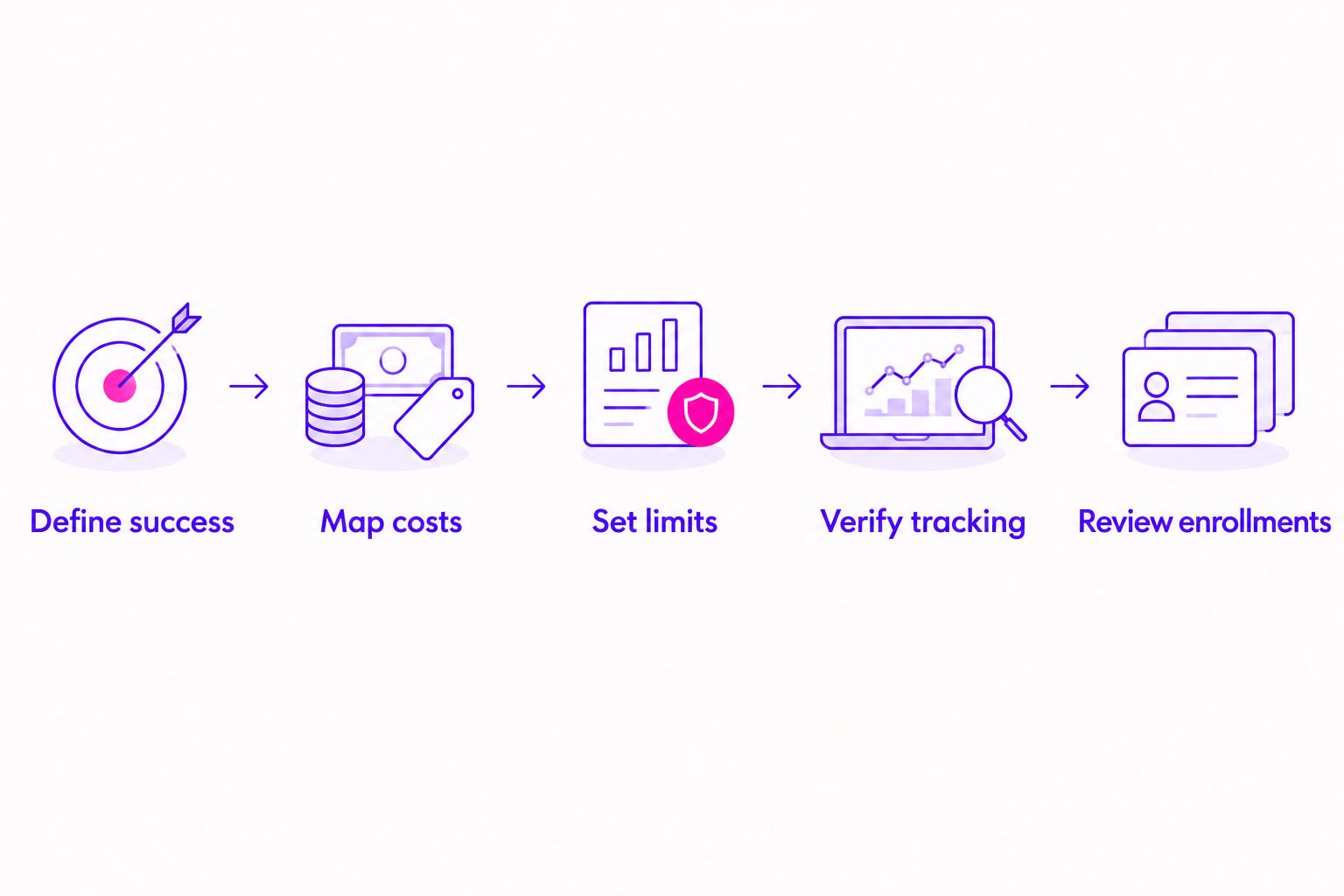
Define success
Name the offer and the outcome you want the campaign to support. Be specific about whether that outcome is a qualified application, a webinar registration, or a paid enrollment.
Then identify the final business result. A registration can be the immediate campaign goal without becoming the definition of profitability.
Map costs
List the expenses involved in acquiring and serving a client. Include advertising, campaign support, payment processing, and the work required to deliver your program.
Keep recurring business expenses visible without assigning unrelated costs to a single campaign. You need a useful decision model, not an accounting puzzle.
Set limits
Choose an advertising commitment your business can sustain without depending on immediate sales. Agree on the conditions for continuing, adjusting, or pausing before the campaign begins.
A spending limit protects cash. It does not prove that a campaign has received enough evidence to answer every performance question.
Verify tracking
Check that forms, booking steps, and purchases record the intended actions. Confirm that a test submission reaches the right destination and that payment records remain accessible.
Tracking is the connection between the campaign and your business records. Treat setup as part of the plan, not a task to postpone until results look confusing.
Review enrollments
Compare advertising results with completed enrollments. Look at lead quality and follow-up before deciding that the ad itself needs to change.
Record what changed between reviews. That gives you a clearer basis for the next decision than memory alone.
Why Instagram advertising costs vary
The same budget does not buy the same outcome for every coach. Meta's auction affects delivery, while your offer and enrollment process affect what happens afterward.
These factors belong in a cost review:
- Auction competition: Other advertisers compete for delivery opportunities. Your chosen audience and schedule influence the auctions your ads enter.
- Campaign objective: Asking Meta to find people likely to click is different from asking it to find people likely to purchase. Compare campaigns with their goals in view.
- Audience relevance: Your message needs to reach people whose interests and needs match the offer. Reach alone does not establish fit.
- Creative clarity: The ad should explain the offer and the next step. Attractive imagery cannot replace a clear invitation.
- Enrollment experience: The landing page, application, checkout, and follow-up all affect the path from interest to enrollment.
- Tracking accuracy: Incomplete or duplicated records distort reported results. Check the measurement before making spending decisions from it.
For your 2026 review, separate a delivery problem from an enrollment problem. Rising delivery costs and weak application quality require different investigations. Changing everything at once makes the cause harder to identify.
Decide what to handle yourself and what to get help with
You do not need to outsource every task to advertise. You do need someone responsible for the campaign and the steps around it.
Choose support based on the work you want to own, not only the invoice. Your time is part of the commitment even when it does not appear in the advertising account.
| Support approach | Best for | Advantage | Limitation |
|---|---|---|---|
| Self-managed advertising | Coaches who want to own setup and ongoing decisions | Direct control over the campaign | Requires time to learn, monitor, and troubleshoot |
| Marketing coaching | Business owners who want guidance while retaining execution | Supports learning and decision-making | You still need capacity to carry out the work |
| Agency support | Business owners seeking outside campaign support | Places agreed campaign tasks with a specialist team | Requires a clear scope, communication, and client input |
ZIVA Marketing is best for spiritual teachers, healers, and coaches seeking paid social advertising or marketing coaching for their online programs. We help conscious business leaders reach a global audience through those services.
The practical limit is important: campaign support does not remove your responsibility for the offer, program delivery, or client experience. Before engaging ZIVA Marketing, clarify which tasks belong to each side and how enrollment outcomes will be shared.
What should I include in my monthly Instagram advertising budget?
Include ad spend and the resources needed to create, manage, measure, and follow up on the campaign. Keep the advertising commitment separate from the rest of your operating budget.
Ask any service provider what the agreement includes, what you must supply, and which expenses sit outside the scope. Clear responsibilities make the full commitment easier to understand.
Is a low cost per lead a good result for a coach?
A low cost per lead is useful only when those leads are relevant to your offer. Check whether they understand the program, complete the next step, and become suitable clients.
Cheap inquiries that need extensive follow-up can still create a demanding enrollment process. Judge lead cost alongside lead quality and paid enrollment.
Should I increase my Instagram budget when ROAS improves?
Improved ROAS is a reason to investigate, not an automatic instruction to spend more. ROAS means return on ad spend: attributed revenue divided by advertising spend.
Confirm tracking, collected revenue, refunds, delivery costs, and capacity before increasing the commitment. Strong advertising returns and a sustainable coaching business are related, but they are not identical.
Use a clear review before changing the campaign
In your 2026 campaign reviews, start with the business outcome and work backward. Did people enroll? If not, where did the path stop?
If applications arrive but calls do not happen, review scheduling and follow-up. If calls happen but enrollment does not, examine fit, offer clarity, and the conversation. If people click but never apply, inspect the landing page and application experience.
These are investigation paths, not proof of a single cause. Use actual records to decide what deserves attention.
ZIVA Marketing provides paid social advertising and marketing coaching for this audience. If you want support with that work, explore ZIVA Marketing and decide whether the service matches the responsibilities you want help with.
FAQ
How much does Instagram advertising cost for coaches in 2026?
Instagram advertising has no fixed rate for coaches in 2026. Meta's ad auction determines delivery costs, while your enrollment results determine acquisition cost; campaign support, creative, and follow-up are separate commitments.
Can I choose how much I spend on Instagram ads?
You can set campaign budgets and use spending controls in Meta Ads Manager. Those controls manage the advertising commitment, not the number of leads or enrollments you will receive.
Do I need an agency to run Instagram ads for my coaching business?
You do not need an agency to run Instagram ads. Self-management requires time for setup, creative, tracking, monitoring, and follow-up; coaching or agency support changes who handles that work.
What is the best cost metric for coaching ads?
Cost per paid enrollment is the clearest advertising-cost metric for client acquisition. Qualified lead cost helps explain earlier progress, but it does not establish profitability on its own.
Does ROAS include all my marketing expenses?
ROAS does not include all your marketing expenses. It compares attributed revenue with ad spend, so review campaign support, creative, payment processing, and delivery costs separately.
Should I stop Instagram ads if I get clicks but no clients?
Review the enrollment path before deciding whether to stop Instagram ads. Check tracking, landing-page activity, lead quality, follow-up, and completed sales against your agreed spending limits.
Can Instagram ads reach people beyond my followers?
Instagram ads can reach people beyond your followers. Audience settings and Meta's delivery system shape that reach; reaching new people still requires a relevant offer and a clear next step.
One last thing
A booked call is not a paid enrollment, and a reported purchase is not the same as revenue after refunds. Keep those distinctions visible in your campaign reviews.
Before increasing your budget, trace a real enrollment from its recorded source through to payment. A clear connection between spending and clients is more useful than a reassuring dashboard alone.