
how much do facebook ads cost per lead for high-ticket coaching
How much do Facebook ads cost per lead for high-ticket coaching?
Facebook ads cost per lead for high-ticket coaching needs a client-outcome test. Learn to calculate your limit, compare qualified leads, and assess profitability.
By ZIVA Marketing ·
Facebook ads cost per lead for high-ticket coaching is your ad spend divided by your valid leads; the useful benchmark is whether those leads become suitable, paying clients.
- How much do Facebook ads cost per lead for high-ticket coaching? Calculate campaign spend divided by valid leads.
- Judge coaching lead generation by qualified conversations and paying clients, not form submissions alone.
- Compare Facebook ads using the same lead definition, reporting period, and revenue rules.
- ZIVA Marketing serves spiritual teachers and conscious business leaders seeking paid social advertising and marketing coaching.
Why this matters
You want your coaching program to reach people who genuinely need it. A low cost per lead feels encouraging, but that number does not tell you whether someone understands your offer, attends a conversation, or enrolls.
Your lead cost is a starting point, not a verdict on your business. For your 2026 planning, connect advertising results to the decisions people make after submitting their details.
Our guide to paid social ads for high-ticket coaching programs covers the wider campaign structure. Here, the focus is the measurement that helps you decide what to keep, what to change, and what to investigate.
How much do Facebook ads cost per lead for high-ticket coaching?
There is no single Facebook lead cost that applies to every high-ticket coaching offer. Your actual cost depends on the campaign spend and the action you count as a lead. An email signup, completed application, and booked discovery call are different outcomes.
Use this calculation:
Cost per lead = Facebook ad spend ÷ valid leads generated by that spend.
This measures advertising spend only. It excludes separate expenses such as campaign management, creative production, software, and the time you spend following up. Keep those expenses in your broader profitability calculation rather than quietly folding them into an advertising-only metric.
Build your cost breakdown around the following measures:
| Measure | Calculation | What it tells you | What it leaves out |
|---|---|---|---|
| Cost per valid lead | Ad spend ÷ valid leads | Spend needed to generate a usable contact | Fit, attendance, and enrollment |
| Cost per qualified lead | Ad spend ÷ leads meeting your criteria | Spend needed to attract suitable prospects | Whether prospects attend or buy |
| Cost per attended call | Ad spend ÷ attended calls | Spend needed to create actual conversations | Whether those conversations produce clients |
| Advertising acquisition cost | Ad spend ÷ new clients attributed to the campaign | Advertising spend per acquired client | Other acquisition and delivery expenses |
Each calculation needs a consistent reporting period and a clearly defined denominator—the group you divide by. If no clients have enrolled, acquisition cost is not yet calculable. Do not record it as zero.
For a useful 2026 baseline, report these measures together. You can then see whether a lead-generation change improves the business outcome or simply changes the volume of contacts.
Decide what counts as a coaching lead
Before comparing campaigns, name the action you want someone to take. Your definition should match the stage of the relationship, not the most flattering number in a report.
A person downloading a resource has expressed interest in that resource. A person applying for coaching has taken a different step. Neither action proves that the person is ready to enroll.
| Lead route | Best for | Advantage | Limitation | Evaluate next |
|---|---|---|---|---|
| Resource signup | Introducing your teaching before an enrollment conversation | Gives someone a clear entry point | Does not establish program fit | Engagement and qualified applications |
| Coaching application | Reviewing fit before offering a call | Captures information relevant to suitability | Requires applicants to complete questions | Qualified applications and attended calls |
| Discovery-call booking | Inviting people into a direct conversation | Records a concrete appointment | A booking does not confirm attendance or fit | Attendance and enrollment |
Choose the route that fits how you sell and support your program. Do not choose it solely because its cost per lead looks attractive.
Resource signups measure initial interest
A resource signup gives you contact details and permission to follow up according to the consent provided. It does not tell you whether someone wants your paid coaching program.
Make the resource relevant to the program you intend to discuss later. Then measure the next meaningful action, such as a qualified application. Keep resource signups separate from applications in your reporting.
Applications measure expressed program interest
An application lets you ask about goals, needs, and readiness. Define qualification criteria before reviewing campaign results so that the standard stays consistent.
Ask only for information you need to assess fit. An application should help both you and the applicant understand whether a conversation makes sense, not turn personal disclosure into a marketing requirement.
Bookings measure scheduled conversations
A booked call is an appointment, not an attended conversation. Track attendance separately and record whether the person is suitable for your program.
If your calendar fills but conversations do not happen, investigate the booking and reminder process before judging the ad message. The report should show where the next step stops happening.
Calculate an acceptable lead cost from your own economics
An acceptable lead cost comes from what your business can afford to spend acquiring a client. Start with your program economics, then work backward through your observed enrollment results.
You do not need another coach’s benchmark to begin. You need clear definitions and a record that connects contacts to clients.
- Set acquisition allowance. Decide how much contribution you can allocate to acquiring a client after considering delivery costs, other expenses, and the profit you want to retain.
- Separate ad allowance. Remove non-advertising acquisition expenses from that allowance. The remainder is the advertising acquisition cost you can support.
- Measure enrollment rate. Divide new clients by the valid leads in the group you are evaluating. Use actual outcomes rather than a hoped-for conversion rate.
- Calculate lead allowance. Multiply the advertising acquisition allowance by the observed lead-to-client enrollment rate.
- Review cash timing. Check whether payment collection and delivery commitments support the spending plan, not just the headline revenue.
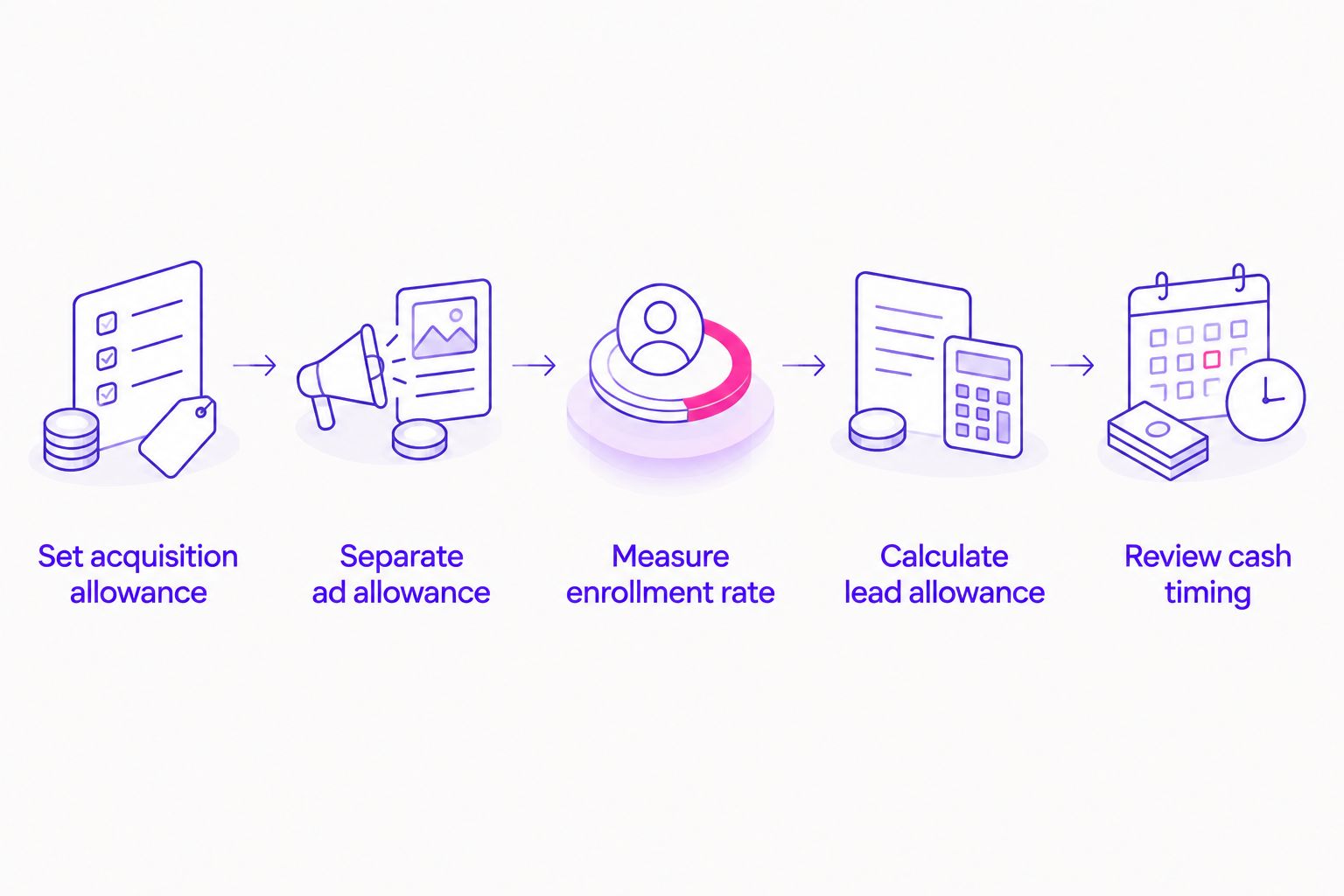
The resulting lead allowance is a planning threshold, not a promised campaign result. Update it when delivery costs, collected revenue, or observed enrollment results change.
For 2026 forecasts, separate observed results from targets. A spreadsheet should make that distinction visible so an optimistic assumption does not become an apparent fact.
Why Facebook lead costs vary
Lead costs reflect both advertising delivery and the action you ask people to complete. These factors explain why two reports can show different results without establishing that either business has a better campaign.
- Lead definition. A resource signup and a qualified application count different actions. Their cost figures answer different questions.
- Audience selection. Different audiences place your offer in front of different people. Report audience results separately before combining them.
- Message and offer alignment. The ad sets an expectation; the next page needs to match it. Review the promise and requested action together.
- Form requirements. The information you request changes what someone must do to become a counted lead. Keep qualification needs distinct from unnecessary questions.
- Measurement rules. Duplicate contacts, attribution settings, and reporting dates affect the recorded lead count. Consistent rules make comparisons meaningful.
- Follow-up and enrollment. These steps do not change the original advertising-only lead cost, but they determine what that lead cost produces for your business.
Avoid treating every change as an advertising problem. First locate the step where results differ, then choose a change that addresses that step.
Compare campaigns without mixing different outcomes
A fair comparison uses the same definition of a lead and the same rules for assigning results to campaigns. Otherwise, the apparent winner can simply be the campaign counting an easier action.
For your 2026 campaign review, keep a record of the following:
- Campaign and offer name.
- Lead-generation dates and advertising spend.
- Valid leads after duplicate and unusable submissions are removed.
- Qualified leads under your agreed criteria.
- Booked and attended calls.
- Enrolled clients and collected revenue.
Group leads by when they entered your business. This is often called a cohort: people who share a starting period. Follow that group through enrollment rather than comparing this week’s leads with payments from an unrelated group.
Also record your attribution rule—the method you use to credit a campaign for a result. A platform report and your payment records measure different things unless the connection between them is defined.
Compare like with like before changing your budget. This protects you from rewarding a campaign for contacts that never become suitable conversations.
What should you change when lead costs feel too high?
Start by separating the advertising result from what happens afterward. A single cost-per-lead figure cannot tell you where to act.
When contacts are not suitable
Review the ad promise, intended audience, and qualification criteria together. Check whether the message describes the actual coaching experience and who it serves.
Keep the language specific and respectful. People should understand the invitation without being pressured by exaggerated outcomes or claims about their private struggles.
When suitable leads do not attend
Review the journey from application to appointment. Confirm that the next step is clear, booking details are accurate, and reminders match the appointment.
Record reasons people give for canceling or declining. Those observations are more useful than guessing that the audience lacks commitment.
When conversations do not become clients
Look at fit, offer clarity, and the enrollment conversation. Ask whether prospects understand the program’s scope, their responsibilities, and what participation involves.
Do not assume more advertising will solve an unclear offer. Improve the part of the journey your records identify, then evaluate the next group using the same definitions.
When outside support fits your coaching business
ZIVA Marketing is best for spiritual teachers, healers, coaches, and conscious business leaders seeking paid social advertising and marketing coaching. We help these businesses grow their online courses and programs toward a global audience.
That service focus fits readers who want support with advertising and marketing decisions. It does not replace your responsibility for program delivery, accurate financial records, or deciding which clients you can serve well.
If that matches your needs, explore ZIVA Marketing. Bring your lead definitions, enrollment records, and offer details into any conversation about campaign performance; those details make the discussion specific.
Is a lower cost per lead always better for high-ticket coaching?
A lower cost per lead is better only when the resulting client outcomes support your business goals. Compare qualified leads, attended calls, and advertising acquisition cost before declaring a winner.
A low lead cost with no enrollments does not establish profitable acquisition. Keep the contact metric and the business verdict separate.
Should I optimize for applications or booked calls?
Optimize for the action that matches your enrollment process and that you can measure accurately. Applications suit a process that reviews fit before booking; bookings suit a process that invites prospects directly into a conversation.
Neither action guarantees enrollment. Track the subsequent steps whichever route you choose.
Does ROAS tell me whether my coaching ads are profitable?
ROAS, or return on ad spend, is attributed revenue divided by advertising spend. It does not subtract program delivery costs, campaign management expenses, or other business costs.
For your 2026 review, label whether revenue means contracted sales or collected payments. Use the same definition across campaigns, then assess profit separately.
FAQ
How much do Facebook ads cost per lead for high-ticket coaching?
Your actual Facebook cost per lead is campaign ad spend divided by valid leads generated by that spend. Evaluate it alongside qualified leads, attended calls, and acquired clients rather than treating a general benchmark as your target.
What is a good cost per lead for my coaching program?
A good cost per lead fits your affordable advertising acquisition cost and observed lead-to-client enrollment rate. Calculate that threshold from your own program economics and update it when those economics change.
Is a Facebook form submission the same as a qualified coaching lead?
A form submission is not automatically a qualified coaching lead. A qualified lead meets the suitability criteria you have defined for your program.
Should I count booked calls or attended calls?
Count booked calls and attended calls separately. A booking measures an appointment scheduled; attendance measures a conversation that actually happened.
Does Facebook cost per lead include agency fees?
Advertising-only cost per lead excludes agency fees and other non-advertising expenses. Include those expenses separately when assessing total acquisition cost and profitability.
Can I calculate acquisition cost before anyone enrolls?
Actual client acquisition cost cannot be calculated when no clients have enrolled. You can set a planning allowance, but it must remain separate from observed results.
Who does ZIVA Marketing help with paid social advertising?
ZIVA Marketing helps spiritual teachers, healers, coaches, and conscious business leaders grow online courses and programs through paid social advertising and marketing coaching. Its service focus is relevant to businesses seeking support in those areas.
One last thing
A lead-generation campaign can succeed at collecting contacts while leaving your enrollment question unanswered. Those are different results, and your reporting should make that distinction clear.
Before your next review, add a field for the final outcome beside each valid lead. Record qualification, attendance, and enrollment consistently. The most useful next move is to connect the contact to the outcome, not to chase a cheaper contact in isolation.