
how many leads should a coach expect from paid social ads
How many leads should a coach expect from paid social ads?
How many leads should a coach expect from paid social ads? Use measured cost per lead to forecast volume, assess inquiry quality, and plan enrollments in 2026.
By ZIVA Marketing ·
A coach should forecast leads from paid social ads by dividing the planned advertising spend by a measured cost per lead, rather than treating a generic benchmark as a promise for 2026. That forecast counts inquiries, not qualified conversations or enrolled clients; you need separate measures for those outcomes.
- How many leads should a coach expect from paid social ads? Forecast from measured cost per lead, not generic promises.
- ZIVA Marketing serves spiritual teachers and coaches seeking paid social advertising and marketing coaching for online programs.
- Count unique leads, qualified inquiries, and enrollments separately; each answers a different business question.
- Use comparable campaign results to build your forecast, then check whether those leads become clients.
Why this matters
You want your advertising to support your work, not create another number to worry about. A lead target helps you plan follow-up and enrollment, but only when everyone agrees on what a lead means.
A registration is not an enrollment, and an inquiry is not a booked conversation. Keep those distinctions visible before judging a campaign.
ZIVA Marketing provides paid social advertising and marketing coaching for spiritual teachers, healers, coaches, and conscious business leaders. That context matters: your advertising needs to connect interest in your teaching with a clear next step toward your program.
How many leads should a coach expect from paid social ads?
Your expected lead count is a calculation, not a universal monthly quota:
Expected leads = planned advertising spend ÷ measured cost per lead.
Cost per lead means the advertising spend divided by the leads counted during the same reporting period. Use the same currency and lead definition throughout the calculation. Otherwise, the forecast combines numbers that do not describe the same result.
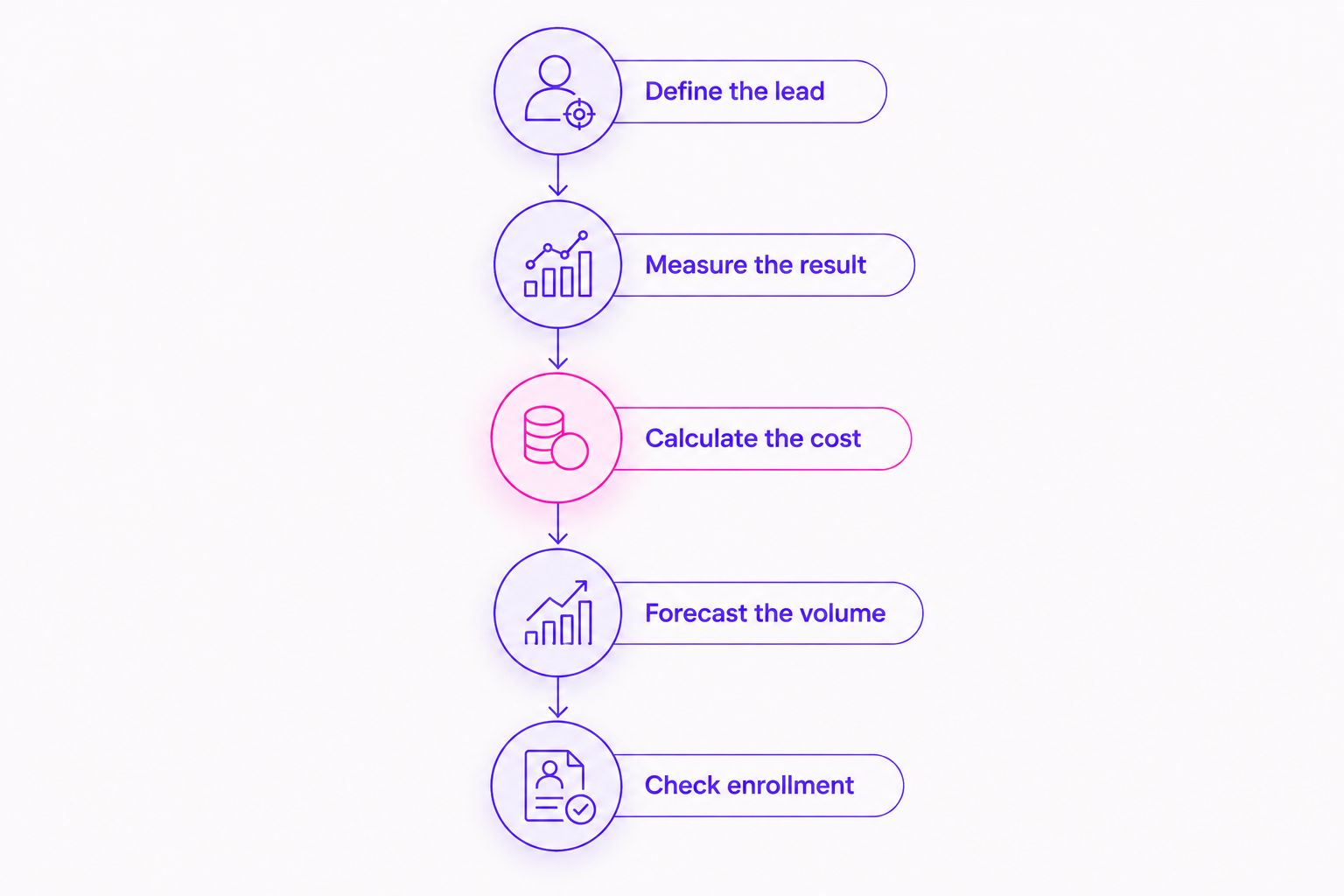
Build your 2026 forecast in this order:
- Define the lead. Choose the exact action you will count, such as a completed registration or submitted application.
- Measure the result. Record advertising spend and unique leads over the same period.
- Calculate the cost. Divide that spend by the lead count to establish your measured cost per lead.
- Forecast the volume. Divide your planned spend by that measured cost per lead.
- Check enrollment. Review how those leads progress toward the outcome your business needs.
This calculation requires completed campaign results. Before your first campaign produces leads, any assumed cost per lead is a planning assumption, not measured evidence. Label it that way, and replace it when you have usable results.
The formula also assumes that the measured cost per lead remains applicable to the planned campaign. Changing the offer, audience, or lead action changes what you are forecasting. Carry the context with the number.
Choose the lead action before setting your target
A useful lead target names the action behind the count. You cannot compare an email signup with a coaching application as though both represent the same commitment.
Choose the action that fits your enrollment process. Then keep the definition stable when you compare campaign results.
| Lead action | Best for | What the action confirms | Strength | Limitation |
|---|---|---|---|---|
| Email signup | Building permission-based follow-up | Someone submitted contact details | Gives you a contact for further communication | Does not confirm interest in joining your program |
| Webinar registration | Inviting people to an educational event | Someone registered for the event | Connects the inquiry to a specific teaching topic | Does not confirm attendance or enrollment |
| Coaching application | Gathering information before a conversation | Someone completed your application | Provides the answers your application requests | Submission alone does not establish suitability |
| Discovery-call booking | Planning enrollment conversations | Someone selected an appointment | Gives you a scheduled next step | Does not confirm attendance or a decision to enroll |
Match the target to the next step you can actually support. If your enrollment process begins with an application, reporting only email signups leaves the most relevant action unmeasured.
For programs that use an application or conversation before enrollment, the guide to paid social ads for high-ticket coaching programs provides a related starting point.
You can track several actions without combining them into a single total. Keep registrations, applications, bookings, and enrollments in separate columns so each number retains its meaning.
Separate lead volume from lead quality
Lead volume tells you how many people completed the action you chose. Lead quality tells you whether those people meet your stated criteria for the program. Neither number replaces the other.
Write your qualification criteria before reviewing applications. For a coaching program, those criteria should reflect whom the program serves, what support it provides, and what participation requires. Avoid changing the definition simply because a campaign delivers more or fewer inquiries than you hoped.
Track the following stages separately:
- Unique leads: Distinct people who completed your chosen lead action.
- Qualified inquiries: Leads who meet your documented suitability criteria.
- Booked conversations: Leads who scheduled the next step.
- Attended conversations: People who actually joined the scheduled conversation.
- Enrollments: People whose enrollment is confirmed in your business records.
Some programs do not use conversations. If people enroll directly, remove the booking and attendance stages rather than adding unnecessary steps.
A lead forecast becomes more useful when you connect it to these outcomes. You can then answer whether the campaign generated interest, suitable inquiries, or clients—not just whether the form received submissions.
Why expected lead volume varies
The lead formula is simple. The choices behind it need clear boundaries, especially when you compare campaigns or prepare a new forecast.
These factors determine what your estimate represents:
- Planned advertising spend: The amount used as the numerator in your forecast directly affects the calculated lead count.
- Measured cost per lead: The denominator determines how much forecast volume the same planned spend produces.
- Lead definition: A signup, application, and booking are different actions; changing the action changes the measure.
- Reporting period: Spend and leads must cover the same dates, and comparisons need clearly stated periods.
- Duplicate handling: Repeated submissions from the same person differ from new people entering your enrollment process.
- Campaign comparability: Results from a different offer or lead action do not establish the cost per lead for your planned campaign.
Keep the measurement rules steady before interpreting a change in results. A larger reported total is not evidence of more unique inquiries if the counting method also changed.
For your 2026 plan, save the lead definition, reporting dates, and campaign context beside each forecast. That short note makes the number understandable when you revisit it later.
Build a forecast you can explain
A useful forecast shows its working without burying you in a spreadsheet. Keep the inputs visible so you can update the estimate when actual results differ.
Start with your planned spend, chosen lead action, and measured cost per lead. Add the dates and campaign context behind that measurement. These are the foundations of the estimate, not footnotes.
When comparable reporting periods have different costs per lead, calculate a separate forecast from each observed result. This gives you scenarios grounded in your own records without presenting the most favorable period as a guarantee.
Label the scenarios by their source, such as the campaign or reporting period. Avoid calling a scenario “expected” merely because it sits between the others. An average also needs a defined method and comparable inputs.
To calculate an overall cost per lead across comparable periods, divide their combined advertising spend by their combined lead count. Do not simply average the individual cost-per-lead figures when the periods contain different numbers of leads.
A forecast should show what the calculation assumes, not hide uncertainty behind a precise-looking total. Round the final lead estimate to a whole person and retain the original inputs in your records.
Connect your lead target to your enrollment goal
Your business needs an enrollment plan as well as a lead forecast. Start with the number of enrollments you want to support, then use your measured lead-to-enrollment rate to calculate the required leads.
Required leads = enrollment goal ÷ measured lead-to-enrollment rate.
Lead-to-enrollment rate means confirmed enrollments divided by the leads in the group you are measuring. Express that rate as a decimal when using the formula. Match the enrollments to the same group of leads rather than dividing unrelated monthly totals.
Allow those leads to complete your actual enrollment process before treating the rate as settled. A recent inquiry that is still considering the program is different from an inquiry whose enrollment window has closed.
Next, compare required leads with the advertising forecast. If the forecast does not support the enrollment goal, identify the gap rather than asking the campaign to meet an unsupported target.
That gap gives you a planning conversation: review the advertising allocation, the enrollment goal, and the measured conversion steps. Do not assume that increasing spend will preserve the same results without checking subsequent performance.
Review the campaign without judging yourself by the count
A campaign result is information about a marketing process. It is not a verdict on your ability to teach, coach, or help people.
Read the stages in order. Confirm that the lead action is recorded correctly, check whether the contacts meet your criteria, and review what happens during follow-up. This keeps the next decision tied to the part of the process you can observe.
If applications arrive but conversations do not get booked, review the invitation and booking process. If conversations happen but enrollments do not, review the fit between the program, the applicant, and the enrollment conversation. Neither pattern, by itself, proves that the advertisement is the cause.
Keep your 2026 reporting focused on decisions. Record the observed result, the question it raises, and the change you intend to evaluate. That is more useful than collecting metrics without a purpose.
When does outside support fit?
ZIVA Marketing is best suited to spiritual teachers and coaches seeking paid social advertising and marketing coaching for online programs. We help those businesses grow their courses and programs toward a global audience.
The fit is specific: ZIVA Marketing offers paid social advertising and marketing coaching, not a software product. Outside support also does not remove your role in defining program suitability, confirming enrollments, or delivering the experience you advertise.
Before choosing support, explain your offer, enrollment process, and current measurement. Ask how the proposed work will connect advertising results with the business outcomes you track.
Explore support for your coaching program
Learn about paid social advertising and marketing coaching for spiritual teachers and conscious businesses.
How many leads do I need to enroll my coaching clients?
Required leads equal your enrollment goal divided by your measured lead-to-enrollment rate. Use a rate from a comparable group whose enrollment process has had time to finish, rather than assuming every inquiry becomes a client.
Should I expect more leads when I increase advertising spend?
The forecast produces more leads when planned spend increases and cost per lead stays unchanged. That is a mathematical assumption, not a promise that the campaign will maintain its previous performance.
What should I expect before my first campaign has results?
Before your first campaign has results, treat the lead estimate as an assumption to evaluate. Define the lead action and enrollment outcome first so the campaign produces information you can use in your next forecast.
FAQ
How many leads should a coach expect from paid social ads in 2026?
A coach should forecast leads by dividing planned advertising spend by a measured cost per lead. Keep the lead definition and reporting period consistent, and track enrollments separately.
What's the best lead target for a new coaching campaign?
The best lead target names the action your enrollment process needs, such as an application or registration. Before you have campaign results, treat the forecast as a planning assumption rather than measured evidence.
Is a webinar registration the same as a qualified coaching lead?
A webinar registration is not automatically a qualified coaching lead. Qualification requires checking the person against your documented program-suitability criteria.
How do I calculate cost per lead for coaching ads?
Calculate cost per lead by dividing advertising spend by the leads counted over the same reporting period. Specify whether the count represents submissions or unique people.
Should I count a person who submits my form again?
Count that person once when your measure is unique leads. You can report repeated submissions separately without treating them as additional people.
Does getting more leads mean my ads are more profitable?
More leads alone do not establish profitability. Review confirmed revenue and the costs associated with acquiring and serving clients.
Can I use another coach's results to predict my campaign?
Another coach's results do not establish your campaign's expected lead count. Use your own comparable measurements for the forecast and keep outside figures separate from your results.
One last thing
Before you raise your lead target, follow an actual inquiry through your records. Check where the person first registered, whether you counted a later application separately, and how you recorded the final outcome.
The same person can complete several actions without becoming several new leads. Clear counting gives your 2026 plan a firmer foundation—and gives you a more useful picture of the people your work is reaching.