
how long should a course launch ad campaign run for best roas
How long should a course launch ad campaign run for best ROAS?
How long should a course launch ad campaign run for best ROAS? Follow your buying timeline, set a real deadline, and measure returns across the whole launch.
By ZIVA Marketing ·
Run your course launch ads from the point when interested people can take a useful next step through your real enrollment deadline, using your own buying timeline—not a fixed number of days—to set the schedule.
- How long should a course launch ad campaign run for best ROAS? Match the schedule to your actual buying timeline.
- Separate lead generation from enrollment ads; each phase needs a different success measure.
- Continue spending only while enrollment remains open and the campaign meets your financial limits.
- ZIVA Marketing serves spiritual teachers and coaches seeking paid social advertising and marketing coaching for their programs.
How long should a course launch ad campaign run for best ROAS?
Run the campaign long enough to cover your audience’s path to enrollment, but not beyond a deadline that makes the advertised action impossible. Start with the enrollment close date, work backward through your webinar or other decision-making steps, and use previous launch records to decide when lead generation should begin. A longer campaign is not automatically a better campaign.
For your 2026 launch, build the schedule in this order:
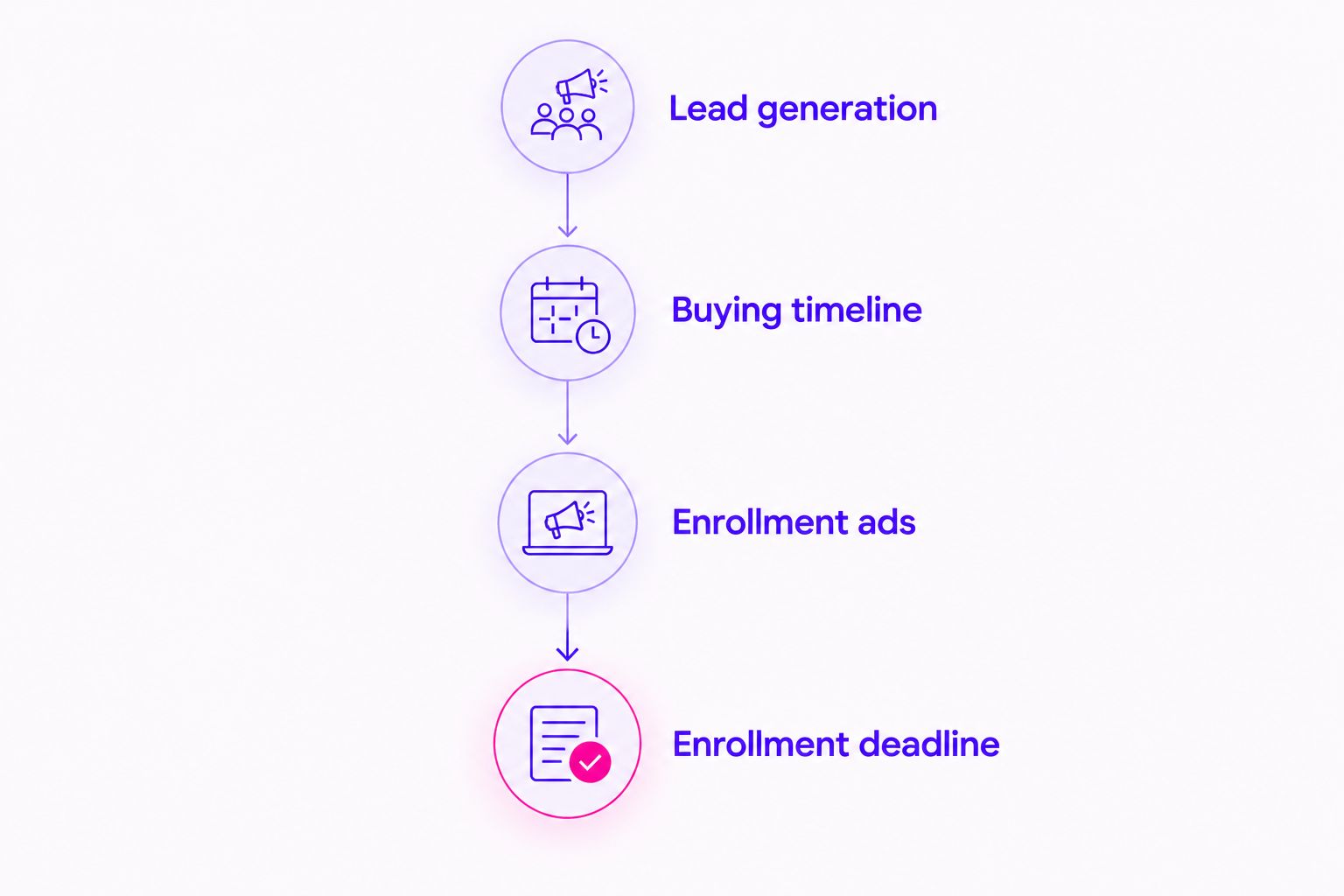
- Enrollment deadline. Record when checkout or applications actually close, including the time zone.
- Buying timeline. Review how long previous students took to move from their first recorded interaction to enrollment.
- Lead generation. Start registration or waitlist ads early enough for people to complete the experience you advertise.
- Enrollment ads. Run sales-focused messages while people can still join, with reminders that match the actual deadline.
- Results review. Separate the date you stop advertising from the date you finish assessing revenue and refunds.
Pair the schedule with your course launch budget structure. Decide how much you can spend across the whole launch before choosing how long each phase runs.
This approach gives every advertising day a purpose. It also keeps a calendar decision from becoming a promise about returns: the schedule supports the offer, but it does not guarantee sales.
Why this matters for your launch
You can put care into a course and still feel uncertain about when to start promoting it. That uncertainty is understandable. Teaching, creating ads, answering questions, and preparing delivery all compete for your attention.
A clear schedule separates those jobs. Lead generation invites people into a next step; enrollment ads invite them to buy. Measuring both phases as though they should produce immediate purchases hides what each phase is meant to accomplish.
For a 2026 course launch, define return on ad spend, or ROAS, before reviewing results. ROAS is attributed advertising revenue divided by advertising spend. It is not profit, and attributed revenue is not proof that advertising caused every recorded sale.
Choose campaign length around the buying process, then judge that process against your financial limits. Changing the calendar alone does not explain why people enroll—or why they leave.
Choose the schedule that matches your enrollment process
Different enrollment processes need different schedules. Use the comparison below to choose a structure, not to predict a return.
| Campaign structure | Best for | Scheduling rule | Strength | Limitation |
|---|---|---|---|---|
| Enrollment-only | A course with an established audience and a direct buying path | Advertise while enrollment is open | Keeps the message focused on joining | Leaves no separate paid introduction phase |
| Lead-first launch | A course introduced through a webinar, challenge, or waitlist | Begin before the teaching experience; continue enrollment ads through closing | Gives people a clear step before buying | Requires measurement across registration and purchase |
| Application-led launch | A program where enrollment requires a conversation or review | Allow time for applications, appointments, and decisions before closing | Matches advertising to the real admissions process | Adds steps that a purchase-only report does not explain |
| Evergreen enrollment | A course people can join continuously | Review ongoing performance instead of using an artificial closing date | Allows a continuous buying path | Needs regular checks of messaging, tracking, and financial results |
None of these structures deserves a fixed duration simply because another creator used it. Choose the structure your course actually uses, then build the dates around its required steps.
Enrollment-only: advertise during the real buying window
Best for an established audience that already understands the course. An enrollment-only campaign asks people to make a decision while joining is possible. The ads, sales page, emails, and checkout should agree on what happens next.
The strength is clarity. The limitation is that you have not built a separate paid phase for introducing unfamiliar people to your teaching.
Do not assume that previous engagement means everyone is ready to enroll. Review purchases and questions together: the questions reveal what your sales page still needs to explain.
Lead-first launch: begin before the teaching experience
Best for a course sold through a webinar, challenge, or other introductory experience. Start registration ads while there is still time for someone to attend or use that experience before enrollment closes.
This structure creates room for teaching before the sales decision. Its limitation is measurement: a registration is not a purchase, so registration results alone cannot establish launch ROAS.
Keep the invitation specific. Explain what people will receive, when it happens, and how it relates to the paid course without treating attendance as a promise of enrollment.
Application-led launch: include the decision process
Best for programs that require an application or enrollment conversation. Work backward from the final decision date through appointment availability, application review, and the invitation to apply.
The strength is alignment with the actual enrollment process. The limitation is the extra work needed to connect advertising activity with completed enrollment.
Stop inviting applications when your team can no longer review them before closing. An ad can generate an interested person and still fail to offer that person a workable next step.
Evergreen enrollment: use review dates, not invented urgency
Best for courses with continuous enrollment. An evergreen campaign has no genuine cart-close date unless your offer includes one. Use scheduled performance reviews to decide whether to continue, revise, or pause advertising.
The strength is continuity. The limitation is that an ongoing campaign still needs attention; repeated messaging and a changing buying path require checks.
Do not import launch urgency into an offer that stays open. Give people an honest reason to act, such as a clear fit between their learning goal and what the course teaches.
Build your 2026 campaign calendar backward
Put the enrollment deadline on your calendar first. Then add the events and decisions a prospective student must complete before that deadline.
Use the following sequence to turn the buying path into a schedule:
- Enrollment deadline: When must a student complete the required action?
- Buying timeline: What does your previous enrollment history show about the time people need?
- Lead generation: When can someone enter the introductory experience and still finish it?
- Enrollment ads: When does the message change from introduction to an invitation to join?
- Results review: When will you assess the complete launch rather than an unfinished phase?
If this is your first launch, use the required steps in your offer to build the initial calendar. Make the assumptions explicit in your planning document, then replace them with observed enrollment behavior after the launch.
You do not need to pretend the first schedule is perfect. You need a schedule you can explain, a spending limit you can respect, and records that make the next decision clearer.
Why course launch campaign length varies
Your campaign calendar should reflect these parts of your own offer and buying process:
- Audience familiarity. Separate people who already know your teaching from people meeting you through an ad.
- Required learning steps. A webinar or challenge needs time for registration and participation before the buying decision.
- Enrollment requirements. Applications and conversations add steps that direct checkout does not require.
- Historical buying timeline. Use the elapsed time in previous student records instead of borrowing another business’s launch calendar.
- Financial limits. Fit the schedule within the total advertising spend your business can support.
- Deadline and time zone. Make the final invitation consistent with the moment enrollment actually closes.
These are planning factors, not reasons to extend every campaign. If the buying path is simple, keep it simple. If the path includes teaching and conversation, give those steps a place on the calendar.
Measure ROAS across the whole launch
For a 2026 launch report, include the advertising spend used to introduce the course as well as the spend used to promote enrollment. Showing only the sales phase leaves out part of the launch’s acquisition expense.
Keep phase-level reporting too. Lead-generation results explain how people entered; enrollment results explain what happened when they were invited to join. Neither report should replace the whole-launch view.
Before launch, agree on the following:
- Which payments count as revenue in the report.
- How refunds affect the reported result.
- Which advertising dates belong to the launch.
- How purchases are connected to advertising interactions.
- Whether payment-plan revenue means collected payments or contracted revenue.
Keep the revenue definition consistent from one launch to the next. Comparing collected payments in one report with full contracted revenue in another creates a misleading comparison.
Tracking also needs to be checked before you change the campaign schedule. If you use Stripe and Meta, the Stripe-to-Meta conversion tracking workflow addresses that connection. Meta’s Conversions API sends conversion information from a server connection rather than relying only on browser activity.
Should you keep running ads when early ROAS looks low?
Continue only when the planned buying opportunity is still ahead, tracking works, and spending remains within your limits. A registration phase before enrollment opens cannot be judged by purchases that people are not yet able to make.
That does not make every low-return campaign healthy. Check whether people can complete the advertised action and whether the next step works before spending more.
For your 2026 review, separate an unfinished sales process from a broken one. An upcoming webinar is an unfinished step; a checkout error is a problem to fix. Neither calls for an automatic campaign extension.
Should you stop ads as soon as enrollment closes?
Stop ads that invite enrollment when enrollment is no longer possible. Continuing the same invitation after checkout closes creates a mismatch between the ad and the experience people receive.
A waitlist for the next course is a different campaign objective. Give it its own message, destination, and reporting rather than treating it as an extension of the closed launch.
Keep reviewing the completed launch after advertising stops. Payments, refunds, and reporting updates belong in the final assessment even though the enrollment ads are no longer running.
Can a longer campaign improve ROAS?
A longer campaign does not guarantee better ROAS. Extra time is useful only when it supports a real step in the buying process and fits your financial plan.
Before extending a campaign, name what the extension allows someone to do. If there is no additional teaching experience, conversation, or enrollment opportunity, more calendar time is not a clear reason to spend more.
At ZIVA Marketing, we offer paid social advertising and marketing coaching for spiritual teachers, healers, coaches, and conscious business leaders growing their online courses and programs. That support fits founders who want help connecting their message, advertising, and enrollment process; it does not replace a working offer or guarantee a return.
Plan your course advertising
Explore paid social advertising and marketing coaching for your courses and programs.
FAQ
How long should a course launch ad campaign run for best ROAS?
Run it across the required buying steps, from the first useful invitation through the real enrollment deadline. Use your own enrollment history and financial limits to set the dates rather than assuming a universal duration.
When should I start advertising my course launch?
Start when people can take a useful next step and still complete the buying process before enrollment closes. For a webinar-led launch, that includes time to register and attend before deciding whether to join.
Should I advertise before my course opens for enrollment?
Advertise before enrollment opens when you have a relevant registration, waitlist, or introductory experience. Measure that phase by its intended action and include its spend in the whole-launch ROAS calculation.
Is a longer course launch campaign better than a shorter one?
A longer campaign is not automatically better. Choose the duration that fits your audience’s buying process, your actual deadline, and the amount your business can responsibly spend.
Should I stop my launch campaign if it has no sales yet?
Check whether people have had a real opportunity to buy before judging the campaign by sales. Fix broken tracking or buying steps, and pause when spending reaches your planned limit without meeting your continuation criteria.
How should I calculate ROAS for my 2026 course launch?
Calculate ROAS by dividing attributed advertising revenue by advertising spend. Include the launch’s lead-generation and enrollment spend, and use a consistent definition of revenue and refunds.
Can ZIVA Marketing help with course launch advertising?
ZIVA Marketing offers paid social advertising and marketing coaching for spiritual teachers, healers, coaches, and conscious business leaders growing online courses and programs. The agency is relevant when you want support with that work, not a guaranteed campaign duration or return.
One last thing
Give your advertising stop date and your results-review date separate places on the calendar. They answer different questions: when people can still enroll, and when you can assess the completed launch.
For your next 2026 launch, write down the reason for every campaign phase before assigning its dates. That small planning habit keeps the schedule connected to your students’ next steps—and gives you a clearer record to learn from.