
how long does it take to build a small retargeting audience
How long does it take to build a small retargeting audience?
How long does it take to build a small retargeting audience? No fixed timeline applies. Check eligible traffic, tracking, and delivery before planning your launch.
By ZIVA Marketing ·
Building a small retargeting audience takes as long as your business needs to collect enough eligible people for the campaign you want to run—not a fixed number of days. The practical timeline includes both collecting those people and confirming that your advertising platform can reach them after matching, exclusions, and any processing delay.
- How long does it take to build a small retargeting audience? Eligible audience growth determines the timeline, not a universal deadline.
- Meta website visitors, social engagement audiences, and customer lists provide different starting points; compare relevance before size.
- Check tracking, audience rules, and exclusions before increasing traffic to grow your retargeting audience.
- ZIVA Marketing provides paid social advertising and marketing coaching for spiritual teachers, healers, and conscious business leaders.
How long does it take to build a small retargeting audience?
Your timeline depends on how quickly eligible people enter your audience and whether that audience supports actual ad delivery. Creating an audience in an advertising account is not the same as having enough reachable people to run a useful campaign.
For a coaching program or online course, start with the action you want to follow up on. A course-page visitor, a webinar registrant, and an Instagram follower have different relationships with your offer. Their next messages should reflect that difference.
Our guide to retargeting strategy for high-ticket coaching offers explores the offer-specific planning that comes after audience selection.
Use the following process to plan your 2026 campaign around observable activity rather than a promised waiting period.
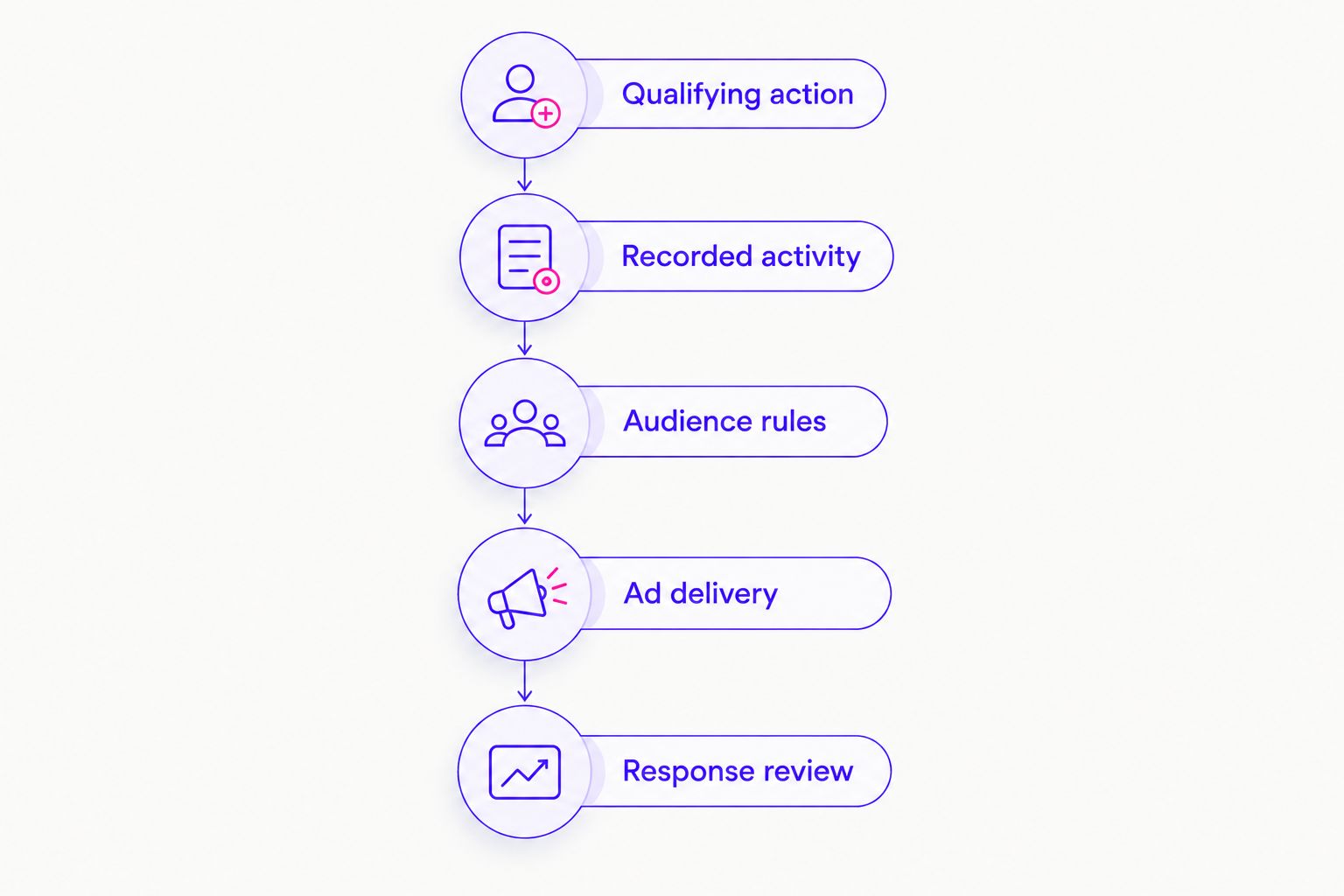
1. Choose the action that qualifies someone
Write down the behavior that makes a person relevant to your next message. For example, your audience rule might include people who visited your course page or interacted with your Instagram account. Choose an action your platform supports and your business can measure.
Be precise. Someone who browsed a general article has not shown the same interest as someone who reached your application page. Neither action proves that the person intends to buy.
Start with relevance, then assess size. A larger audience does not fix a mismatch between the person's earlier action and the offer in your ad.
2. Confirm that the source records activity
For website audiences, check that the tracking setup records the intended page visit or event. An event is a recorded action, such as a registration or purchase. Verify the action in the platform's available testing tools instead of assuming that installing tracking completed the setup.
For an engagement audience, confirm that you selected the correct business account and interaction type. For a customer list, confirm that you have permission to use the information for advertising and that the upload follows the platform's requirements.
A quiet audience does not automatically mean your content failed. First establish whether the underlying activity is being recorded correctly.
3. Inspect the audience rules
Check the page, event, account, and time period used to include people. The retention window is the period during which a qualifying action keeps someone in the audience. A narrow rule or short window limits who remains eligible.
Then review exclusions. Removing existing buyers makes sense for an ad inviting people to buy the same program, but an incorrect exclusion can remove people you meant to reach.
Geography also matters. An audience built from worldwide activity is not identical to the portion eligible for a campaign restricted to selected countries.
4. Measure people rather than repeated actions
Website visits, page views, and audience members are different measures. One person can visit a sales page repeatedly. Counting every visit as a new audience member makes the expected build time look shorter than it is.
Use the most relevant unique-person measure available, and compare it with the platform's audience information. Do not assume your website analytics and advertising platform will report identical totals; they record and identify activity differently.
For your 2026 planning, label each figure clearly. Keep website visitors, matched contacts, and reachable audience estimates separate so you know what each figure actually represents.
5. Check whether the campaign reaches the intended people
Read the campaign's audience settings, not just its audience name. Where a platform offers audience expansion or treats a custom audience as a suggestion, distinguish that setup from a campaign restricted to your intended retargeting group.
Next, inspect delivery. Confirm that the ad receives impressions and reaches people under the settings you selected. An audience that exists in the account but receives no delivery has not yet become a functioning follow-up campaign.
Do not interpret delivery alone as success. It establishes that the campaign can reach people, not that those people are ready to enroll.
6. Review response before adding complexity
Once delivery begins, inspect the action the campaign is meant to support: registrations, applications, or purchases. Connect that action to reliable tracking wherever possible. ROAS means return on ad spend; it compares attributed revenue with advertising spend.
With limited activity, keep your conclusions narrow. A purchase confirms that a purchase happened; it does not establish a dependable long-term result. Likewise, an early lack of purchases does not identify the cause by itself.
Expand your setup when the evidence supports a specific change. Avoid dividing a small audience into increasingly narrow groups without a clear message difference.
The sequence is simple: establish who belongs, check that their activity is recorded, and verify that the campaign actually reaches them. These checks separate audience-building work from campaign-performance work.
Why this matters for a small coaching business
If you are preparing a launch, an uncertain audience timeline can feel like another moving deadline. Give yourself a clearer decision point: confirm the audience source and delivery conditions before counting on retargeting to support enrollment.
Retargeting follows up with people who have already interacted with your business. It does not replace the work of attracting new, relevant people. If the source receives little qualifying activity, waiting alone does not solve the problem.
Your 2026 launch plan should therefore include an audience-building activity, a tracking check, and a message for the next step. That next step might be learning about the program, registering for a webinar, or completing an application.
Which audience source should you start with?
Choose the source that reflects your existing relationship with prospective students or clients. These options are not interchangeable, and none comes with a universal build-time promise.
| Audience source | Best for | Useful advantage | Limitation to check |
|---|---|---|---|
| Website visitors | Following up on a specific offer-page visit | Connects the message to a known page interaction | Depends on supported tracking, eligibility, and sufficient qualifying visits |
| Social engagement | Reaching people who interacted with your content | Uses an existing interaction with your account | Engagement does not establish interest in a particular paid program |
| Customer list | Following up with contacts you have permission to use | Starts from an existing contact relationship | Uploaded contacts must match platform accounts; not every contact becomes reachable |
Website visitors: best for offer-specific follow-up
Website retargeting fits a message that continues a sales-page or registration-page experience. Keep the ad connected to the page someone visited. Clarify the program format, explain the next step, or address a genuine question about participation.
The limitation is collection. If the intended page receives little eligible activity, its audience remains limited even when other parts of your website attract visitors.
Social engagement: best for continuing a content relationship
Social engagement audiences fit people who already recognize your teaching or content. A useful follow-up introduces the offer in context rather than assuming that an interaction means purchase intent.
The limitation is specificity. Someone who enjoys a meditation post has not necessarily expressed interest in your paid course. Match the invitation to the relationship you actually have.
Customer lists: best for permission-based contact follow-up
Customer lists fit an existing contact relationship when you have the required permission to use the data for advertising. Check whether the intended contacts match and whether buyers should be excluded from the particular invitation.
The limitation is reach. A contact database is not the same as a matched advertising audience, and a matched audience is not a guarantee of campaign delivery.
Why retargeting audience build time varies
The timeline changes when the source activity or audience rules change. Review these factors before assigning a launch date to a retargeting campaign:
- Qualifying activity: Relevant page visits, supported engagement, or permitted contacts determine what can enter the audience.
- Tracking accuracy: Missing or incorrectly configured events prevent the intended behavior from becoming useful audience data.
- Matching and eligibility: Recorded activity and uploaded contacts do not automatically become reachable advertising accounts.
- Retention window: Older qualifying activity drops out when it falls outside the selected period.
- Exclusions and restrictions: Buyer exclusions, location settings, and other campaign limits reduce the group you intend to reach.
- Overlapping activity: The same person can qualify through several actions; adding source totals together does not establish a unique-person total.
For a 2026 launch, document these settings alongside your audience estimate. That makes changes easier to explain and prevents you from treating a configuration change as sudden audience growth.
How to estimate your own timeline
Use your observed eligible audience growth rather than a general traffic benchmark. First, record the audience's current state and settings. Then compare later observations under the same rules.
If your platform supplies a usable audience count, the basic planning relationship is:
Estimated collection time = additional eligible people needed ÷ observed net new eligible people per day.
This is a planning calculation, not a platform promise. Net growth means additions after accounting for people who leave the selected window or otherwise stop qualifying. If the observed growth is zero or negative, that calculation does not produce a useful arrival date.
Also distinguish your own planning target from a platform requirement. Do not turn a number you selected into a supposed universal minimum for retargeting.
Where audience estimates are unavailable or too imprecise, use source activity and actual delivery as separate checks. Avoid manufacturing an exact deadline from an estimate that cannot support one.
When is a small audience ready for a campaign?
A small audience is ready for a controlled test when its source is valid, its settings match your intention, and the campaign can deliver. Profitability is a separate question that requires campaign results.
Before launching, confirm that you can answer these questions:
- What action qualified the person for this audience?
- Does the ad offer a relevant next step after that action?
- Are existing buyers excluded where that is appropriate?
- Does the campaign restrict delivery as intended?
- Can you measure the action the ad asks someone to take?
Keep your 2026 test focused on a clear learning goal. If the goal is webinar registration, assess registrations rather than treating inexpensive engagement as equivalent evidence.
When outside support fits
ZIVA Marketing is best for spiritual teachers, healers, coaches, and conscious business leaders seeking paid social advertising and marketing coaching. At ZIVA Marketing, we help these businesses grow their online courses and programs.
Agency support fits when you want help connecting audience selection, campaign messages, and measurement. It does not remove the need for relevant source activity or establish a guaranteed audience-build deadline. Bring a clear offer and permission-based audience sources into the conversation.
Can I retarget people if my website has little traffic?
Limited website traffic does not rule out other supported audience sources. Review relevant social engagement or a permitted customer list, but keep the message appropriate to that relationship. Do not present a general follower as someone who considered your course.
Does an audience retention window tell me how long to wait?
A retention window tells you how long qualifying activity remains eligible, not how long audience collection takes. A longer window retains older activity; it does not create new interest. Choose the window around the offer and your audience's actual decision process.
Is a small retargeting audience enough to sell a course?
A small retargeting audience does not establish whether a course campaign will be profitable. Audience relevance, the offer, the message, and measurable response all matter. Test the next action without promising sales from audience size alone.
FAQ
How long does it take to build a small retargeting audience?
There is no fixed build time that applies to every business. Your timeline depends on eligible audience growth, the audience rules, and whether the campaign can deliver to the intended people.
Can I create a retargeting audience before I launch ads?
You can set up a supported audience before launching its retargeting campaign. Confirm that the selected source records qualifying activity; creating the audience does not guarantee that it contains reachable people.
Do website visitors and audience members mean the same thing?
Website visitors and advertising audience members are different measures. Matching, tracking eligibility, retention rules, and exclusions affect who becomes reachable through the advertising platform.
Should I use website visitors or Instagram engagement?
Use website visitors for page-specific follow-up and Instagram engagement for continuing a content relationship. Neither source automatically proves purchase intent, so match the ad to the action someone actually took.
Will increasing my budget build the audience faster?
Increasing budget does not by itself establish faster eligible audience growth. Check whether the activity it funds brings relevant people into your selected audience source and whether that activity is recorded correctly.
Why is my retargeting audience not receiving impressions?
Check audience status, campaign restrictions, exclusions, and ad approval before assuming the audience only needs more time. Review the platform's delivery information to identify the issue rather than assigning a generic waiting period.
Can ZIVA Marketing help with paid social retargeting?
ZIVA Marketing offers paid social advertising and marketing coaching for spiritual teachers, healers, coaches, and conscious business leaders. Retargeting planning still depends on your offer, audience sources, permissions, and tracking setup.
One last thing
A longer retention window can make an audience larger while making its relationship with your current offer less recent. That is a useful reminder: size and relevance are different qualities.
Before extending the window, read your ad as someone who last interacted with your business during an earlier offer. Does the invitation still make sense? If not, update the message or reconsider the audience rule instead of celebrating the larger estimate.
Build the follow-up around a real relationship, then let observed activity guide the timeline. You do not need an invented countdown to make a clear next move.