
how long does it take for facebook ads to show results for coaches
How long does it take for Facebook ads to show results for coaches?
How long does it take for Facebook ads to show results for coaches? No fixed deadline applies. Learn to judge qualified leads, enrollments, and next steps.
By ZIVA Marketing ·
Facebook ads show meaningful results for coaches when they generate qualified interest and paid enrollments—not when a set number of days passes. Separate early activity from business results so you can judge progress without expecting a click, a booked call, and a sale to happen on the same timeline.
- How long does it take for Facebook ads to show results for coaches? Judge qualified leads and enrollments, not elapsed days.
- Facebook ad clicks show activity; paid coaching enrollments show business results.
- Webinar and application campaigns need follow-through beyond the initial signup.
- Ziva serves spiritual teachers and coaches seeking paid social advertising and marketing coaching.
Why this matters
Waiting for your first enrollment can feel personal. You have put care into your program, and now you want evidence that the right people see its value. A quiet sales dashboard does not tell you which part of the journey needs attention.
Your 2026 campaign needs a clear definition of success before you judge its speed. A campaign designed to collect webinar registrations has a different immediate job from a campaign designed to sell a course directly.
Start with reliable measurement. The Stripe-to-Meta Conversions API setup workflow covers a connection relevant to tracking purchases; Meta's Conversions API sends website or business event data to Meta from a server.
Measure the outcome you asked the campaign to produce, then check whether that outcome leads to enrollment.
How long does it take for Facebook ads to show results for coaches?
There is no fixed timeline that guarantees coaching leads, clients, or profitable sales. Your first useful result is evidence that someone completed the action your campaign targets. Your first business result is a paid enrollment you can connect to the advertising journey.
For a 2026 campaign, use these milestones to distinguish progress from proof:
| Milestone | What it tells you | What it does not prove |
|---|---|---|
| Ad delivery | Your ad is reaching people | People want your program |
| Website visits | People are following the ad's invitation | Visitors understand or accept your offer |
| Relevant inquiries | Potential buyers are expressing interest | Those buyers will book or enroll |
| Qualified calls or applications | Prospects meet your stated fit criteria | Your enrollment process converts them |
| Paid enrollments | Buyers are purchasing | Advertising produces a repeatable, profitable result |
These milestones are a diagnostic sequence, not a promised schedule. A direct-purchase course does not need a discovery call. An application-based coaching program does.
The right question is whether each required step is working—not whether the campaign has reached a particular birthday. Keep elapsed time in your records, but interpret it alongside delivery, completed actions, lead quality, and sales follow-through.
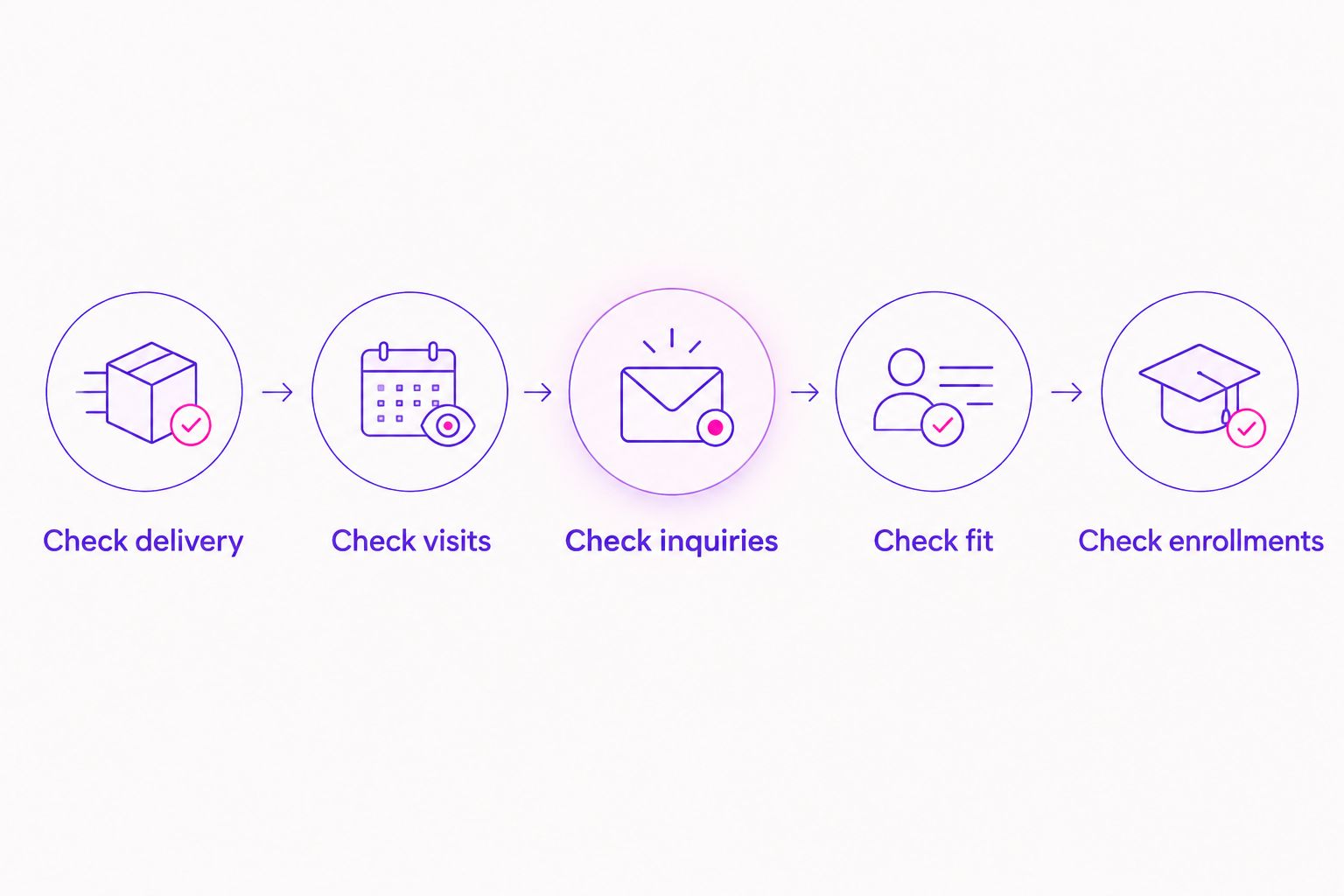
Check progress in the order buyers experience it
Use this sequence before changing your ads. It helps you separate an advertising problem from a website, follow-up, or enrollment problem.
- Check delivery. Confirm that the campaign is active and actually delivering. An ad that has not reached people has not tested your offer.
- Check visits. Confirm that the ad sends people to the intended page. Open the destination yourself and test it on a phone.
- Check inquiries. Submit the form or complete the registration process. Confirm that the action appears in your records and that the promised next step arrives.
- Check fit. Compare inquiries with the audience your program serves. Record why a prospect is relevant rather than treating every submission as equally valuable.
- Check enrollments. Connect purchases to the earlier inquiry, application, or registration where possible. Review completed payments, not just expressions of interest.
This sequence makes your next move clearer. If the booking link fails, repair it before rewriting the ad. If suitable applicants attend calls but do not enroll, review the conversation and offer before assuming the audience is wrong.
Match the timeline to your enrollment path
Your enrollment path determines what must happen between an ad response and a purchase. Choose a path that suits how buyers evaluate your program, then measure its specific steps.
| Enrollment path | Best for | Useful early result | Strength | Limitation |
|---|---|---|---|---|
| Direct purchase | Courses with a clear purchase decision | Completed purchases | Connects the ad invitation directly to checkout | The sales page must explain the offer without a live conversation |
| Webinar registration | Programs explained through a teaching session | Relevant registrations and attendance | Creates space to teach and explain the program | Registration alone does not demonstrate buying intent |
| Coaching application | Programs that require a fit conversation | Suitable applications and attended calls | Lets you assess whether the program fits the applicant | Enrollment depends on booking, attendance, and the sales conversation |
None of these paths earns a universal speed guarantee. Each has a useful role and a measurement gap to address.
Direct purchase: judge completed enrollments
Best for: courses that buyers can understand and purchase without a fit conversation. A direct-purchase campaign sends people toward a sales page and checkout. Its business result is a completed purchase, not a checkout visit.
Review the promises on the ad and sales page together. They should describe the same course, audience, and next step. A visitor should not need to guess what they receive or how the course works.
The strength is a straightforward measurement path. The limitation is that your page must answer purchase questions without you being present. When visitors arrive but purchases do not follow, inspect the page and checkout before treating more traffic as the solution.
Webinar registration: follow the journey beyond signup
Best for: programs where a teaching session helps buyers evaluate your approach. A webinar campaign first asks for registration. Enrollment comes later in the journey, after the buyer has an opportunity to attend and consider the program.
Separate registrations, attendance, offer engagement, and purchases. A registration confirms interest in the session; it does not confirm interest in buying coaching. That distinction keeps an encouraging signup report from becoming an unsupported sales forecast.
The strength is room to demonstrate your teaching style. The limitation is that attendance and follow-up remain necessary parts of the process. Review whether registrants receive clear access instructions and whether attendees understand the invitation to continue with your program.
Coaching application: track fit and attendance
Best for: coaching programs that require a conversation about suitability. An application campaign produces potential conversations before it produces enrollments. Track whether applicants fit your criteria, book a call, attend, and choose to join.
Define fit in terms your team can apply consistently. Relevant criteria include the applicant's stated goal, the support they seek, and whether your program addresses that need. Avoid defining quality only as enthusiasm.
The strength is a deliberate fit check. The limitation is that advertising cannot complete the conversation for you. A campaign can generate suitable applications while a confusing booking process prevents those applicants from reaching you. Check the handoff before judging the ad's contribution.
Why Facebook ad result timelines vary
A coaching campaign's timeline depends on the actions required to reach enrollment. These factors help explain the difference without turning it into a guess about days or weeks:
- The requested action. Registering for a teaching session and purchasing a coaching program are different commitments. Measure each against its purpose.
- Prior familiarity. Record whether prospects already know your work. Do not combine existing followers and new contacts without identifying that difference.
- Offer clarity. Buyers need to understand who the program serves, what it includes, and what participation involves.
- Required enrollment steps. An application, booking, and conversation create additional stages to complete before payment.
- Follow-up readiness. Access instructions, booking messages, and answers to questions must reach the prospect and support the next step.
- Tracking accuracy. Missing or duplicated records distort your view of progress. Reconcile platform reports with your actual inquiries and payments.
Fix an observable obstacle before assuming the campaign simply needs more time. Waiting does not repair a broken form or explain an unclear offer.
Decide whether to continue, adjust, or pause
A useful 2026 review connects a specific observation with a specific action. Write down what is happening before you decide what to change.
Continue when the intended journey is working
Continue evaluating when the campaign produces relevant actions and prospects can complete the next step. Keep tracking the journey through payment. Do not call the campaign profitable simply because suitable people are responding.
Preserve a clear record of the ad, destination, audience, and enrollment path. Changing these together makes it harder to understand which change affected the outcome. Your goal is useful learning, not a dashboard that looks busy.
Adjust when you can identify the weak step
Adjust the part of the journey supported by the evidence. If people visit but do not submit the form, review the invitation and form experience. If suitable applicants book but do not attend, review access details and reminders.
If calls happen but enrollments do not, capture the questions and reasons prospects share. Their words help you distinguish a mismatch from an explanation gap. Change the offer presentation only when those observations support the change.
Pause when the test cannot answer your question
Pause a campaign that sends people to a broken destination or records the wrong action. Repair the issue and test the complete journey before resuming. Spending through a known measurement problem does not give you a clearer answer.
For your 2026 review, distinguish a technical pause from a verdict on your coaching offer. A failed checkout says something about checkout. It does not establish whether your program has demand.
What should you track before expecting ROAS?
ROAS means return on ad spend: revenue attributed to advertising divided by advertising spend. It describes revenue relative to ad spend, not profit after all business expenses.
Before using ROAS to judge your coaching campaign, confirm what counts as a purchase and how revenue reaches your reports. Reconcile those reports with your payment records. Do not count an application or a booked call as purchase revenue.
For a 2026 launch, keep enrollment timing visible alongside revenue. A registration and its later purchase belong to the same customer journey, even when they appear in different reporting periods. Record that connection where your systems allow it, and avoid treating an incomplete journey as a final result.
Should you stop Facebook ads if you have leads but no clients?
Leads without clients call for a journey review, not an automatic stop. Check relevance first, then booking, attendance, and enrollment. A lead count alone cannot tell you which stage needs attention.
Read actual submissions and review the follow-up each prospect received. If the inquiries do not match your program, revisit the ad's message and invitation. If suitable prospects lose access to the next step, fix that handoff before judging demand.
Does a small audience mean results take longer?
Audience size alone does not establish your enrollment timeline. Separate the number of people you can reach from the number who take relevant actions. Neither a follower count nor an email-list size proves that a campaign will generate clients.
Focus on whether your message identifies the right buyer and whether your enrollment path works. Keep existing contacts distinct from new prospects in your records so you can understand who responds without assigning either group an unsupported deadline.
When advertising support fits your next move
Ziva is best suited to spiritual teachers, healers, and coaches seeking paid social advertising and marketing coaching for online courses and programs. At Ziva, we help these businesses grow their courses and programs toward a global audience.
Advertising support addresses campaign work; it does not replace your responsibility to explain and deliver the program. You still need a clear offer and a functioning enrollment path. Agency support is not evidence that results will arrive by a guaranteed date.
Explore support for your program
Learn about paid social advertising and marketing coaching for your online courses and programs.
FAQ
How long does it take for Facebook ads to show results for coaches?
Facebook ads have no fixed timeline that guarantees coaching clients or profitable enrollments. Judge delivery, relevant inquiries, and paid enrollments separately so early activity does not become a sales promise.
Can Facebook ads get coaching clients immediately?
Immediate coaching clients are not a guaranteed outcome of launching Facebook ads. A purchase requires a buyer to complete your enrollment path, whether that involves checkout, a webinar, or a conversation.
What counts as a result from Facebook ads for a coach?
A result is the action your campaign is designed to produce, such as a registration, application, or purchase. Paid enrollments establish sales; clicks and registrations do not establish profitability.
Should I stop my ads if I get clicks but no sales?
Check the journey between the click and the purchase before deciding to stop. Confirm that the destination works, the offer is clear, and the intended next action is recorded correctly.
Are webinar signups proof that my coaching ads work?
Webinar signups prove that people registered, not that they will buy coaching. Track attendance and paid enrollments to evaluate the complete journey.
What should I measure in a Facebook ads campaign in 2026?
Measure the intended action, prospect fit, completed enrollment steps, and paid revenue. Reconcile advertising reports with your own inquiry and payment records before judging ROAS.
Does Ziva support spiritual coaches with Facebook advertising?
Ziva offers paid social media advertising and marketing coaching for spiritual teachers, healers, coaches, and conscious business leaders. The agency focuses on helping online courses and programs reach a global audience.
One last thing
Before you ask your 2026 campaign for more enrollments, experience the full journey as a prospect. Open the ad destination, submit the form, read the confirmation, and follow the booking or purchase instructions.
Your next useful improvement might be after the ad, not inside it. A clear next step gives interested people a way to act. A working tracking setup lets you see that action. Together, they give you a sounder basis for deciding what deserves more time and what needs attention now.