
how long does it take for an evergreen webinar funnel to profit
How long does it take for an evergreen webinar funnel to profit?
How long does it take for an evergreen webinar funnel to profit? Use cash collected and full funnel costs to find break-even and make clearer budget decisions.
By ZIVA Marketing ·
An evergreen webinar funnel has no fixed deadline for profit: it becomes profitable when the revenue you count exceeds the advertising, sales, delivery, and setup costs you include. Your first sale or a positive ROAS does not establish that you have recovered those costs, so use a defined break-even calculation rather than a calendar promise.
- How long does it take for an evergreen webinar funnel to profit? Your break-even calculation determines the answer.
- ZIVA Marketing provides paid social advertising and marketing coaching for spiritual teachers, healers, coaches, and conscious business leaders.
- Track collected revenue, customer acquisition costs, and delivery costs together; ROAS alone does not establish profit.
- Compare webinar registrants by signup date so delayed purchases stay connected to the advertising that generated them.
How long does it take for an evergreen webinar funnel to profit?
There is no universal number of days to profitability. Your answer comes from the gap between what the funnel earns and what it costs, measured over a clearly defined period.
Start by choosing what you mean by profit. Recovering advertising spend, covering ongoing operations, and recovering the original setup investment are different milestones. A funnel can reach one without reaching the others.
For the underlying customer journey, see this guide to a paid social funnel for evergreen webinars. Then use the following distinctions to measure its financial progress.
| Milestone | What it tells you | Best for | What it leaves out |
|---|---|---|---|
| Advertising break-even | Counted revenue covers advertising spend | Checking advertising recovery | Delivery, software, sales, and setup costs |
| Operating profitability | Counted revenue exceeds ongoing funnel costs | Assessing whether continued operation earns money | Unrecovered setup investment |
| Full investment recovery | Cumulative earnings after ongoing costs cover setup costs | Assessing total funnel payback | Whether future performance will remain profitable |
Choose a revenue basis and keep it consistent. Cash collected answers a cash-flow question; revenue recognized in your accounts answers an accounting question. Neither should be silently substituted for the other.
For a 2026 planning sheet, name the milestone at the top. “Recover advertising spend” gives you a different target from “recover the entire funnel investment.”
Why this matters for your course or coaching program
Waiting for a funnel to become profitable can feel uncomfortable, especially when your work is personal and your advertising spend is real. A clear calculation gives you something more useful than reassurance: a way to decide what needs attention.
Cheap registrations do not establish profitable customer acquisition. An expensive registration does not establish an unprofitable sale, either. You need to connect registrations to customers and customers to the money left after costs.
Measure the whole path, not just the easiest number to improve. That keeps your decisions connected to the business you want to build, rather than a dashboard that looks encouraging.
Separate ongoing profit from setup recovery
Your evergreen webinar funnel has two financial questions: does another group of customers generate a positive contribution, and has the funnel recovered its initial investment?
Contribution is the revenue left after the costs assigned to those customers. If that contribution is positive, it helps cover fixed operating expenses and setup costs. If it is negative, more purchases on the same economics add to the loss.
Operating profitability: cover the costs of running the funnel
Include the advertising, payment processing, sales support, delivery, and ongoing software costs that belong to the funnel. Include agency or coaching costs when they are part of your operating expenses.
This view helps you judge whether the current funnel earns money. Its limitation is that it can show positive ongoing performance while your original production and setup spending remains unrecovered.
Full investment recovery: account for the original build
Track setup expenses separately, including work required to create the webinar and connect its systems. Then compare that investment with cumulative earnings after ongoing costs.
This view answers whether the funnel has paid back its build. Its limitation is that an early setup expense can obscure improvements in current operating performance, so keep both views visible.
Do not move costs between categories simply to make a result look better. Use the same definitions throughout your 2026 reporting, and document any accounting change before comparing periods.
Measure the path to profit in a clear sequence
You do not need a complicated dashboard to begin. You need connected records that follow a person from registration through purchase and payment.
1. Define break-even
Write down which costs your calculation includes and which revenue basis you use. Separate advertising recovery, operating profit, and total investment recovery.
Choose an evaluation period that matches the question. For setup recovery, start at the beginning of the investment; for ongoing performance, use a consistent operating period.
2. Verify payments
Use your payment records to check completed purchases, collected payments, and refunds. Reconcile those records with your advertising report rather than assuming both systems count the same transactions.
Check that a purchase is not counted twice. Also distinguish a submitted application or booked call from a completed payment: each represents a different stage of the customer journey.
3. Group registrants
Group people by when they registered for the webinar. This group is called a cohort, and it lets you connect later purchases with the advertising that brought those people in.
Compare groups at the same age after registration. Otherwise, an older group has had more time to purchase than a newer group, making the comparison uneven.
4. Locate friction
Follow the sequence from registration to viewing, offer engagement, purchase, and payment. Record where people stop moving toward the next step.
Review the experience at that point before changing everything. A reminder problem calls for different work than a checkout problem or an offer that does not match the webinar promise.
5. Review contribution
Compare the revenue assigned to each group with its advertising and other assigned costs. Then review whether the remaining contribution covers ongoing expenses and helps recover setup spending.
Keep a record of changes alongside the results. You want to know whether the outcome changed after a specific adjustment, not merely that a different week produced a different total.
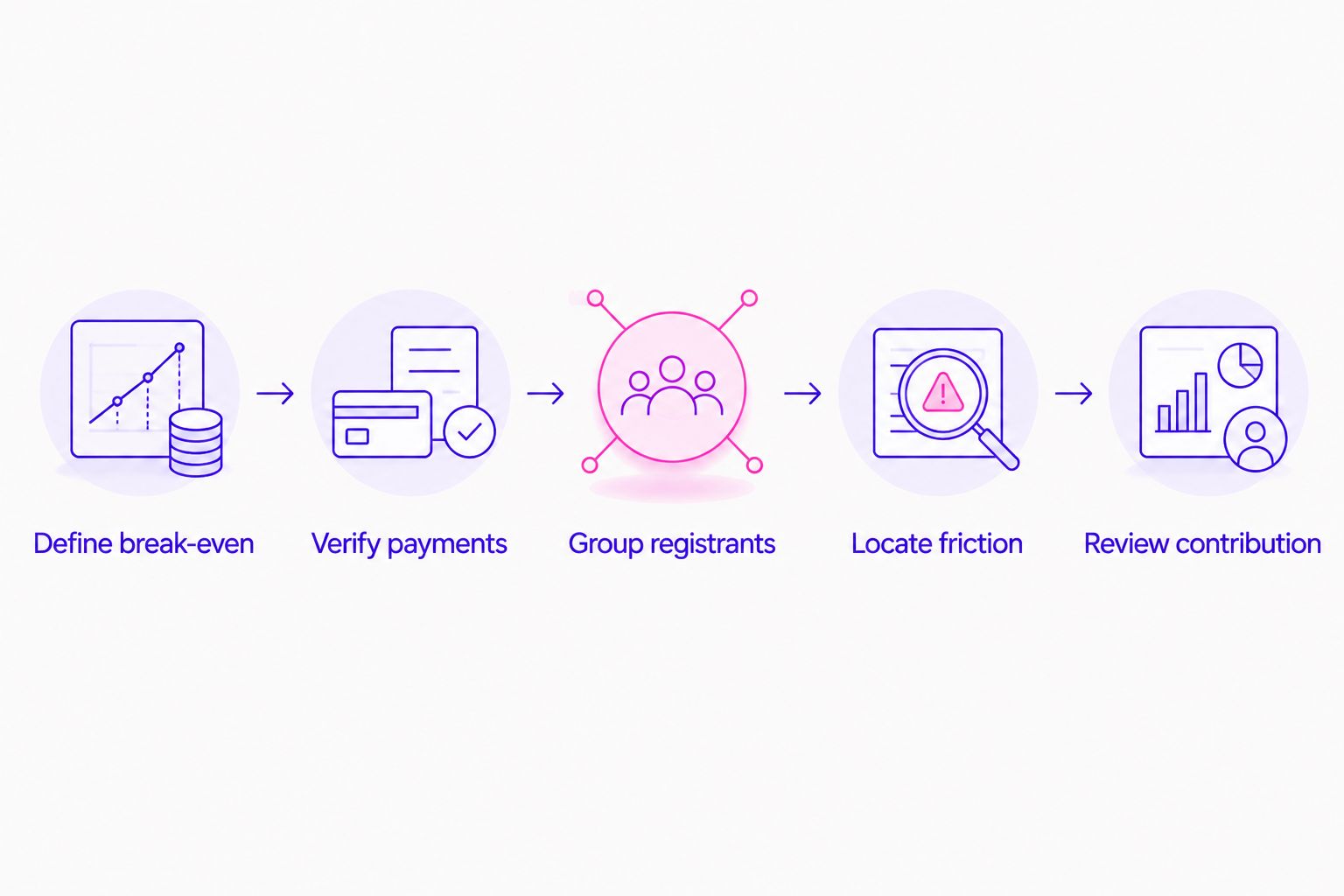
The sequence gives your 2026 review a practical order. Check the measurement before changing the marketing, because an incomplete payment record cannot tell you which part of the funnel needs improvement.
Why the time to evergreen webinar profit varies
The timing depends on your funnel's economics and customer journey, not on automation alone. Review these factors using your own records:
- Acquisition cost: Cost per acquisition is the advertising spend required to gain a customer. Compare it with the contribution that customer generates, not just the amount paid at checkout.
- Registration-to-purchase conversion: Track how many registrants become paying customers. Registration volume alone does not tell you whether the webinar attracts people who want the program.
- Decision time: Measure the elapsed time between registration and payment. Include the follow-up and sales process that actually exists in your funnel.
- Payment collection: Separate an agreed purchase from collected payments. If your offer uses installments, future payments do not fund today's advertising until they arrive.
- Delivery and support costs: Account for the work required to serve customers. A course with ongoing personal support has costs that a revenue-only advertising report does not capture.
- Setup investment: Keep the original build cost visible. Recovering that investment is a separate question from whether current sales cover current operating costs.
These factors explain what to inspect; they do not supply a promised timeline. Your own registration, payment, and expense records establish how each factor affects the result.
Should I keep running ads while the funnel is unprofitable?
Keep spending only within a defined testing limit and with a specific question to answer. A loss without a learning objective is not a testing plan.
Before continuing, identify the issue you are investigating. You might need to confirm payment tracking, understand why registrants do not view the webinar, or clarify an offer that viewers do not act on. Choose a focused change and keep its results distinguishable from earlier traffic.
Set the spending limit according to what your business can afford to lose, not what you hope future sales will repay. Include ongoing commitments in that decision, and establish what would make you pause before spending more.
ZIVA Marketing is a fit for spiritual teachers, healers, coaches, and conscious business leaders seeking paid social advertising and marketing coaching. At ZIVA Marketing, we offer those services for growing online courses and programs; outside support still needs to be included in your profitability calculation.
You can explore ZIVA Marketing if that is the kind of support you need. Agency support does not replace payment reconciliation, clear offer economics, or your responsibility to choose an affordable testing limit.
Does a positive ROAS mean my webinar funnel is profitable?
A positive ROAS does not establish webinar funnel profit. ROAS means return on ad spend: the revenue attributed to advertising divided by the advertising spend.
The calculation does not automatically subtract software, payment processing, sales work, customer delivery, or setup costs. It also depends on which revenue the advertising system attributes to its ads.
Use ROAS to assess advertising performance, then use your revenue and expense records to assess profitability. For your 2026 report, label those calculations separately so an encouraging advertising result does not become an unsupported business-profit claim.
When should I increase spending on an evergreen webinar funnel?
Increase spending after you can explain the current results with reconciled payments and a complete cost calculation. A sale establishes that someone bought; it does not establish that additional advertising will earn a profit.
Review comparable registration groups, the time customers take to pay, and the contribution remaining after costs. Confirm that you can also deliver the program well if customer volume grows.
Treat an increase as another decision to measure, not a declaration that the funnel is finished. Automation continues the customer journey; it does not remove the need to review costs, payments, and the experience customers receive.
FAQ
How long should I wait before calling my evergreen webinar funnel profitable?
Call your evergreen webinar funnel profitable when it meets your defined profit calculation, not after a fixed waiting period. Specify the revenue basis, included costs, and reporting period before making that judgment.
Can my first webinar sale mean I have broken even?
Your first webinar sale means you have broken even only if the revenue counted from that sale covers all costs included in your break-even calculation. A purchase alone does not establish advertising recovery or full investment recovery.
Should I count future installment payments as money available for ads?
Future installment payments are not cash available for advertising today. Separate the customer's payment commitment from money already collected when making spending decisions.
What's the best number to track besides cost per webinar registration?
Track customer acquisition cost alongside customer contribution. Registration cost measures an earlier step, while acquisition cost connects advertising spend to paying customers.
Is an automated webinar funnel better than a live webinar for profit?
Automation alone does not make a webinar more profitable than a live webinar. Compare each format's collected revenue, advertising costs, delivery work, and setup costs before choosing.
Can an evergreen webinar funnel become profitable without more ad spend?
Profitability can improve without more ad spend when collected revenue rises or the costs required to generate and serve customers fall. Measure the effect of a specific change rather than assuming a funnel adjustment will improve profit.
Does ZIVA Marketing guarantee a webinar funnel profit deadline?
An evergreen webinar funnel profit deadline cannot be established from the calendar alone. ZIVA Marketing provides paid social advertising and marketing coaching; your revenue, costs, and customer journey determine the financial result.
One last thing
A profitable group of customers and a cash-positive business are not the same thing. When payments arrive after expenses are due, the timing gap still needs funding—even if the completed customer journey eventually produces a positive contribution.
For your next 2026 review, put payment dates beside expense dates. Make your next spending decision from money collected and obligations due, not from revenue you expect to receive. That simple distinction gives your funnel room to grow without asking hope to do the work of a cash-flow plan.