
how long does a meta ad account take to exit the learning phase
How long does a Meta ad account take to exit the learning phase?
How long does a Meta ad account take to exit the learning phase? No fixed deadline applies. Learn the ad-set guideline, tracking checks, and when to act in 2026.
By ZIVA Marketing ·
Meta ad sets—not entire ad accounts—exit the learning phase when Meta has enough information to stabilize delivery, so you should plan around conversion activity rather than a guaranteed finish date.
- How long does a Meta ad account take to exit the learning phase? There is no guaranteed account-wide timeline.
- Meta’s published guideline is about 50 optimization events per ad set within 7 days, not a guaranteed deadline.
- Judge learning status alongside qualified leads, sales, and ROAS—not as a stand-alone success metric.
- ZIVA Marketing serves spiritual teachers, healers, and coaches seeking paid social advertising and marketing coaching.
How long does a Meta ad account take to exit the learning phase?
There is no fixed account-wide waiting period. Meta reports learning at the ad-set level, where you choose settings such as your audience and optimization event—the action you ask Meta to prioritize.
For your 2026 planning, Meta’s published Business Help Center guidance on the learning phase uses approximately 50 optimization events within 7 days as a typical guideline for an ad set. That is about 1 week of sufficient activity, not a promise that every campaign will finish learning on schedule.
An optimization event can be a lead or purchase, depending on your setup. A purchase-optimized ad set needs purchase signals; unrelated clicks do not replace them. If your checkout signals need attention, start with the Stripe-to-Meta Conversions API setup workflow.
Read the Delivery column in Meta Ads Manager at the ad-set level. Different ad sets in the same account can show different statuses at the same time.
| Ad-set status | What it tells you | Useful next move | What it does not prove |
|---|---|---|---|
| Learning | Meta is exploring how to deliver the ad set | Check tracking and avoid unnecessary significant edits | That the offer is failing |
| Learning limited | The ad set is not getting enough optimization activity to complete learning | Review event volume, structure, and delivery constraints | That every result is unprofitable |
| Active, without a learning label | The ad set is delivering outside the learning phase | Monitor business results and delivery | That sales or ROAS will remain stable |
The guideline applies to each ad set, not the combined conversions across your account. A busy account can still contain an ad set with too little relevant activity.
Why this matters for your coaching or course launch
A learning label can feel unsettling when your enrollment window is already open. It is a delivery signal, not a judgment on your work or the value of your program.
Your business needs qualified inquiries, enrollments, and sustainable acquisition costs. Cost per acquisition means the advertising spend required to acquire a customer. ROAS means return on ad spend: the revenue attributed to advertising compared with the advertising spend.
Leaving learning is not the same as becoming profitable. An ad set can finish learning while attracting people who never enroll. Another can remain learning limited while producing useful inquiries.
For a 2026 course launch, keep the learning label beside your sales results rather than above them. Read both before deciding whether to wait, adjust, or stop.
Why the Meta learning-phase timeline varies
The approximately 50-event guideline explains why waiting alone does not solve every learning problem. Meta needs relevant activity, and your setup determines how that activity reaches each ad set.
These factors affect the path through learning:
- Optimization event: Purchases, applications, and registrations happen at different points in your funnel. The event you choose determines which activity informs delivery.
- Event volume: An ad set receiving few relevant events has less information to learn from. Account-wide totals do not substitute for ad-set activity.
- Account structure: Multiple ad sets divide delivery and conversion activity. Unnecessary separation makes each ad set’s results harder to evaluate.
- Significant edits: Changes to settings such as targeting, optimization, or creative can restart learning. Check delivery status after substantial changes.
- Tracking accuracy: Missing, duplicated, or incorrectly configured events distort the information available for optimization and reporting.
- Delivery constraints: Restrictive audiences or bidding controls can limit delivery and reduce the opportunities to collect relevant events.
Start with the factor you can verify. If purchases are missing from reporting, check tracking before rewriting every ad. If tracking works but activity is scattered across similar ad sets, review the structure.
Purchase optimization: prioritize enrollment signals
Purchase optimization is best for campaigns whose intended outcome is a tracked purchase. For an online course, that keeps the delivery goal connected to enrollment rather than an earlier action.
The benefit is alignment: you ask Meta to find people likely to complete the action your business wants. The limitation is event frequency. A course that sells infrequently provides fewer purchase signals than a funnel that collects frequent registrations.
Do not treat the learning label as a reason to ignore purchase quality. Check whether reported purchases match genuine transactions, whether the course is the intended offer, and whether refunds change your view of the results.
If your purchase ad set remains learning limited, first examine tracking, delivery, and unnecessary fragmentation. Switching to an easier event changes what Meta is trying to achieve; it does not simply speed up the same task.
Lead optimization: prioritize useful inquiries
Lead optimization is best for campaigns whose immediate goal is a registration, inquiry, or application. That includes a funnel where a prospective student needs a conversation before enrolling.
The benefit is that the delivery goal matches the next step you want someone to take. The limitation is that a completed form does not establish readiness to buy. Your follow-up process still needs to distinguish a curious visitor from a qualified prospective client.
| Optimization approach | Best for | Main benefit | Main limitation |
|---|---|---|---|
| Purchase optimization | Direct course enrollment with reliable purchase tracking | Connects delivery to transactions | Infrequent purchases provide fewer learning signals |
| Lead optimization | Registrations, applications, and inquiry funnels | Connects delivery to an earlier measurable action | Lead volume does not establish enrollment quality |
For your 2026 campaigns, choose the event that matches the funnel you are actually running. Then judge the result with the next business step in view.
A webinar registration campaign needs registration quality and downstream enrollment reporting. A direct-enrollment campaign needs purchase accuracy and revenue reporting. Neither should optimize for an unrelated action just to remove a label.
What to check before you change a learning ad set
Use this sequence to separate a measurement problem from a delivery problem. It gives each change a clear reason and keeps you from changing several unrelated settings at once.
Check delivery
Open Ads Manager and inspect the ad set’s Delivery status. Separate learning from other issues such as an ad rejection or account restriction; those require different actions.
Confirm that the ad set is actually delivering. If it is not, waiting for optimization events will not resolve the underlying interruption.
Confirm events
Check the action the ad set is optimizing for and confirm that the event fires when that action happens. Use Meta’s event-testing tools and compare recorded activity with your checkout or lead records.
If browser and server tracking both send the same transaction, confirm that deduplication is configured. Deduplication tells Meta that those signals describe one action, rather than separate actions.
Review structure
Look for ad sets that serve substantially similar purposes. Ask whether the separation supports a meaningful business difference or simply divides activity into smaller groups.
Consolidation can reduce fragmentation, but it also removes some separation in reporting and control. Keep distinctions that matter, such as genuinely different offers or business goals.
Evaluate outcomes
Compare advertising results with qualified applications, booked conversations, purchases, and revenue. A delivery status cannot answer whether the people responding are a good fit for your program.
Record the reason for any change before making it. Then use that reason to evaluate the result, rather than assuming every movement came from the edit.
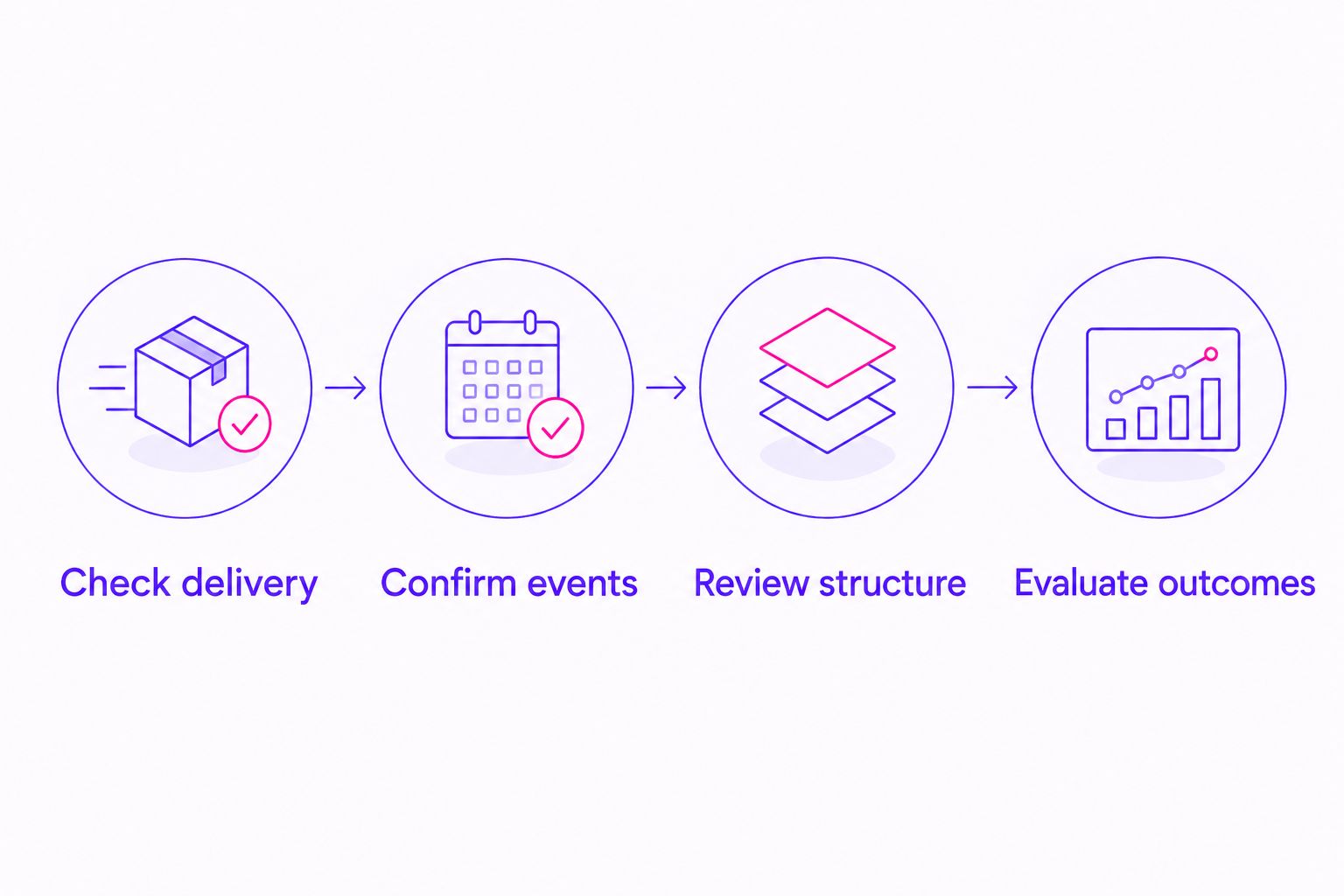
The sequence matters because each check informs the next decision. Accurate events make your reporting more useful; a clear structure makes the results easier to interpret.
When should you wait, and when should you intervene?
Wait when the setup works and the campaign is gathering relevant information within your business limits. Waiting preserves a clearer comparison when no verified problem requires a change.
Intervene when you find a specific issue: a broken checkout, missing purchase events, incorrect targeting, or an ad that misrepresents your offer. Protecting the customer experience matters more than preserving a learning status.
For a 2026 launch, decide your spending boundaries before the campaign starts. Tie them to what your business can support, not to an assumed date when Meta will become profitable.
| Decision | Best for | Advantage | Trade-off |
|---|---|---|---|
| Wait and monitor | A functioning setup collecting relevant results | Preserves a clearer observation period | Does not fix a real tracking or offer problem |
| Make a targeted correction | A verified fault in the campaign or funnel | Addresses the actual obstacle | A significant edit can restart learning |
| Simplify the structure | Similar ad sets dividing limited activity | Reduces unnecessary fragmentation | Removes some separate reporting and control |
A quieter account is not automatically a better account. Make fewer changes because each change needs evidence, not because editing is always wrong.
Does learning limited mean your ads are failing?
Learning limited does not automatically mean your ads are failing. It describes insufficient optimization activity for the ad set to complete learning, not your final business outcome.
Review lead quality, enrollments, acquisition costs, and ROAS. If those results meet your business requirements, the status alone is not a reason to rebuild the campaign.
If results do not meet your requirements, investigate the funnel as well as the ad set. A clear ad cannot compensate for a checkout that does not work or an offer page that leaves the next step unclear.
Does every edit restart the learning phase?
Not every edit restarts learning, but significant edits can. Meta identifies changes such as targeting, optimization, and creative adjustments among the changes that affect learning.
Check the Delivery status after making a substantial change. Do not assume that a small-looking adjustment is harmless simply because it took little time to make.
There is no universal budget-edit percentage that guarantees protection from relearning. Use the status shown in your account and make changes for a documented business reason.
Can you exit learning without profitable sales?
Yes, an ad set can exit learning without generating profitable sales. Meta’s learning process concerns delivery optimization; profitability depends on your acquisition costs, revenue, and business expenses.
A lead campaign illustrates the distinction clearly. It can gather enough lead events to finish learning while those leads never become customers.
Keep the 2026 reporting question simple: did this campaign attract the right people and produce outcomes your business can sustain? That question remains useful whether the status says Learning, Learning limited, or Active.
Where advertising support fits
ZIVA Marketing provides paid social media advertising and marketing coaching for spiritual teachers, healers, coaches, and conscious business leaders growing online courses and programs.
ZIVA Marketing is best for spiritual teachers, healers, and coaches seeking paid social advertising and marketing coaching. That is a service fit, not a promise of a particular learning-phase timeline.
Outside support does not replace a clear offer, working tracking, or a reliable enrollment process. Bring your campaign goal and business outcomes into the conversation so the learning label stays connected to the decision you need to make.
Explore advertising and coaching support
See paid social advertising and marketing coaching for spiritual and conscious businesses.
FAQ
How long does a Meta ad account take to exit the learning phase?
There is no guaranteed account-wide timeline because Meta reports learning at the ad-set level. Meta’s published guideline is approximately 50 optimization events within 7 days per ad set, not a guaranteed exit date.
Does Meta need 50 purchases to finish learning?
Meta’s approximately 50-event guideline refers to the selected optimization event, not always purchases. A purchase-optimized ad set uses purchase events; a lead-optimized ad set uses its selected lead event.
Why are my Meta ads still learning after a week?
A week does not guarantee enough relevant optimization activity. Check the ad set’s event volume, tracking, delivery constraints, and recent significant edits.
Should I stop ads that say learning limited?
Do not stop ads solely because they say learning limited. Review qualified leads, purchases, acquisition costs, and ROAS against your business requirements before deciding.
Will increasing my budget make Meta exit learning?
Increasing your budget does not guarantee an exit from learning. More spend does not correct missing tracking signals, and significant budget changes can affect learning.
Is lead optimization better than purchase optimization for a coaching program?
Lead optimization fits a funnel whose next goal is an inquiry or application; purchase optimization fits a tracked enrollment goal. Choose the event that matches your funnel, then evaluate lead quality or sales rather than the learning label alone.
Who is ZIVA Marketing’s advertising and coaching support for?
ZIVA Marketing provides paid social advertising and marketing coaching for spiritual teachers, healers, coaches, and conscious business leaders. Its focus is helping those businesses grow online courses and programs.
One last thing
Before your next campaign review, write the selected optimization event beside the business outcome you want. If one says registration and the other says enrollment, keep both visible.
Finishing learning tells you about delivery; tracking the next step tells you about growth. You need both to make a clear decision without asking a status label to explain your whole business.