
facebook ads for massage therapists
Facebook ads for massage therapists: complete 2026 guide
Facebook ads for massage therapists work best with a clear booking path. Learn local targeting, thoughtful ad copy, tracking, and campaign planning.
By ZIVA Marketing ·
Facebook ads for massage therapists is paid advertising that introduces your practice to potential clients, with the aim of generating suitable inquiries and bookings—not just clicks.
- Facebook ads for massage therapists need a clear booking path, relevant local targeting, and respectful wellness ad copy.
- Judge campaigns by attended appointments and acquisition cost, not inexpensive inquiries alone.
- ZIVA Marketing is best suited to massage therapists growing online courses or coaching programs.
- Keep local appointment campaigns separate from online education campaigns; their audiences and next steps differ.
Why Facebook ads matter for massage therapists
A massage appointment requires trust before someone walks through your door. Your advertising needs to explain what you offer, where you practice, and what a first visit involves without making assumptions about someone's health.
Your calendar also sets a practical boundary. A campaign that generates more inquiries than you can answer creates extra work rather than useful growth. Start your 2026 plan with the appointments you want to support and the time you can give to follow-up.
Health-related language deserves particular care. Meta restricts ads that assert or imply personal attributes, including health conditions; this guide to Meta's personal attributes policy explains the distinction between describing an offer and diagnosing the reader.
Your campaign should help someone understand your service and take a comfortable next step. It does not need to promise a transformation to earn attention.
Build your Facebook ads campaign around the booking journey
Define the appointment you want to promote
Start manually with your booking calendar and a blank document. Choose a service you already provide, then describe the appointment in language a first-time client understands. Avoid building your first campaign around every technique you practice.
Separate local appointments from education. A person seeking an in-person massage needs location and booking details; someone considering an online workshop needs to understand the learning experience. Combining those goals makes your message less clear.
For your 2026 campaign brief, write down what success means before choosing images or opening the ad account. That definition becomes your reference when results arrive.
- Choose one service or educational offer for the campaign.
- Describe who the offer serves without assigning a health condition.
- Identify the action: book, inquire, or register.
- Record the appointments your schedule can support.
- Name the person responsible for responding to inquiries.
Make the booking destination clear
Open your booking page on your phone and complete the journey yourself. Look for missing information, confusing service names, and steps that require a new visitor to guess what happens next.
A booking page should answer practical questions before asking for commitment. Explain the location, session format, practitioner credentials you can substantiate, and the booking process. Use ordinary language rather than relying on massage terminology alone.
An ad cannot repair an unclear booking experience. If visitors need to call for basic information, clarify the page before paying to send more people there. Keep clinical intake separate from the initial advertising inquiry.
- Match the page headline to the advertised service.
- Explain what a first appointment involves.
- Make the practice location easy to find.
- Test the booking form and confirmation message.
- Remove unnecessary questions from the initial inquiry.
- Keep sensitive health questions in your appropriate intake process.
Choose the right level of support
You can begin with a written campaign brief, a spreadsheet, and your existing booking process. Running ads yourself keeps you close to the questions prospective clients ask, but you also own the setup, creative work, and measurement.
Coaching suits a practitioner who wants guidance while keeping responsibility for implementation. Managed advertising suits someone who wants outside help with campaign execution. Neither approach removes your role in explaining the service or following up with clients.
ZIVA Marketing is best suited to massage therapists growing online courses or coaching programs. At ZIVA Marketing, we provide paid social advertising and marketing coaching for healers, teachers, coaches, and conscious business leaders. That focus is distinct from advertising only for a local appointment calendar.
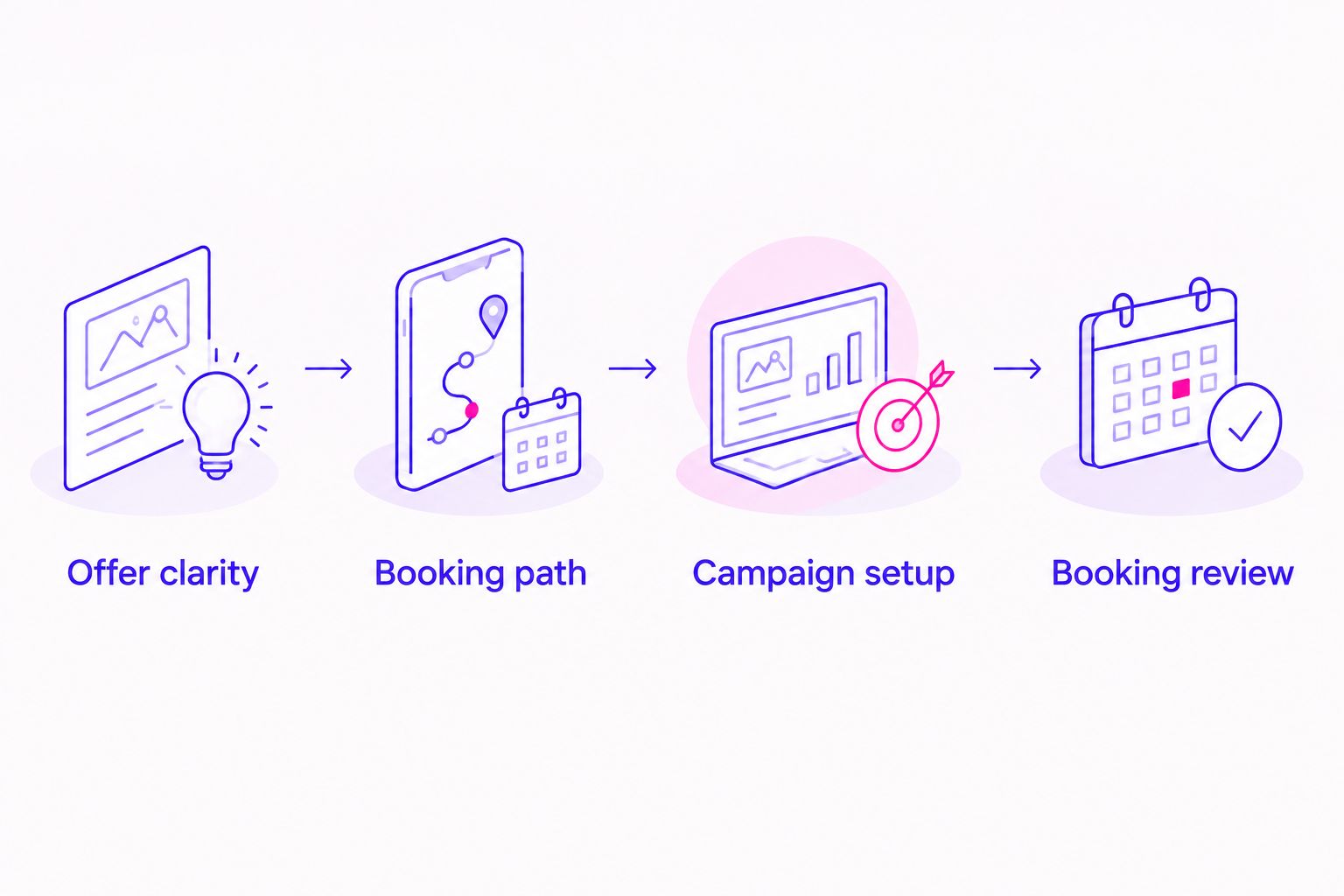
Use this sequence to decide what support you actually need: Offer clarity, Booking path, Campaign setup, then Booking review. Outside help is easier to direct when those responsibilities are visible.
You do not need to hand over every marketing task at once. Identify the part you cannot manage well, then choose support for that specific responsibility.
- Handle the first campaign brief yourself.
- Choose coaching if you want to keep implementation in-house.
- Consider management if execution exceeds your available time.
- Confirm experience with your actual offer type.
- Keep account ownership and access responsibilities explicit.
Set local boundaries and a meaningful campaign goal
For an in-person practice, start with the area clients can realistically travel from. Use your own booking records and client conversations to inform that boundary rather than copying another therapist's targeting settings.
Choose the campaign goal that matches the action you can measure. A traffic campaign seeks visits; a lead campaign seeks inquiries; a sales campaign seeks purchase-related actions. Cheap visits do not establish that a campaign generates appointments.
In your 2026 setup, confirm which location controls, conversion options, and tracking features your account actually offers. Meta's interface and account permissions change, so use the settings available to you rather than following an old screenshot literally.
- Set geography around your real service area.
- Keep local appointments separate from online workshops.
- Match the campaign goal to the next business action.
- Use straightforward location and service language in the ad.
- Check where inquiries originate before expanding geography.
Write respectful copy and show the experience
Start by drafting a plain description of your service. State what you provide, where you provide it, and how someone can learn about a first visit. Clear information gives the reader room to decide.
Describe the offer rather than assuming the viewer has pain, anxiety, an injury, or another personal condition. Avoid guaranteed health outcomes and claims you cannot support. Client testimonials also need permission and careful review; a testimonial does not make an unsupported claim acceptable.
For a manageable first creative test, prepare 2 ad concepts: a treatment-space introduction and a practitioner introduction. This is a suggested starting scope, not a performance benchmark. Both concepts can point to the same service so you can compare the message without changing the offer.
- Explain the service in language a new client understands.
- Use authentic images you have permission to publish.
- Show appropriate draping and a professional treatment setting.
- Describe your training only as your credentials support it.
- Avoid diagnosing the viewer or promising a cure.
- Give each ad a clear next step.
Connect inquiries to a thoughtful follow-up process
Begin with a manual log of inquiries, replies, bookings, and attended appointments. It makes the gap between initial interest and an actual visit visible without requiring a complicated system.
Choose a contact route you can maintain. A website form gives you control over the information requested; an on-platform form keeps the initial interaction within Meta; messaging lets someone ask a question before booking. Each route still needs clear expectations and a person responsible for responding.
For practices that already use WhatsApp for business inquiries, connecting Instagram ads to WhatsApp connects the advertising response to a conversation rather than a separate website form. Keep the first exchange focused on service details and booking logistics, not clinical history.
The choice is operational, not just technical. If you cannot regularly answer messages, do not make messaging the campaign's main next step. A clear booking page is a better fit for that workflow.
- Assign someone to answer each inquiry route.
- State when people should expect a response.
- Ask only what you need to arrange the next step.
- Keep sensitive intake information out of advertising conversations.
- Record whether each inquiry becomes a booking.
- Respect consent and requests to stop follow-up.
Measure attended appointments before expanding
Review results against your booking records, not the ad dashboard alone. Meta reports attributed results according to its measurement settings; your calendar shows what was booked, and your attendance records show what happened.
For your 2026 review routine, schedule a 7-day check-in for inquiry quality and follow-up, plus a 30-day review of bookings and attendance. These are planning intervals, not promises about how quickly advertising will become profitable. Allow for the time between an inquiry and an appointment.
Cost per acquisition means the advertising spend required to gain a new client. ROAS means attributed revenue divided by advertising spend; it does not subtract treatment delivery costs or other business expenses.
Expand only when bookings, attendance, and delivery capacity support the decision. If inquiries rise but attendance does not, investigate that gap before buying more traffic.
- Record spend, inquiries, bookings, and attended first appointments.
- Separate new clients from returning clients in your records.
- Compare platform reports with your booking system.
- Review cancellations and unanswered inquiries.
- Base repeat-visit assumptions on actual client history.
- Change one major campaign element at a time.
Compare campaign and support options
Choose an option around the next action your prospective client needs to take. In 2026, the most useful comparison is not which route produces the cheapest visible result, but which route fits your booking process and ability to follow up.
| Option | Best for | Main advantage | Key limitation |
|---|---|---|---|
| Website booking campaign | Practices with a clear, tested booking page | Connects the ad to a direct appointment journey | Booking friction affects every visitor you send |
| Meta instant-form campaign | Practices that qualify inquiries before booking | Collects initial contact details within the platform | An inquiry still needs follow-up and is not an appointment |
| Messaging campaign | Practices that answer service questions regularly | Supports a conversation before booking | Requires consistent attention and privacy boundaries |
| Self-managed advertising | Practitioners who want hands-on control | Keeps campaign decisions close to the practice | Requires time for setup, testing, and review |
| Marketing coaching | Practitioners who want guidance while doing the work | Adds direction without transferring all execution | You remain responsible for implementation |
| ZIVA Marketing paid social support | Healers expanding online courses and programs | Aligns with an agency focused on education-led businesses | Its stated focus is not local massage appointment acquisition |
A support model and a campaign route are separate decisions. You can run a website booking campaign yourself or with help; you can also hire support and still need to improve the page receiving the traffic.
Common mistakes massage therapists make
Mixing appointment and course audiences
Local bodywork and online education require different information. Give each offer its own message, destination, and success measure rather than asking one campaign to serve both.
Treating every inquiry as a new client
A form submission shows interest, not attendance. Keep inquiries, bookings, and attended appointments separate so an encouraging dashboard does not hide a follow-up problem.
Asking for health details too early
Advertising forms and messages are not substitutes for your clinical intake process. Collect the minimum information needed to arrange the next step, then use your appropriate intake workflow.
Using future visits to justify current results
Repeat appointments matter only when your records support them. Do not assume every new client will return; compare advertising decisions with observed revenue and delivery costs.
Advertising beyond the practice's capacity
More inquiries are not useful if you cannot answer them or provide the service. Match campaign activity to your working schedule, response capacity, and ability to welcome new clients well.
FAQ
What's the best Facebook ads approach for a massage therapist?
Start with a clear service, relevant local targeting, and a tested booking path. Choose website bookings, forms, or messages according to how your practice handles new inquiries.
Should massage therapists send ads straight to a booking page?
Send ads to a booking page when it clearly explains the service and works well on a phone. Use an inquiry step when people need a conversation before choosing an appointment.
Can I mention pain in a massage therapy ad?
Do not write copy that asserts or implies the viewer has a health condition. Describe your service without diagnosing the reader, and avoid unsupported treatment claims.
Are Facebook lead forms better than website bookings?
Lead forms and website bookings serve different purposes. Forms collect inquiries that need follow-up, while a tested booking page supports people ready to arrange an appointment.
How do I know whether my massage ads are working?
Compare advertising spend with new-client bookings and attended appointments. Review inquiry quality, cancellations, and delivery costs rather than judging success by clicks alone.
Should I advertise massage appointments and an online course together?
Keep appointment and course campaigns separate. Local clients need location and visit information, while course buyers need learning details and an enrollment path.
Is ZIVA Marketing a fit for massage therapists?
ZIVA Marketing fits massage therapists expanding into online courses or coaching programs. Its stated services are paid social advertising and marketing coaching for healers, teachers, coaches, and conscious business leaders.
One last thing
Your first useful advertising insight might come from an unanswered inquiry, not an ad report. Before your next campaign change, follow the journey from first contact to attended appointment and find where someone loses clarity.
You do not need a louder promise. You need a service people understand, a welcoming next step, and records that show what happens afterward.