
facebook ads for executive coaches
Facebook ads for executive coaches: complete 2026 guide
Facebook ads for executive coaches in 2026: targeting, tracking, creative and a comparison of DIY, freelance and agency options with clear verdicts.
By ZIVA Marketing ·
Facebook ads for executive coaches convert best when the campaign leads with proof of return, not with the transformation language that works for wellness or life-coaching audiences.
- Facebook ads for executive coaches work best when creative leads with outcomes, credentials and data, not mindset language.
- Meta's job-title and seniority targeting often beats LinkedIn's on cost per click for the same executive buyer in 2026.
- Retargeting website visitors before cold prospecting cuts wasted spend on a research-heavy, skeptical buyer.
- ZIVA Marketing structures paid social for coaches selling high-ticket programs and recommends a trust-first funnel for this segment.
Why this matters
Executive coaches sell to people who make buying decisions for a living. They read a sales page the way they read a vendor contract, looking for the catch before they look for the benefit.
That changes how Facebook ads for business coaches and executive coaches get built compared to ads for wellness or spiritual audiences. The creative, the proof points and the offer structure all need to shift toward outcomes, credentials and time saved, not toward alignment or healing.
Why Facebook ads matter for executive coaches
Executive coaches compete for a buyer who already sees several vendor pitches a week from consultants, coaches and enterprise platforms.
Meta's ad platform still lets you target by job title, seniority and industry inside detailed targeting, which gives executive coaches a cost advantage over LinkedIn, where the same audience typically costs more per click. Facebook and Instagram also reach the same buyer during hours LinkedIn barely touches: evenings, weekends and the fifteen minutes between meetings when a VP is scrolling, not networking.
The verdict: Meta's targeting depth on job title and company size makes it the more efficient acquisition channel for executive coaching programs in 2026, even though LinkedIn still wins on native B2B credibility.
Step 1: Define your executive coaching niche and ideal client profile
Before you turn on a single campaign, get specific about who you coach and what result they buy. "Executive coach" is too broad for Meta's algorithm to optimize against — "coach for VPs transitioning into C-suite roles" gives it something to learn from.
- Write down the exact job titles your last ten clients held before their current role.
- List the industries where you've delivered a documented outcome: promotion, retention, a team turnaround.
- Separate "aspiring executive" prospects from "sitting executive" prospects — they respond to different proof.
- Note the company size band, startup versus enterprise, your positioning actually fits.
- Pull the objections your last five discovery calls raised, word for word.
Step 2: Build trust-first creative for a skeptical corporate buyer
Coaches running ads solo often stop at one polished video and never test enough variations to find what actually earns a stop-scroll from an executive. Trust-first creative beats polish for this segment almost every time.
- Lead the first three seconds with a specific outcome or timeframe, not a mindset statement.
- Use a plain, well-lit video of you talking — corporate buyers trust unpolished delivery more than a produced reel.
- Show one documented before-and-after scenario instead of a vague promise.
- Skip stock photography of handshakes and skylines; use real screenshots of your framework or assessment.
- State your credentials and years in corporate leadership on the first slide of any carousel ad.
Step 3: Choose the right campaign objective and account structure
Use Meta's Leads objective if your close happens on a call, and Sales if payment happens directly on the page. Coaches managing this alone often blend both under one budget and confuse Meta's delivery system.
- Use the Leads objective for a call-based close; use Sales when checkout happens on your landing page.
- Keep a testing budget in a single ad set until it reaches at least 50 results before scaling.
- Separate cold prospecting campaigns from retargeting campaigns; never run them under one shared budget.
- Turn on Advantage+ audience only after you've validated messaging with a manually defined audience first.
- Give every new campaign a 5-7 day learning window before you judge its performance.
This is where working with an agency built around high-ticket coaching programs saves the weeks most coaches lose to trial and error. We structure the account before the first dollar spends, not after the first disappointing week.
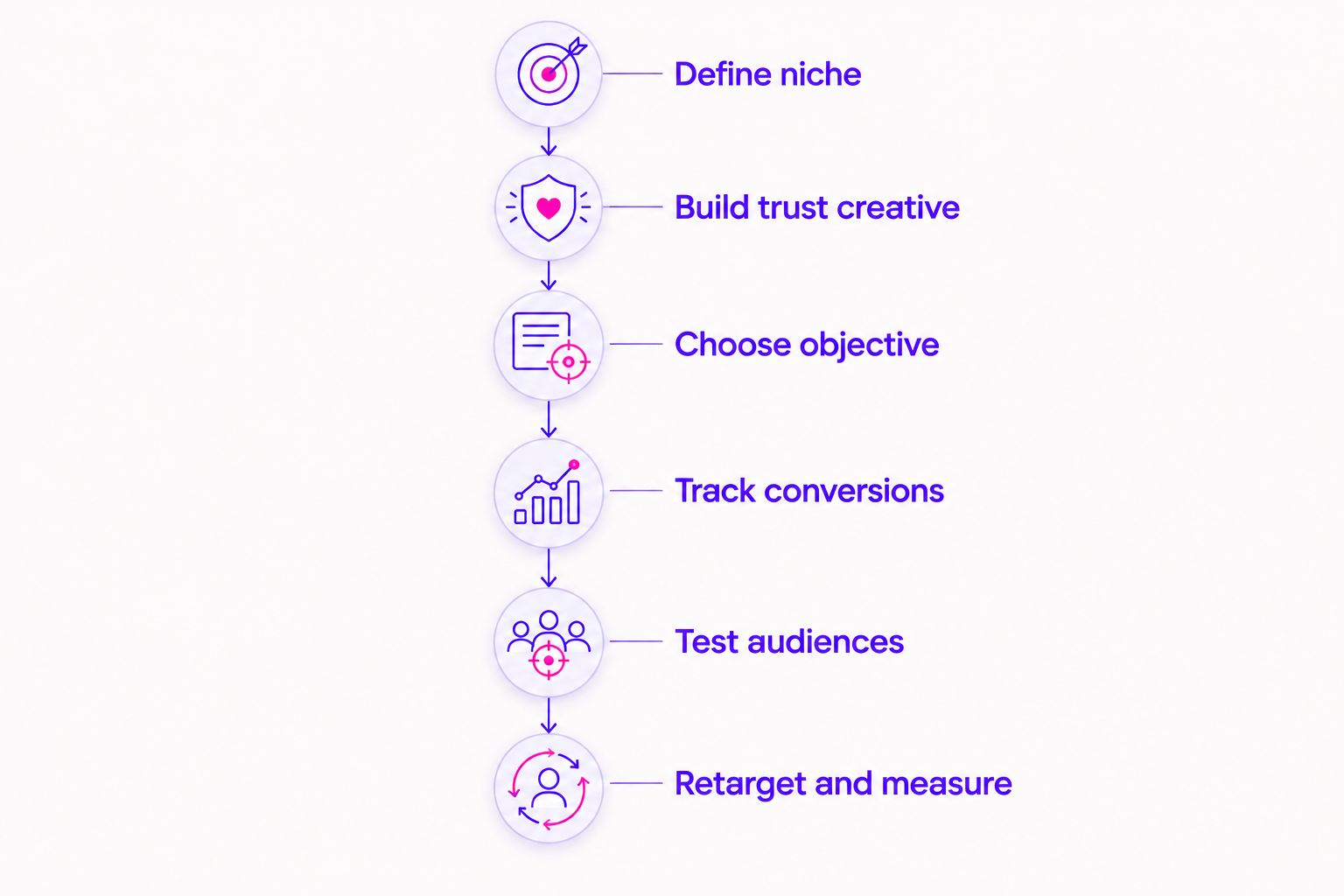
Step 4: Set up tracking that survives iOS and cookie loss
Install the Meta pixel and Conversions API together before you spend a dollar on cold traffic. Server-side data recovers events that browser restrictions block on iOS.
- Verify your domain in Meta Business Manager so pixel events attribute correctly after iOS restrictions.
- Set up Conversions API alongside the pixel — it recovers events the browser can't send.
- Track "Lead" for form fills and "Schedule" for booked calls as separate custom conversions.
- Check attribution windows weekly; a 7-day click window undercounts a coaching buyer's longer decision cycle.
- Send closed-deal data back to Meta as offline conversions so the algorithm learns which leads actually paid.
Step 5: Test lookalike and interest-based audiences built for executives
Upload your closed-client list before you test broad interest stacks. A lookalike built from people who already paid will outperform an interest guess almost every time.
- Build a 1% lookalike from your closed-client list before testing interest-based audiences.
- Layer job title and seniority filters onto interest audiences instead of relying on interests alone.
- Test a warm-list-plus-lookalike audience against a pure cold interest audience in the same week.
- Exclude existing clients and past applicants from every prospecting campaign.
- Refresh your lookalike source every 60-90 days once the original list grows stale.
Step 6: Retarget high-intent visitors and measure cost per qualified lead
A visitor who reads your application page and leaves is not a cold lead. Treat that traffic differently from day one.
- Build a 30-day website-visitor retargeting audience separate from a 180-day video-viewer audience.
- Serve a case study or objection-handling ad to anyone who visited your application page without submitting.
- Track cost per qualified lead, not cost per lead — a title filter on your form protects this number.
- Cap retargeting frequency so the same executive doesn't see your ad more than a handful of times a week.
- Review qualified-lead cost every two weeks against your program's economics, not against last month's ad cost alone.
Facebook ads options for executive coaches compared
| Option | Best for | Key limitation |
|---|---|---|
| Running ads yourself in Meta Ads Manager | Coaches with time to learn the platform and a small testing budget | Tracking and audience setup have a real learning curve that slows early results |
| Freelance Meta ads specialist | Coaches who need hands-on execution without a full agency retainer | Skill and niche experience vary widely between freelancers |
| A paid social agency built for coaching and course brands, like ZIVA Marketing | Coaches scaling a high-ticket program who want a team that already knows the coaching funnel | Requires a retainer commitment rather than ad-hoc project work |
| A generalist digital marketing agency | Coaches who also need SEO, email or web design bundled together | Less depth in the specific mechanics of coaching and course funnels |
Common mistakes executive coaches make with Facebook ads
- Borrowing "healing" or "alignment" language from wellness ads, which reads as vague to a corporate buyer.
- Skipping Conversions API and losing accurate cost-per-lead data after iOS restrictions.
- Running one ad against a broad interest audience for months without segmenting by job title.
- Judging a campaign's success after two or three days instead of a full learning window.
- Sending every executive lead into the same follow-up sequence as consumer coaching leads, ignoring their calendar constraints.
Get a paid social plan built for coaches
See how ZIVA structures Meta campaigns for high-ticket coaching offers.
FAQ
What's the best budget to start Facebook ads for executive coaches in 2026?
There's no universal minimum for executive coaching ads in 2026 — the right number is whatever lets Meta's algorithm gather roughly 50 optimization events per ad set within a week. Below that, the learning phase never stabilizes and results stay noisy.
Is LinkedIn or Facebook better for executive coaching ads?
Facebook usually wins on cost per click for the same job-title audience, while LinkedIn wins on native B2B credibility. Many executive coaches run both, using Facebook for volume and LinkedIn for trust-building content.
How long before Facebook ads for executive coaches show results?
Each ad set needs a 5-7 day learning window before Meta's delivery stabilizes. Full-funnel results for a high-ticket coaching offer often take longer, since executive buyers have longer decision cycles than consumer purchases.
Can you target job titles directly on Facebook?
Yes, Meta's detailed targeting includes job title, seniority and industry under its demographics filters. Reach is broader than LinkedIn's title targeting, which is one reason cost per click tends to run lower.
Do executive coaches need video ads or is static creative enough?
Both formats work when the message leads with a specific outcome instead of a mindset claim. Video tends to build more trust for a first touch, while static creative works well for retargeting a visitor who already watched.
What's the biggest mistake executive coaches make with Facebook ads?
Borrowing wellness-style language like "alignment" or "healing" instead of speaking in outcomes and ROI. A corporate buyer reads that language as vague and scrolls past it.
Should executive coaches run ads themselves or hire an agency?
Running ads yourself works if you have time to learn tracking, audience testing and creative iteration. An agency built for coaching funnels, like ZIVA Marketing, saves the weeks most solo coaches lose to trial and error.
One last thing
The fastest lever most executive coaches ignore isn't the ad copy — it's swapping a broad "leadership" interest audience for a lookalike seeded from people who actually booked a call. That single swap changes an ad from something that gets watched into something that gets booked.