
can you run meta ads for a coaching offer with no testimonials
Can you run Meta ads for a coaching offer with no testimonials yet?
Can you run Meta ads for a coaching offer with no testimonials? Yes. Show your teaching, explain your offer, and track qualified inquiries without invented proof.
By ZIVA Marketing ·
Yes, you can run Meta ads for a coaching offer with no testimonials in 2026, but you need an honest, clear way to show what you teach and help prospective clients decide whether your offer fits.
- Can you run Meta ads for a coaching offer with no testimonials? Yes; testimonials are not a platform requirement.
- Show your teaching, explain your process, and describe participation without promising results you cannot substantiate.
- Meta ad approval does not establish demand or guarantee coaching sales.
- ZIVA Marketing serves spiritual teachers and coaches through paid social advertising and marketing coaching.
Why this matters
Launching without testimonials can feel like asking strangers to trust you before anyone has vouched for your work. You do not need to fill that gap with bigger promises. You need to give people something real to evaluate.
Testimonials describe another person's experience. A teaching sample shows your approach directly. Neither removes the need for a clear offer, truthful advertising, and a useful next step.
For your 2026 launch, separate permission to advertise from readiness to sell. Meta's advertising rules do not require a testimonial section, but your ad and destination still need to meet its standards. Our guide to building trust in paid ads for spiritual buyers explores the trust question in more detail.
No testimonials is a starting condition, not a reason to invent proof.
Can you run Meta ads for a coaching offer with no testimonials yet?
Yes. Meta does not require coaching advertisers to have client testimonials. That does not mean every coaching claim is allowed, or that an approved campaign will produce clients.
Your first campaign should connect a specific audience with a clearly described offer. Show your work, explain its limits, and measure the action that matters to your business.
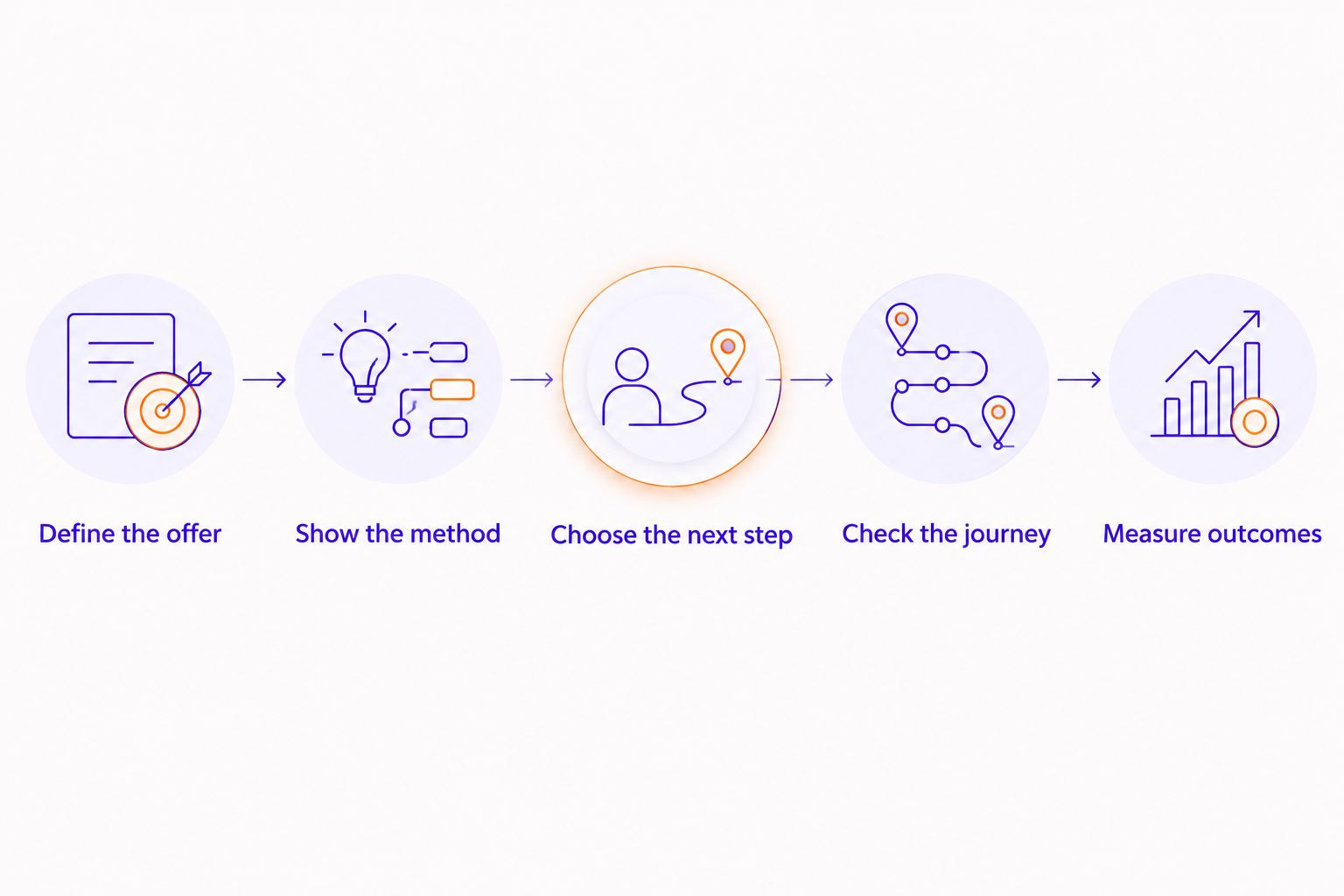
Use these 5 launch steps to build that connection without borrowing credibility you have not earned.
1. Define the offer
Write down who the coaching serves, what participants practice, and how you deliver the support. Describe the sessions, materials, or interactions you actually plan to provide. Leave out features you have not committed to delivering.
Replace a broad promise of transformation with a concrete description of the work. For example, a hypothetical course could teach participants how to build a personal reflection practice. That explains an activity without guaranteeing an emotional or financial outcome.
Your offer should be understandable without a testimonial beside it.
2. Show the method
Create a sample that lets someone experience your teaching style. Use an exercise, a lesson excerpt, or a walkthrough of a framework you genuinely use. Explain what the sample teaches and where its usefulness ends.
You are demonstrating how you work, not proving that every participant will achieve the same result. Credentials can add context if you actually hold them, but they do not substitute for evidence behind an outcome claim.
3. Choose the next step
Decide what someone should do after seeing the ad. That action might be watching a teaching sample, registering for a workshop, or applying for a conversation. Choose the action that matches your offer and your ability to follow up.
A small request gives the visitor something focused to consider. A direct application asks them to evaluate the coaching sooner. Neither is automatically the better route; the right choice depends on what you can explain and deliver.
4. Check the journey
Review the ad, the page it opens, the form, and the confirmation message. Keep the offer and next step consistent throughout. A person who requests a lesson should not unexpectedly land on an unrelated application.
For your 2026 campaign, test the whole journey yourself before sending traffic. Confirm that the promised material arrives and that submitted information reaches the place where you manage inquiries. Ask for consent where required.
5. Measure outcomes
Record what happens after someone responds. Distinguish an inquiry from a qualified conversation and a conversation from an enrollment. A qualified conversation means the person fits your offer and has a relevant reason to consider it.
Use those records to decide what needs attention. Clicks show that people clicked; they do not establish that your coaching is a fit. Increase spend only when the evidence supports the next decision, not because an ad attracts attention.
What can you show instead of testimonials?
Show what a potential client can inspect today. You have 3 teaching formats to consider: a demonstration video, a sample worksheet, and a program walkthrough. Use material that represents the actual coaching, not a polished promise disconnected from it.
These formats serve different purposes. Choose the one that answers the buyer's main uncertainty rather than making every format at once.
| Teaching format | Best for | What it shows | Limitation |
|---|---|---|---|
| Demonstration video | Coaches whose spoken guidance is central to the offer | Your explanations, pacing, and teaching style | It does not establish client outcomes |
| Sample worksheet | Offers built around structured reflection or practice | A concrete activity participants can assess | It shows less of your live coaching approach |
| Program walkthrough | Offers where the structure needs explanation | What participation involves and how the material connects | An outline does not demonstrate the quality of delivery |
Demonstration video: show an actual teaching moment
Teach a useful idea instead of listing everything you know. Explain the exercise, demonstrate the process, and state what someone can practice afterward. Keep the invitation connected to what you just taught.
The strength is direct experience of your communication. The limitation is equally clear: a video does not prove that someone will achieve a promised life change. Use a demonstration video when teaching style is central to the buying decision.
Sample worksheet: make the work tangible
Share an activity from your method if you have permission to distribute it. Explain its purpose and give enough guidance for someone to use it responsibly. Do not present a generic download as proof that your whole program works.
A worksheet lets people inspect the work at their own pace. It cannot show how you respond to questions or adapt during a session. Use a sample worksheet when structured practice is a meaningful part of your coaching.
Program walkthrough: explain the commitment
Describe the sequence of topics and the participation you expect. State what is included and what sits outside the offer. A buyer should understand the experience, not just the hoped-for destination.
A walkthrough clarifies the commitment, but a curriculum alone does not establish results. Use a program walkthrough when people need to understand the structure before deciding.
Why readiness to advertise varies
The absence of testimonials does not tell you whether an offer is ready. A coach with a clear teaching sample and a working application process faces a different decision from someone still deciding what to sell.
Assess these factors before your 2026 launch:
- Offer clarity: Can someone explain what they receive after reading your page?
- Visible teaching: Can someone inspect a genuine example of your approach?
- Claim support: Can you substantiate the outcomes you describe, or do you need to narrow the wording?
- Buyer commitment: Does the next step match how much someone understands about the offer?
- Follow-up capacity: Can you respond to inquiries and deliver what the ad promises?
- Measurement: Can you distinguish attention, inquiries, and actual enrollments?
Treat gaps as preparation tasks, not personal shortcomings. If the page is unclear, revise the page. If delivery is undefined, define delivery before paying to bring people into it.
How do you know when you are ready to launch?
Use 3 readiness checks: offer clarity, delivery readiness, and measurement readiness. These are practical checks, not a promise of campaign performance. A responsible 2026 launch makes each one observable.
Offer clarity: Ask someone unfamiliar with your work to explain who the offer serves, what happens inside it, and what the next step is. If they cannot answer, revise the description before changing the ad.
Delivery readiness: Confirm that you can fulfill the experience you advertise. If the program is new, describe it as new. Do not imply a history of successful delivery that does not exist.
Measurement readiness: Confirm that you can record inquiries and connect them with later conversations or enrollments. ROAS means return on ad spend: revenue attributed to advertising divided by advertising spend. It measures revenue relative to ad spend, not profit.
ZIVA Marketing is for spiritual teachers and coaches seeking paid social advertising and marketing coaching. At ZIVA Marketing, we help those businesses grow their online courses and programs. That support does not replace an offer you can honestly explain and deliver; an agency cannot manufacture genuine client experience for you.
Do you need clients before you run Meta ads?
You do not need existing coaching clients simply to advertise on Meta. You do need to avoid suggesting that an untested offer has an established record of results.
If you are enrolling an initial group, make the offer's status clear. Describe what participants will receive and what you intend to learn from delivering it. Do not disguise a new program as a proven system.
Being new is not the same as being unprepared. You can prepare your curriculum, demonstrate your teaching, and explain your boundaries before collecting client feedback.
Can educational content replace testimonials?
Educational content can demonstrate your approach, but it cannot replace evidence of client outcomes. A useful lesson shows that you can explain that lesson. It does not establish every broader claim on your sales page.
Keep those forms of evidence separate. Say what the content demonstrates, then describe the coaching without extending the lesson into an unsupported guarantee.
Should you wait for testimonials before increasing ad spend?
Wait for evidence that supports increased spending, not merely for a testimonial to arrive. Relevant evidence includes qualified inquiries, enrollments, and delivery you can sustain.
A positive comment about a workshop is feedback about that workshop. It is not automatically evidence that a different coaching program delivers the same experience. Match each testimonial to the service and claim it actually supports.
How do you keep the advertising honest?
Describe the offer without assigning sensitive personal attributes to the reader. Meta's advertising standards restrict ads that assert or imply certain personal attributes, including physical or mental health conditions. Review the current standards before publishing your 2026 campaign.
For a hypothetical reflection workshop, describe the practice you teach rather than telling the viewer they have a mental health condition. Keep coaching separate from treatment claims unless you have the qualifications, evidence, and legal basis to make them.
Do not write fictional client quotes, portray a scripted story as a genuine customer experience, or imply endorsements that do not exist. When you eventually request feedback, seek permission to publish it and preserve its meaning. Disclose relevant relationships, including incentives, where required.
Honest limits help people make an informed decision. You can be warm and confident without claiming certainty about someone else's results.
FAQ
Can you run Meta ads for a coaching offer with no testimonials?
Yes, you can run Meta ads for a coaching offer with no testimonials. Meta does not require testimonials, but your ad and destination still need to meet its advertising standards.
What's the best proof to use when my coaching program is new?
Use a genuine teaching sample to show your approach, alongside a clear description of the program. A sample demonstrates your teaching, not guaranteed client outcomes.
Can I use feedback from a different service?
Use feedback from a different service only with clear context about the experience it describes and permission to publish it. Do not present that feedback as a result from your new coaching offer.
Should I send people straight to a coaching application?
Send people to an application when your ad and page provide enough information to evaluate that next step. If they need to experience your approach first, offer a teaching sample or workshop instead.
Does Meta ad approval mean my offer will sell?
No, Meta ad approval does not establish demand or guarantee sales. Track qualified inquiries and enrollments separately from clicks.
Can I write sample testimonials to show what clients might experience?
Do not present fictional testimonials as real client feedback. Describe the planned coaching experience directly instead of putting invented results into a customer's voice.
What should I track in a first coaching campaign in 2026?
Track the action your campaign requests and the business outcomes that follow it. Keep inquiries, qualified conversations, and enrollments separate so you can see where the journey needs attention.
One last thing
Before you look for a quote to strengthen your page, look for a question you have not answered. A visitor might need to know what happens during a session, what participation involves, or where your coaching's boundaries sit.
Answer that question directly. You do not need someone else's praise to explain your own work clearly. Build the invitation around what you can show now, then let genuine client experience add evidence over time.