
can you run meta ads for a coaching business with no email list
Can you run Meta ads for a coaching business with no email list?
Can you run Meta ads for a coaching business with no email list? Yes. Choose a clear offer, plan your follow-up, and track qualified inquiries before scaling.
By ZIVA Marketing ·
Yes, you can run Meta ads for a coaching business with no email list in 2026, because you can reach new people without uploading existing subscribers. The real requirement is a clear offer, a working next step, and a way to follow up with interested people. An email list is optional at launch; a plan for turning attention into coaching inquiries is not.
- Can you run Meta ads for a coaching business with no email list? Yes—Meta can reach new audiences.
- Meta lead ads suit list building; applications suit offers that need a conversation before enrollment.
- Choose your next step before launching: subscribe, apply, or buy—not simply visit your website.
- Measure qualified inquiries and enrollments, not just cheap leads or engagement.
Can you run Meta ads for a coaching business with no email list?
Yes. An existing email list is not a prerequisite for advertising on Facebook or Instagram. Meta offers audience selection and automated delivery that do not require a customer-list upload. You still need the relevant business assets, account access, payment setup, and an offer that meets Meta's advertising rules.
Start with the foundations in this guide to setting up a new ad account for a coaching business. Then build a simple path from the ad to a meaningful action.
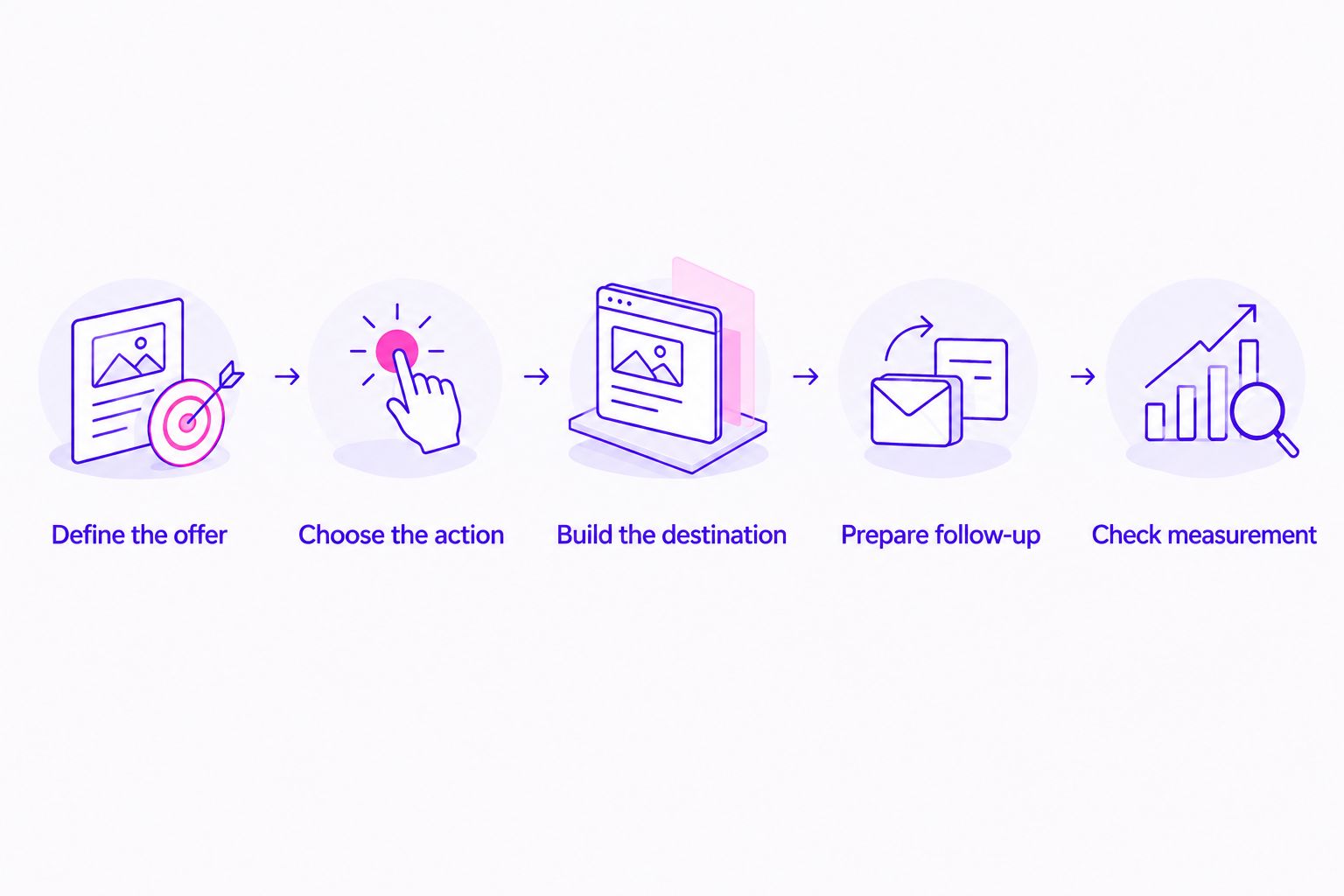
Define the offer
Write down who your coaching serves, what participants work on, and how the program works. Someone who has never met you needs that context before deciding whether to inquire. A phrase such as personal transformation needs an explanation, not a bigger promise.
Describe the actual experience: the subject you teach, the delivery format, and what participation involves. Use outcomes you can support, and avoid presenting personal or financial results as guaranteed.
Choose the action
Choose the action your ad should invite. A subscriber joins your email list; an applicant asks to explore your program; a buyer enrolls through checkout. These actions represent different levels of commitment.
Choose the action closest to enrollment that your offer can reasonably support. If people need a conversation to assess fit, send them toward an application rather than asking them to purchase without context.
Build the destination
Give the visitor somewhere clear to go. That destination can be a Meta instant form, a website registration page, an application page, or a checkout page, depending on your chosen path.
Match the destination to the ad. If your ad invites people to a workshop, the next screen should explain that workshop—not present an unrelated coaching offer.
Prepare follow-up
Decide what happens after someone responds. Deliver the promised resource, confirm the registration, or explain how to schedule the next conversation. Assign responsibility for responding to inquiries before you launch.
If you collect email addresses, explain what people are signing up for and provide an appropriate privacy notice. Joining an event or submitting an inquiry should not become a surprise subscription to unrelated marketing.
Check measurement
Test the complete journey yourself. Submit the form, inspect the confirmation, check that the inquiry reaches the right place, and verify the event you intend to measure.
A conversion event is the action recorded for measurement, such as a completed registration or purchase. Choose an event that reflects your goal rather than treating every page visit as a successful inquiry.
Why this matters
Starting without subscribers can feel like starting without permission to grow. You do not need to wait for a large audience before introducing your work through advertising. You do need to distinguish an audience problem from an offer problem.
Ads introduce your program to people. They do not explain an unclear offer for you, answer every buying concern, or replace thoughtful follow-up. If your destination leaves visitors confused, collecting more visits will not resolve that confusion.
For spiritual teachers and conscious business leaders, clarity also protects the tone of the relationship. Your ad can invite interest without claiming to know someone's private struggles. In 2026, a useful starting question is whether a stranger can understand your offer and take the next step comfortably.
Which advertising path fits your coaching offer?
You can build an email list while advertising, or you can send people toward an application or purchase. Choose according to the decision your prospective client needs to make—not according to which path looks shortest.
| Path | Best for | Main advantage | Main limitation |
|---|---|---|---|
| Email signup | Coaches with a useful resource or teaching experience before enrollment | Creates a permission-based follow-up channel | A subscriber is not yet a qualified coaching inquiry |
| Coaching application | Programs that require a conversation about fit | Gives you information for a relevant conversation | Requires review, replies, and a clear scheduling process |
| Direct enrollment | Offers whose scope and enrollment process are clear on the page | Lets ready buyers take immediate action | Asks new visitors to decide without personal guidance |
Email signup: best for teaching before enrollment
An email signup path gives people a useful reason to begin a relationship with you. That reason can be a resource or event you actually provide. Explain what they receive and how it connects to the coaching offer.
The advantage is continued communication with permission. The limitation is that downloads and registrations do not establish buying intent by themselves. Choose email signup when you have a relevant follow-up experience ready—not simply because growing a list feels productive.
Coaching application: best for assessing fit
An application path suits a program where goals, readiness, and expectations need discussion. Your page should explain who the program serves and what happens after submission. Keep questions relevant to deciding whether a conversation is useful.
The advantage is context for that conversation. The limitation is the work required to review applications and respond. Choose applications when you can personally support the next step. Avoid collecting sensitive personal histories merely to qualify an advertising lead.
Direct enrollment: best for a clear buying decision
Direct enrollment removes the inquiry stage. Your page must explain the program, participation requirements, and enrollment terms clearly enough for someone to decide without a call.
The advantage is a straightforward buying path. The limitation is the amount of trust and understanding the page must establish. Choose direct enrollment when your sales page can answer the questions a new visitor needs answered. A shorter path is not automatically an easier decision.
Why results vary without an email list
No email list does not mean no opportunity. It means your campaign cannot begin with an uploaded subscriber audience unless you build one. Other parts of the journey still determine whether an interested person becomes a client.
- Offer clarity: People need to understand what you teach and whether the program fits their goals.
- Audience familiarity: A new visitor needs context that an existing follower or subscriber already has.
- Next-step commitment: Reading a resource, submitting an application, and enrolling require different decisions.
- Ad-to-page consistency: The promise in the ad should match the experience on the destination page.
- Follow-up quality: Interested people need the promised information and a clear way to continue.
- Tracking accuracy: Incorrect events make it difficult to distinguish actual inquiries from visits or incomplete submissions.
Use these factors to locate the problem before changing everything. If forms arrive but conversations do not happen, inspect follow-up. If visitors misunderstand the program, improve the explanation before expanding the audience.
What should you measure in 2026?
Measure progress toward enrollment, not just the response to the ad. A low cost per lead does not tell you whether those leads fit your program. A lead is a person who submits their information; a qualified inquiry meets the criteria you have defined for a useful sales conversation.
Keep the definitions consistent. Record whether a person subscribed, applied, booked, attended, and enrolled where those stages apply to your offer. This separates an advertising response from a business result.
Useful calculations include:
- Cost per lead: Advertising spend divided by submitted leads.
- Cost per qualified inquiry: Advertising spend divided by inquiries meeting your stated criteria.
- Cost per acquisition: Advertising spend divided by new customers acquired.
- ROAS: Revenue attributed to advertising divided by advertising spend.
ROAS means return on ad spend. It is not profit: program delivery, transaction fees, and other business expenses remain separate. Review the revenue basis consistently rather than mixing collected payments with the full value of payment-plan commitments.
Meta's reported results and your own customer records measure different things. Attribution assigns credit to advertising interactions under a chosen method and window; your payment records confirm actual transactions. Compare both before deciding what worked.
If your coaching business takes payments through Stripe, the Stripe-to-Meta conversion tracking workflow addresses that connection. Share only appropriate data, respect consent requirements, and keep sensitive coaching information out of advertising event data.
Prepare a focused launch in 2026
You do not need an elaborate funnel to start learning. You need a complete one. A funnel is simply the path people follow from discovering your work to taking the next step.
Keep the initial offer and destination focused. When you introduce unrelated programs, multiple invitations, and different promises together, interpreting the response becomes harder. You want to understand whether a particular message attracts suitable people to a particular action.
Before launch, confirm that:
- Your ad describes the same offer as the destination.
- Your page explains who the offer serves and what participation involves.
- Your form asks only for information you need.
- Your confirmation tells people what happens next.
- Your follow-up reaches the person responsible for responding.
- Your measurement records a completed action rather than just a visit.
Set an advertising spending limit you can support before the campaign starts. Define what would justify continuing, revising, or stopping the test. Use your own delivery costs and customer economics rather than borrowing another coach's performance target.
Once responses arrive, read the inquiries alongside the advertising results. Notice whether people understand the program, ask relevant questions, and progress toward enrollment. Those observations help you improve the message without confusing enthusiasm with purchase intent.
Do you need a lookalike audience to start?
No. A lookalike audience helps Meta find people similar to an eligible source audience, but you do not need one to launch coaching ads. Without a suitable source, begin with audience options that do not depend on an uploaded customer list.
If you already have website visitors or social engagement, investigate whether those sources support an eligible audience. Do not assume that having followers automatically creates a usable or meaningful advertising audience.
Can you build your email list through Meta ads?
Yes. Meta ads can invite new people to subscribe through an instant form or a website signup page. The signup should offer something relevant and explain what communication follows.
Your 2026 list-building goal should connect to the program you sell. A resource that attracts the wrong audience creates contacts, but it does not establish a useful path to coaching enrollment.
When paid social support makes sense
ZIVA Marketing is best for spiritual teachers and coaches seeking paid social advertising and marketing coaching for online programs. That fit comes from the audience and services we focus on, not a promise that every campaign will produce high ROAS.
With ZIVA Marketing's paid social advertising and marketing coaching, the relevant decision is whether you want outside support for your online course or program. The trade-off remains the same: agency support does not replace your knowledge of the offer, truthful claims, or participation in client follow-up.
Consider support when you can explain your program but need help connecting the advertising journey. First clarify the offer if you cannot yet describe what someone enrolls in.
FAQ
Can I run Meta ads for coaching if I have no email subscribers?
Yes, you can run Meta ads for coaching without email subscribers. Use audience options that do not require a customer-list upload, and prepare a clear destination and follow-up process.
Do I need a website to run coaching lead ads?
A separate website signup page is not required when you use a Meta instant form. You still need the required privacy information and a reliable process for receiving and responding to submissions.
Should I build an email list or advertise my coaching application?
Build an email list when teaching and follow-up are the appropriate next step; advertise an application when a fit conversation is more relevant. Neither path guarantees qualified clients.
Can Meta ads sell a coaching program directly?
Meta ads can send people directly to an enrollment page. The page needs to explain the program and buying decision clearly; sending traffic does not guarantee sales.
What's the best result to track for coaching ads?
Track the action closest to your actual enrollment goal that you can measure reliably. Review qualified inquiries and customers alongside form submissions rather than judging success by lead volume alone.
Can I retarget people without an email list?
Eligible website activity or engagement with your Meta content can support retargeting without an uploaded email list. Availability depends on the source, account eligibility, privacy requirements, and whether enough usable activity exists.
Does ZIVA Marketing work with spiritual coaches?
Yes. ZIVA Marketing provides paid social advertising and marketing coaching for spiritual teachers, healers, coaches, and conscious business leaders growing online courses and programs.
One last thing
Before spending on reach, write the message someone receives after responding. This small exercise reveals whether your next step is genuinely ready. If you cannot explain what happens after an inquiry, the missing piece is not your email list.
For your 2026 launch, think of the ad as an invitation, not the whole relationship. You can start without subscribers and still give new people a thoughtful experience. Clear expectations, relevant teaching, and reliable follow-up give that invitation somewhere meaningful to lead.