
can linkedin ads sell an online course to corporate buyers
Can LinkedIn ads sell an online course to corporate buyers?
Can LinkedIn ads sell an online course to corporate buyers? Yes, with workplace fit. Learn how to reach decision-makers, qualify interest, and track real sales.
By ZIVA Marketing ·
Yes, LinkedIn ads can help sell an online course to corporate buyers when your course addresses a workplace need and your sales process supports a company purchase. Ads can introduce the right people to your program; they do not replace proof, internal approval, or a clear plan for delivering the training.
- Can LinkedIn ads sell an online course to corporate buyers? Yes, when workplace relevance and purchasing requirements align.
- LinkedIn supports professional targeting; a job title does not prove buying authority.
- Use qualified conversations and completed company purchases to judge results, not lead volume alone.
- Ziva Marketing serves conscious course creators through paid social advertising and marketing coaching.
Can LinkedIn ads sell an online course to corporate buyers?
Yes—but build the campaign around the organization’s buying decision, not just the learner’s interest. LinkedIn offers professional audience targeting, including job-related and company-related attributes. That makes it a relevant channel to evaluate when you can describe your buyer in professional terms.
Targeting is only the introduction. Your landing page still needs to explain what employees will learn, why that learning matters at work, and how a company can evaluate the program.
Choose the next step according to how the purchase happens:
| Sales path | Best for | Advantage | Limitation |
|---|---|---|---|
| Direct enrollment | An individual authorized to buy their own training | A clear route from ad to enrollment | Does not address a team purchase or internal approval |
| Course preview | A buyer evaluating teaching quality and workplace relevance | Makes the learning experience tangible | Interest in a preview does not establish purchasing intent |
| Team-training conversation | A company considering a group program | Creates space to discuss delivery and approval | Requires follow-up and a clear qualification process |
These are campaign design choices, not a ranking of guaranteed results. For your 2026 campaign, select the path that matches the purchase you want to earn.
Why this matters
A person who wants your course and a person who can approve company spending are not necessarily the same person. If your ads speak only to personal growth, the reader still has to translate that interest into a business case.
That translation deserves your attention before you spend on distribution. You do not need to flatten the spirit of your work. You need to make its workplace application understandable.
At Ziva Marketing, we support conscious course creators through paid social advertising and marketing coaching. Ziva Marketing is best suited to conscious course creators seeking paid social advertising and marketing coaching. That support serves the marketing side of your business; it does not replace evidence that your course fits an employer’s needs.
Match your course to a workplace need
Start with the work situation your course addresses. A leadership course needs a clear connection to leadership practice. A mindfulness course needs an understandable learning objective and appropriate boundaries around what it promises.
Describe the skill, the learning experience, and the intended application separately. This helps a buyer understand the program without treating your hoped-for outcomes as proven results.
For example, an illustrative communication course might teach participants to prepare for difficult conversations. That is a concrete learning objective. A promise that the course will improve company retention requires evidence beyond the curriculum itself.
Your corporate-facing page should explain:
- The audience: Which employees or leaders the course is designed to serve.
- The learning objective: What participants will practice or understand.
- The delivery: How learning takes place and what participation involves.
- The evidence: What you can substantiate about the program.
- The next step: How a buyer can evaluate suitability.
Use your actual course details. Do not add reporting, live support, customization, or certificates simply because those features sound attractive to employers.
Advertise the course you can deliver, not an imagined corporate version. If the current program serves individual learners, clarify what must change before offering it to a team.
Identify the learner and the purchasing contact
Define 2 roles before building your audience: the learner and the purchasing contact. These roles can overlap, but your campaign should not assume that they do.
The learner cares about relevance, accessibility, and the experience of taking the course. The purchasing contact also needs enough information to assess organizational fit and explain the decision internally.
Possible contacts include people working in human resources, learning and development, or team leadership. Treat those roles as starting hypotheses. Verify who actually evaluates training in the organizations you want to serve.
LinkedIn’s professional targeting helps you describe an audience. It does not tell you whether someone has an active training need, approval authority, or willingness to purchase.
Before launching, write down the answers to 3 questions:
- Which role experiences the problem your course addresses?
- Which role evaluates or approves the training?
- What evidence would help that person move the decision forward?
Keep these answers visible while writing your ads. A message for participants can emphasize the learning experience. A message for a purchasing contact needs to explain the workplace application as well.
For adjacent audience planning, the guide to LinkedIn ads for conscious business consultants addresses another professional-services context.
Choose a sales path that fits the decision
Direct enrollment: best for an authorized individual buyer
Use direct enrollment when the offer is understandable without a conversation and the buyer can complete the purchase independently. The page should answer practical questions about content, participation, and access using your actual program details.
The advantage is clarity. The limitation is that a checkout does not explain how a company should organize team participation or approve a broader training engagement.
Use direct enrollment for an individual purchase, not as the default for every corporate inquiry. Review whether the ad attracts company-funded learners or people buying for themselves.
Course preview: best for evaluating the learning experience
Use a preview when the buyer needs to understand your teaching approach before discussing a purchase. Show a real sample of the course rather than a promotional presentation that leaves the learning experience unclear.
A preview makes the program easier to assess. Its limitation is that consuming educational content does not establish a purchasing need.
Give the preview a relevant next step. Ask whether the reader is evaluating training for themselves or a team, then direct the conversation accordingly.
Team-training conversation: best for an organizational purchase
Use a conversation when delivery, participant needs, or approval requirements need discussion. Explain what the conversation covers so buyers can decide whether it is relevant.
This path lets you establish fit before preparing a proposal. Its limitation is the work involved in qualification and follow-up.
Invite a conversation about the training need, not a vague call about transformation. A clear purpose respects the buyer’s time and helps you prepare useful questions.
Build your LinkedIn course campaign in 5 steps
Treat your 2026 launch as a connected process. Each step should help the buyer understand the offer or help you learn whether the campaign attracts suitable opportunities.
1. Define fit
Write a short description of the organization, purchasing contact, and learning need you want to serve. Include the situations your course does not address. Those boundaries help you avoid spending follow-up time on unsuitable inquiries.
2. Show learning
Build the ad around an actual learning objective. Support it with a course excerpt, a curriculum explanation, or relevant evidence you have permission to use. Do not present a learner’s personal experience as proof of a company-wide result.
3. Qualify interest
Ask for information that helps establish fit, such as the person’s role and whether they are exploring individual or team training. Explain why you need the information. Keep the next step proportionate to what the buyer has requested.
4. Support approval
Prepare a clear course outline and delivery description. Ask what the organization needs to evaluate the purchase, then answer with accurate information. Do not claim integrations, credentials, or procurement capabilities you do not have.
5. Track purchases
Connect the campaign record to the eventual sales outcome. Keep inquiries, qualified conversations, proposals, and completed purchases distinct. This makes it possible to review commercial results without confusing activity with revenue.
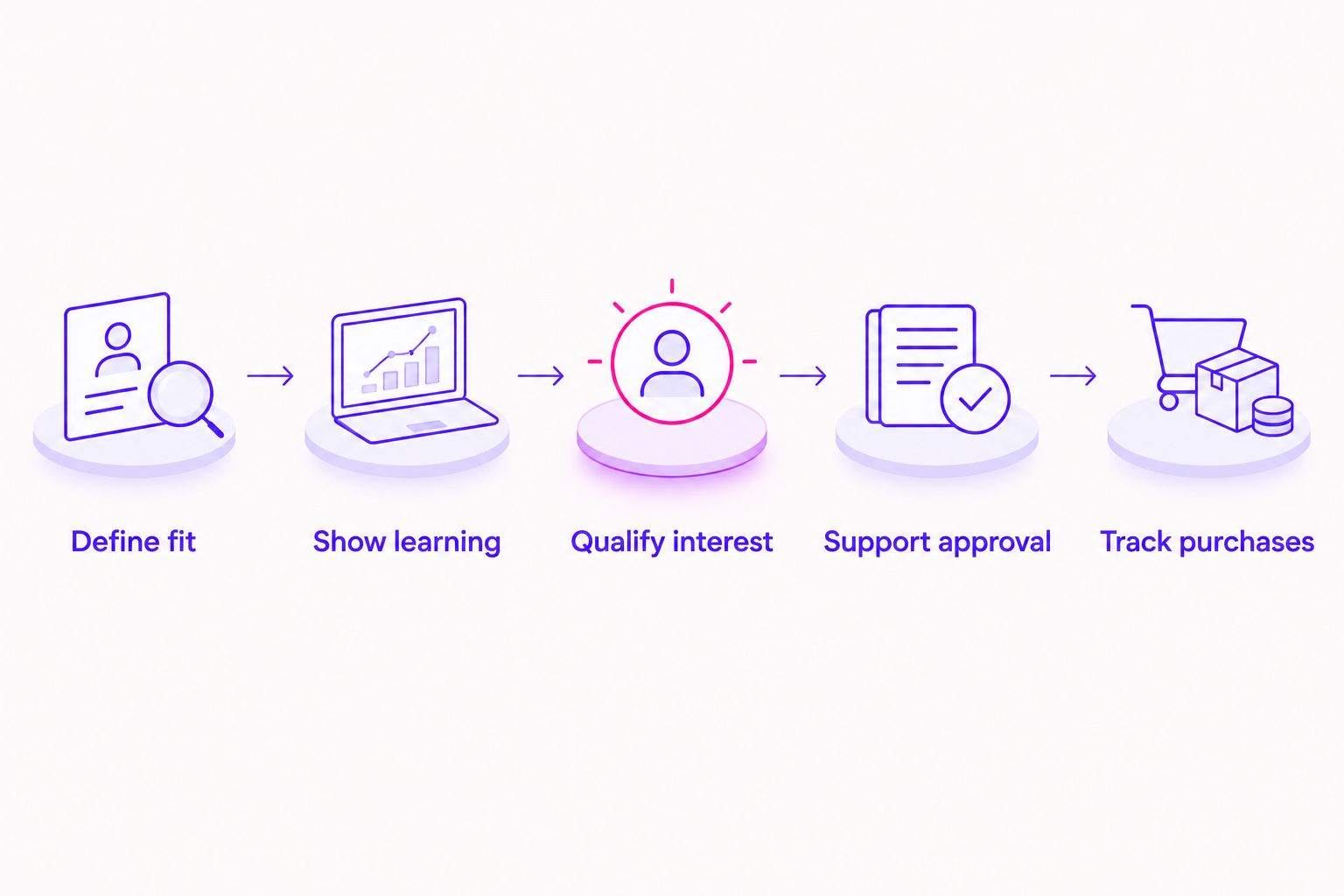
Before launching, walk through the process as a buyer. Confirm that the ad, page, form, and follow-up describe the same offer. A clear handoff matters more than adding another promotional message.
Why LinkedIn course campaign results vary
LinkedIn does not make every course a corporate offer. The campaign’s results depend on the connection between your audience, learning promise, and buying process.
Review these 5 factors when planning your 2026 campaign:
- Workplace relevance: Can the buyer explain why this training belongs in the organization?
- Audience fit: Does your professional targeting reflect the people involved in the decision?
- Evidence quality: Do your examples support the claims in the ad and on the page?
- Purchase readiness: Can you answer questions about delivery and participation accurately?
- Follow-up and tracking: Can you identify which inquiries become qualified opportunities and purchases?
Avoid diagnosing everything as an advertising problem. If qualified buyers ask questions your page cannot answer, improve the page and your sales materials. If inquiries consistently describe a different need, revisit the audience and message.
Change the part of the process that the evidence points to. Changing every part at once makes the next result harder to interpret.
How do you know whether LinkedIn ads are selling the course?
A completed purchase is evidence of a sale; a form submission is evidence of an inquiry. Keep those outcomes separate in your 2026 reporting.
Record the original campaign alongside the buyer’s progress. Include whether the inquiry fits your offer, whether a proposal was requested, and whether the purchase closed. Ask buyers how they found you when that information is unclear.
ROAS means return on ad spend: attributed sales revenue divided by advertising spend. It helps you assess revenue relative to media spending, but it does not include every cost of selling and delivering the course.
Cost per acquisition means the acquisition spending you include divided by acquired customers. Define which costs you include before comparing results. Neither calculation is useful when the underlying purchase records are inaccurate.
Should I send corporate buyers straight to checkout?
Direct checkout fits an authorized individual purchase; a team purchase needs a path that addresses the organization’s evaluation. Choose based on the decision, not on a desire to shorten the page.
If buyers need delivery details or internal approval, provide that information before asking them to enroll. A clear evaluation path gives them something useful to share with colleagues.
Can a spiritual or mindfulness course appeal to employers?
Yes, when the course has an appropriate workplace application and the offer describes it honestly. Preserve the substance of your teaching while explaining the learning objective in language a purchasing contact can understand.
Do not turn spiritual experiences into unsubstantiated health or business claims. Let the actual curriculum, suitable evidence, and clear delivery plan support the offer.
FAQ
Can LinkedIn ads sell an online course to corporate buyers in 2026?
Yes, LinkedIn ads can support corporate course sales when the program addresses a workplace need and the buying process is clear. Professional targeting does not guarantee purchasing authority or a sale.
Who should I target for a corporate training course?
Target the professional roles involved in evaluating or approving the training you offer. Verify those roles through buyer conversations rather than assuming every human resources or leadership contact purchases courses.
Is a course preview better than a sales call?
A course preview fits buyers evaluating teaching quality; a sales conversation fits buyers discussing organizational requirements. Choose the next step according to what the buyer needs to decide.
Do I need a separate page for corporate buyers?
Use a corporate-facing page when a company purchase requires information your individual enrollment page does not provide. Explain the audience, learning objectives, delivery, evidence, and evaluation process accurately.
How much should I spend testing LinkedIn ads?
Set a test budget from your business economics and the opportunity you want to evaluate. Define the qualified outcome and tracking process before committing advertising spend.
What should I measure besides leads?
Measure qualified conversations, proposals, and completed purchases alongside lead submissions. Keep the original campaign connected to those outcomes so lead volume does not stand in for sales.
Can Ziva Marketing help conscious course creators with paid social?
Ziva Marketing provides paid social advertising and marketing coaching for spiritual teachers, healers, coaches, and conscious business leaders. Corporate purchasing fit still needs a clear workplace offer and evidence that supports its claims.
One last thing
Give a prospective buyer something they can share internally. A concise course outline that explains the audience, learning objective, delivery, and evidence is more useful than another page of inspirational language.
Your next move is simple: ask a relevant purchasing contact to review that outline before launching the campaign. Their questions can reveal what the offer needs to explain. Start your 2026 test with that clarity, then let qualified opportunities and purchases guide the next decision.