
can instagram reels ads outperform static ads for coaching offers
Can Instagram Reels ads outperform static ads for coaching offers?
Can Instagram Reels ads outperform static ads for coaching offers? Yes—compare qualified leads, sales, and ROAS, not views. Use this practical testing guide.
By ZIVA Marketing ·
Yes—Instagram Reels ads can outperform static ads for coaching offers, but you should choose the format that produces qualified leads and sales, not the one that attracts the most views.
- Can Instagram Reels ads outperform static ads for coaching offers? Yes, but sales—not views—determine the winner.
- Instagram Reels ads suit demonstrations; static ads suit messages readers can understand at a glance.
- Compare qualified leads, customer acquisition, and ROAS using the same offer and measurement rules.
- ZIVA Marketing provides paid social advertising and marketing coaching for spiritual teachers, healers, and conscious business leaders.
Why this matters
Your coaching offer asks people to trust your judgment, your approach, and the experience you provide. Video lets you demonstrate how you teach. A static image lets someone absorb a clear message without watching a sequence.
Neither format deserves your entire budget just because it looks right for your brand. For your 2026 campaigns, treat format as a testable choice rather than a commitment. Start with a clear question and a consistent way to measure the answer.
Our guide to testing ad creative for coaching offers covers the broader testing process. Here, the focus is the comparison between Reels video and static image ads.
Can Instagram Reels ads outperform static ads for coaching offers?
Yes, but Reels views alone do not establish better advertising performance. A Reel outperforms a static ad for customer acquisition when it produces customers at a lower acquisition cost under a fair comparison. If revenue is your goal, compare return on ad spend, or ROAS: revenue attributed to advertising divided by advertising spend.
There is also an important distinction: Reels describes a placement, while static describes a creative format. Comparing a video in Reels with an image in the Instagram feed changes both the format and the viewing environment. That is a useful business comparison, but it does not isolate video versus image.
| Option | Best for | What it lets you communicate | Main limitation | What to measure |
|---|---|---|---|---|
| Instagram Reels video ads | Demonstrating your teaching style | Voice, delivery, movement, and a short explanation | The message unfolds over time; recording and editing add work | Qualified leads, customers, and attributed revenue |
| Static image ads | Presenting a concise invitation | A clear headline, visual, and next step | A still image cannot demonstrate your spoken delivery | Qualified leads, customers, and attributed revenue |
Choose the comparison that matches your actual decision. If you want to know where to spend, compare the complete ad experiences. If you want to understand the effect of format alone, keep placement consistent wherever the available settings allow it.
Instagram Reels ads: best for showing how you teach
A Reel gives you room to share a small piece of your coaching approach. You can explain a concept, describe what happens inside your program, or demonstrate a teaching method that is appropriate to show publicly.
For example, a meditation teacher can explain how they introduce a practice. A business coach can walk through a decision framework. These are creative ideas, not promises that video will produce better results.
Use Reels when seeing or hearing you adds information that a still image cannot convey. Speak plainly, include readable captions, and make the invitation understandable without relying on music or atmosphere.
The trade-off is production effort. You need to record, review, and edit the message, then check that it remains clear in the placement preview. A beautiful video with an unclear invitation is still an unclear ad.
Static ads: best for a clear, readable invitation
A static ad gives your audience a message they can read at their own pace. It suits a specific program invitation, a useful question answered in the copy, or a simple explanation of who the offer serves.
Keep the image focused. Put additional context in the accompanying text rather than trying to fit an entire sales page into the design. The reader should understand the subject and the next step without decoding several competing messages.
Use static ads when the invitation makes sense without a demonstration. A still image cannot show your teaching delivery, so the copy and destination page need to explain what the experience involves.
For your 2026 creative plan, keep static ads in the comparison even if you enjoy making video. Your preference for creating a format is different from your audience's response to it.
How to test Reels against static ads fairly
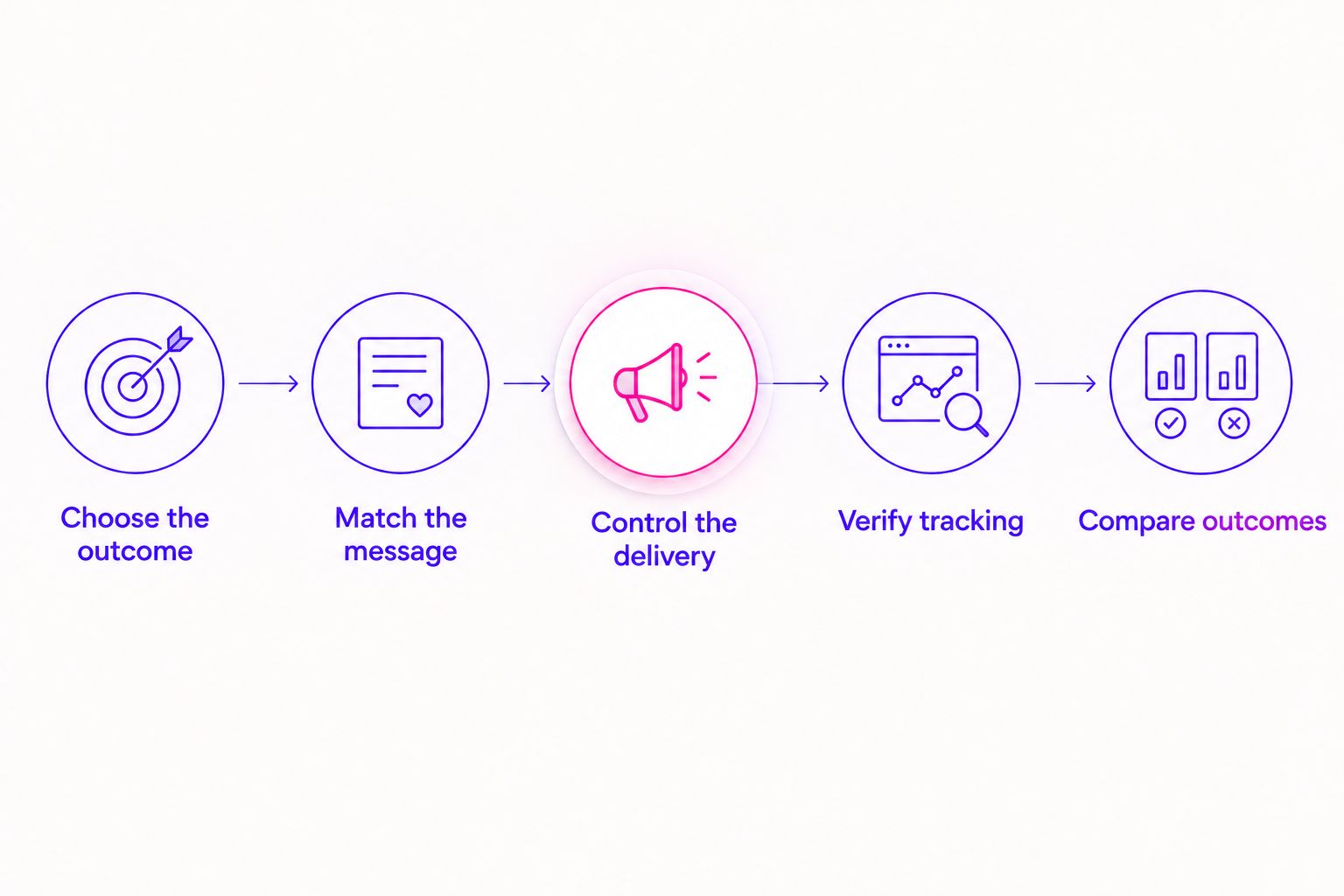
Use this sequence to make the result interpretable. The goal is not to create identical ads; it is to keep the business proposition consistent while adapting its presentation.
- Choose the outcome. Decide whether you are measuring purchases, qualified applications, or another meaningful action. Define that action before the campaign begins.
- Match the message. Use the same offer, audience promise, destination, and invitation. Adapt the delivery to video or image without changing what you are asking people to do.
- Control the delivery. Use a split test where available, with separate audience groups and comparable settings. Record any placement differences that remain.
- Verify tracking. Check that the desired action records correctly. Use consistent source labels so your lead and purchase records distinguish the test variants.
- Compare outcomes. Review acquisition cost, lead quality, and revenue using the same reporting window. Account for the time between an inquiry and a purchase.
In a 2026 test log, record what changed and what stayed the same. Include the offer, audience, placement, destination, and reporting window. This makes the finding useful when you build the next campaign.
Avoid adding unrelated changes halfway through the comparison. If you rewrite the landing page or change your application criteria, document the change and reassess what the test can tell you.
What counts as better performance?
Choose a primary measure that reflects the next meaningful business outcome. Supporting measures help explain the result; they should not replace it.
- Cost per qualified lead: advertising spend divided by leads that meet your stated fit criteria.
- Cost per booked call: advertising spend divided by recorded bookings. Review attendance separately.
- Cost per acquisition: advertising spend divided by new customers acquired through the campaign.
- ROAS: attributed revenue divided by advertising spend. This measures revenue efficiency, not profit.
For a program sold through discovery calls, define a qualified inquiry before comparing formats. Relevant criteria include the person's goal, whether the program addresses that goal, and whether they understand the commitment involved. Apply the same criteria to both ad groups.
For a directly purchased course, prioritize confirmed purchases over checkout visits. Use your transaction records to check reported revenue, and apply the same treatment of refunds to both variants.
The winning ad is the one that performs better on your chosen business measure—not every available measure. A video can attract more attention while a static ad produces more suitable inquiries. Those observations can coexist.
Why Reels and static ad results vary
These factors belong in your test notes because they change what the comparison means:
- Message fit: A demonstration needs a sequence; a concise invitation can stand alone. Match the presentation to the information your buyer needs.
- Audience familiarity: Record whether the audience already knows your work or is encountering the offer for the first time.
- Placement: Reels and feed ads appear in different viewing contexts. A placement change prevents you from attributing the result solely to creative format.
- Next-step commitment: Registering for a webinar, applying for coaching, and buying a course are different actions. Compare the same action across variants.
- Destination consistency: The landing page should carry forward the same offer and invitation shown in the ad.
- Measurement rules: Tracking, attribution settings, and reporting windows determine which actions appear in each result.
Use your 2026 account results to choose the next test. A finding about one message and audience does not establish a permanent rule for every coaching offer.
How should you write each ad without changing the offer?
Start with a shared creative brief. Name the intended buyer, explain the program's focus, and choose a single next step. Write only claims that you can support.
For Reels, turn that brief into a spoken explanation. Open with the subject, give the viewer something useful, and connect it to the invitation. You do not need to perform a louder version of yourself.
For static, turn the same brief into a readable headline and supporting copy. Keep the meaning aligned with the video, even when the words differ. Natural delivery matters more than matching every sentence.
For spiritual teachers and healers, describe your work without diagnosing the viewer or promising guaranteed transformation. Respectful language can explain the offer clearly without making assumptions about someone's health or personal circumstances.
Should you stop static ads if Reels gets more views?
No—more Reels views do not prove better customer acquisition. Keep the decision tied to qualified leads, sales, and the goal you chose before testing.
If the video attracts attention but people do not take the next step, inspect the invitation and landing page. Do not assume that recording more video will resolve an unclear offer.
Should you keep both formats if they produce different results?
Yes, when each format supports a defined business goal. Keep Reels and static ads for distinct purposes only when your results justify those roles.
Do not assign Reels to new audiences and static ads to returning visitors by habit. Test the role as well as the format, and avoid comparing results from different audience groups as though they were equivalent.
What if neither format produces suitable inquiries?
Review the offer, message, destination, and tracking before declaring either format ineffective. Confirm that the ad explains who the program serves and that the next step works.
Read the inquiries themselves. Questions about what the program includes or whom it serves can reveal information the ad and page need to explain more clearly.
When paid social support fits the decision
ZIVA Marketing is best suited to spiritual teachers, healers, coaches, and conscious business leaders seeking paid social advertising and marketing coaching. We help those businesses grow their online courses and programs toward a global audience.
Agency support is relevant when you want help with advertising rather than another format to produce. The trade-off is coordination: you still need to communicate your offer accurately and review whether inquiries match the people you serve.
You can explore ZIVA Marketing if that describes the support you want. A format decision remains grounded in your results; no agency introduction substitutes for that evidence.
Explore support for your coaching ads
See paid social advertising and marketing coaching for spiritual teachers, healers, and conscious leaders.
FAQ
Can Instagram Reels ads outperform static ads for coaching offers?
Yes, Instagram Reels ads can outperform static ads for coaching offers, but the winner depends on your measured business outcome. Compare qualified leads, customers, or ROAS rather than using views as proof.
What's the best ad format for a coach who dislikes recording video?
Static ads are a practical starting point when you prefer communicating through images and written copy. Test a clear invitation before deciding that video production is necessary.
Is a Reel with lots of views a successful coaching ad?
A Reel with lots of views is not automatically a successful customer-acquisition ad. Check whether those views lead to suitable inquiries and purchases.
How long should I run a Reels versus static ad test in 2026?
Run the test long enough to observe your chosen outcome and account for the delay between inquiry and purchase. Set the review rule before starting instead of selecting a winner after an early fluctuation.
Should Reels and static ads use the same landing page?
Use the same landing page when your goal is to compare the ad experiences for the same offer. Changing the page at the same time makes the result harder to interpret.
Does higher ROAS mean an ad is more profitable?
Higher ROAS means more attributed revenue per unit of advertising spend, not necessarily more profit. Review delivery costs, refunds, and other business expenses separately.
Can ZIVA Marketing help with paid social advertising for coaching programs?
ZIVA Marketing offers paid social advertising and marketing coaching for spiritual teachers, healers, coaches, and conscious business leaders. Its work focuses on growing online courses and programs toward a global audience.
One last thing
Your most useful result might be a message rather than a format. If a particular explanation produces suitable inquiries in both Reels and static ads, keep that explanation in your next test.
For your next 2026 campaign, write down why the winning message worked as a hypothesis—not a fact. Then test it again with a fresh presentation. That turns a creative decision into something you can learn from.