
can facebook ads grow a spiritual coaching business
Can Facebook ads really grow a spiritual coaching business?
Can Facebook ads grow a spiritual coaching business? Yes. Learn how clear offers, honest messaging, and enrollment tracking turn attention into measured growth.
By ZIVA Marketing ·
Yes, Facebook ads can grow a spiritual coaching business in 2026 by introducing your work to new people, but meaningful growth depends on paid enrollments—not clicks or followers.
- Can Facebook ads grow a spiritual coaching business? Yes—judge success by paid enrollments and delivery capacity.
- Facebook ads need a clear coaching offer, trustworthy messaging, and a working path from interest to enrollment.
- ROAS measures advertising revenue against ad spend; it does not measure your full business profit.
- ZIVA Marketing serves spiritual teachers and coaches seeking paid social advertising and marketing coaching for online programs.
Can Facebook ads really grow a spiritual coaching business?
Yes, when your advertising connects a relevant audience to an offer they understand and a next step they can complete. Facebook ads buy distribution. Your teaching, offer, enrollment process, and follow-up still need to earn the person's trust.
A useful starting point is this guide to Facebook ads for spiritual coaches and healers. Then use the process below to decide what your own business is ready to advertise.
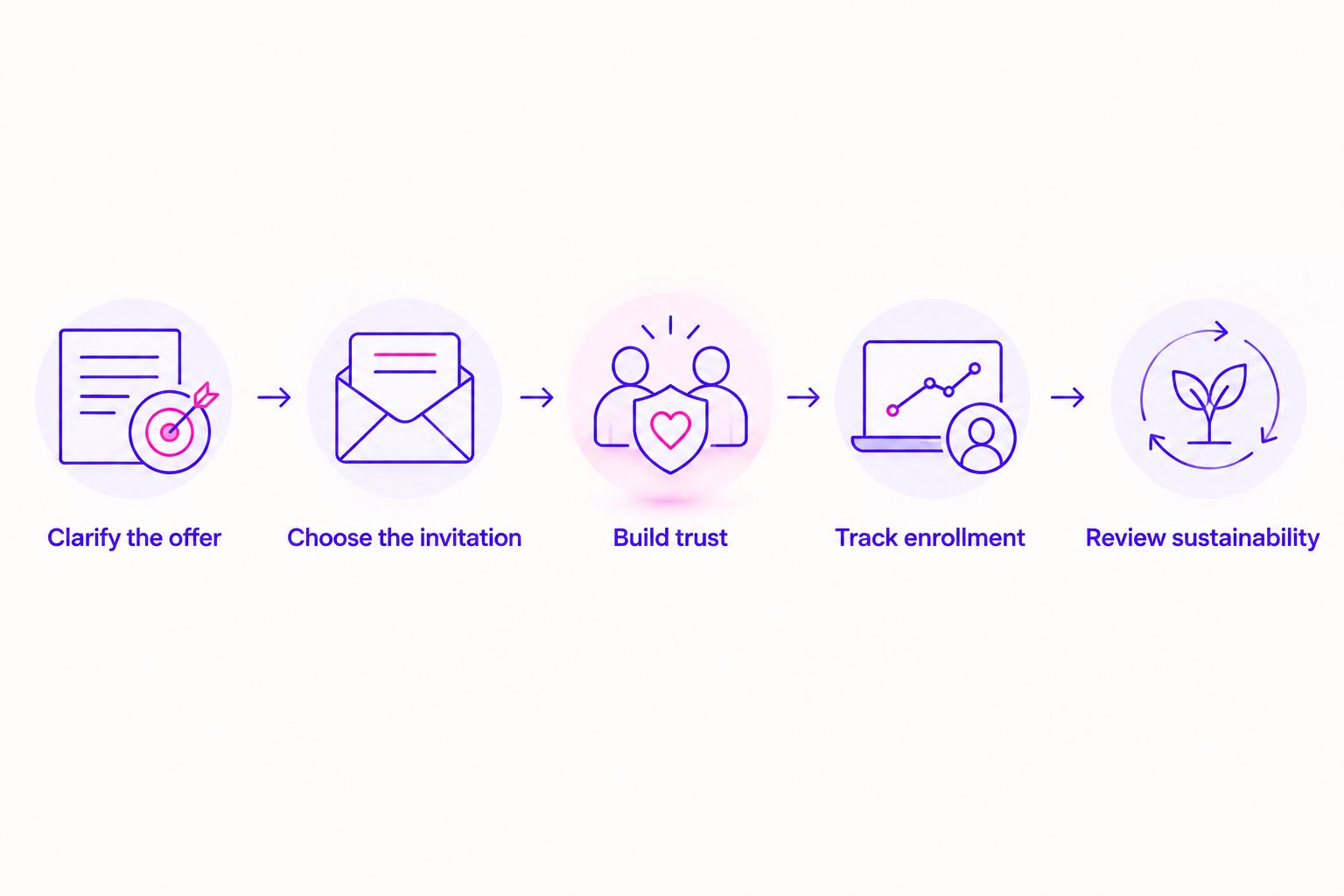
- Clarify the offer. Describe who the program serves, what participants learn, and how you deliver it.
- Choose the invitation. Send people to a course page, teaching session, or application that fits the decision.
- Build trust. Show your approach without promising outcomes you cannot substantiate.
- Track enrollment. Connect advertising activity to applications, purchases, and collected revenue.
- Review sustainability. Evaluate acquisition costs alongside delivery costs and your capacity to serve participants.
These steps separate an advertising campaign from a growth plan. A campaign brings attention; a growth plan explains how that attention becomes a sustainable client relationship.
Why this matters
Advertising your spiritual work can feel uncomfortable when you associate marketing with pressure. You do not need to adopt that style. You need to explain your work clearly enough that someone unfamiliar with you can make an informed choice.
For your 2026 plan, define growth before you open an advertising account. More qualified applications, paid course enrollments, and retained members are different goals. Choose the outcome that supports the business you want to build.
Your message can stay warm while your measurement stays precise. Neither spiritual language nor a busy advertising dashboard replaces evidence that the right people are joining your program.
Choose an enrollment path that fits your offer
There is no single enrollment path for every spiritual coaching business. Match the invitation to what a person needs to understand before joining, rather than copying another coach's campaign.
| Enrollment path | Best for | Main advantage | Main limitation |
|---|---|---|---|
| Direct course enrollment | A clearly explained course with a straightforward buying decision | Lets interested people enroll without an extra event or conversation | The page must answer questions without personal guidance |
| Teaching session followed by an invitation | A program whose approach benefits from a demonstration | Gives people a sample of your teaching before deciding | Adds attendance and follow-up work |
| Application followed by a conversation | Coaching that requires a fit assessment | Creates space to discuss needs, expectations, and suitability | Requires your time and reliable application handling |
Each path needs an honest description of the experience. Tell people whether they are joining a teaching session, submitting an application, or purchasing access to a course.
Choose the simplest path that gives the buyer enough information. Additional steps should answer a real question, not create activity for its own sake.
Direct course enrollment: make the page do the explaining
Best for: a course that people can evaluate without a personal conversation. Your page needs to explain the curriculum, teaching format, access arrangements, and intended participants using your actual program details.
Show what the student will do, not just how you hope they will feel. Describe practices, lessons, or exercises that exist in the course. Distinguish educational intentions from guaranteed personal outcomes.
The advantage is a straightforward invitation. The limitation is that your page must carry the explanation and answer objections. If buyers repeatedly ask the same question, improve the page before sending more paid traffic to it.
Teaching session: let people experience your approach
Best for: a program that needs context or a sample of your teaching. A live or recorded session can introduce your method and give people something useful before you invite them into a program.
Give the session a specific subject and a clear description. Explain what attendees will learn and whether you will present a program afterward. Let the invitation feel like a continuation of the lesson, not a surprise change of purpose.
This path gives your teaching room to speak. Its limitation is the work between registration and enrollment: reminders, attendance, useful follow-up, and a clear program invitation all need attention.
Application and conversation: protect the quality of fit
Best for: coaching where suitability matters before enrollment. An application should collect the information you genuinely need to assess fit and prepare for a conversation.
Explain what happens after submission. Tell applicants whether the conversation covers their goals, your coaching approach, or program suitability. Keep personal questions proportionate to that purpose.
This path supports a considered decision, but it asks more of your time. Track completed applications, suitable applicants, attended conversations, and enrollments separately so you can see where people stop progressing.
Why Facebook ad results vary
Facebook advertising results reflect more than the ad itself. Review these factors when deciding what to improve:
- Offer clarity: The audience needs to understand the program, its purpose, and who it serves.
- Audience relevance: Your message and destination need to match the people you intend to invite.
- Trust: Your explanation, teaching examples, and substantiated testimonials need to support the decision.
- Enrollment experience: Forms, pages, checkout, and follow-up need to work as described.
- Tracking accuracy: Recorded purchases and applications need to represent real actions without duplicates.
- Business economics: Acquisition costs need to leave room for delivery, support, and other expenses.
A disappointing result is a reason to inspect the path, not a judgment on the value of your work. Locate the stage that needs attention before rewriting everything.
Build a measurable path from ad to enrollment
For a 2026 campaign, write down the intended journey before launch. This keeps the ad, page, follow-up, and measurement focused on the same outcome.
Clarify the offer
Write a plain-language description of your program. Name the intended participant, the learning experience, and the delivery format. Remove language that sounds meaningful to existing clients but leaves a newcomer unsure what they are joining.
Choose the invitation
Select a next step that matches the enrollment path. An ad inviting someone to a teaching session should lead to that session's registration page. An application invitation should lead to an application, not a general homepage.
Build trust
Use a real teaching example, an accurate explanation of your approach, or a testimonial you have permission to use. Keep the evidence connected to the claim. A participant's individual experience does not establish a guaranteed outcome for everyone.
Track enrollment
Check that the action you record is the action you want. A page visit is not a purchase. A submitted form is not an attended coaching conversation. Test the journey yourself before relying on the reporting.
Review sustainability
Compare the campaign outcome with the resources required to deliver the program. Include your teaching time and participant support. An enrollment target should fit the experience you can provide.
Measure revenue without mistaking ROAS for profit
ROAS means return on ad spend: revenue attributed to advertising divided by advertising spend. Cost per acquisition means the advertising cost required to gain a paying customer.
ROAS is an advertising measure, not a complete profit measure. It excludes expenses such as program delivery, payment processing, software, and professional support. Review those costs separately.
Keep your 2026 reporting consistent. Decide whether a report uses collected revenue or booked sales, then label it accordingly. Account for refunds and avoid treating an unpaid installment commitment as money already received.
Lifetime value means the revenue a customer generates across the relationship with your business. Use your own customer records to assess it. Do not justify today's acquisition spending with future purchases that have not happened.
Compare advertising reports with your enrollment and payment records. Investigate differences before changing the campaign based on a headline figure.
Write spiritual ad copy that respects the reader
Lead with the experience you offer. Describe a practice, lesson, or program rather than declaring something personal about the person seeing the ad.
Meta's Personal Attributes advertising standard prohibits ads that assert or imply certain personal attributes, including religious beliefs and physical or mental health conditions. Review the current standard when preparing your 2026 campaign, particularly when your work touches sensitive experiences.
A useful writing approach is to describe the session instead of diagnosing the reader. Explain the practice participants explore rather than promising a cure. Describe a financial education topic rather than guaranteeing financial results.
Keep the landing page equally clear. State what coaching includes and what it does not include. Where relevant, distinguish coaching or spiritual education from licensed medical or mental health care.
Honest boundaries give people better information for their decision. You can communicate possibility without promising a result you cannot prove.
Test the message before expanding the campaign
Start with a specific learning question. You might test whether a teaching demonstration or a plain explanation produces more suitable applications. Choose the outcome before reviewing results.
Keep the offer and destination consistent while you evaluate the message. If you change the audience, ad, page, and invitation together, you cannot isolate what caused the difference.
Record the campaign changes and resulting business actions. Look beyond reactions and clicks to completed applications, enrollments, and collected revenue. Use those records to decide what deserves another test.
Before expanding a 2026 campaign, check that tracking works, the enrollment process is clear, and delivery capacity is available. More traffic should support a working process, not conceal an unresolved problem.
What should you do when ads get clicks but no clients?
Clicks without clients mean the advertising has not yet produced the business outcome you need. Check the destination first: does it match the invitation, explain the offer, and provide a working next step?
Then inspect the later stages. Separate incomplete registrations from unattended sessions, unsuitable applications, and conversations that do not lead to enrollment. Each calls for a different response; changing the ad alone does not address every stage.
Do you need a large following before running Facebook ads?
A large following is not a requirement for buying Facebook advertising. You still need a credible offer, a clear destination, and a way to evaluate whether new people become customers.
Use existing conversations and customer questions to improve the explanation before launch. Your current audience can inform the message without being the only audience you reach.
When does agency support make sense?
ZIVA Marketing is best for spiritual teachers and coaches seeking paid social advertising and marketing coaching for online programs. At ZIVA Marketing, we focus on those services for spiritual teachers, healers, coaches, and conscious business leaders.
That focus is relevant when you want support connecting advertising with your course or program. It does not remove your responsibility for the offer, participant experience, or accurate claims.
Before choosing support, discuss responsibilities, reporting, account access, and how success will be assessed. If your offer is still unclear, begin by clarifying it rather than expecting campaign management to supply the answer.
FAQ
Can Facebook ads grow a spiritual coaching business in 2026?
Yes, Facebook ads can grow a spiritual coaching business in 2026 when they connect relevant people to a clear offer and a working enrollment process. Measure paid enrollments and collected revenue, not just clicks or followers.
What's the best Facebook ad strategy for a spiritual coach?
The best starting strategy matches the invitation to the buying decision. Use direct enrollment for a clearly explained course, a teaching session when people need context, or an application when coaching requires a fit assessment.
Do I need a big email list before advertising my coaching program?
A big email list is not a requirement for buying Facebook advertising. You still need a clear offer, useful follow-up, and a way to connect advertising activity with enrollments.
Is a high ROAS enough to prove my coaching ads are profitable?
A high ROAS alone does not prove profitability. ROAS compares attributed revenue with ad spend, while profit also depends on delivery costs and other business expenses.
Can I advertise spiritual coaching without promising transformation?
Yes, you can advertise spiritual coaching by explaining the learning experience and practices you offer. Use substantiated claims and avoid guarantees you cannot prove.
Why do my Facebook ads get leads but no enrollments?
Leads without enrollments require a review of lead suitability, follow-up, and the enrollment experience. Track those stages separately before deciding that the ad itself needs changing.
Who is ZIVA Marketing's paid social support best for?
ZIVA Marketing's paid social support is best for spiritual teachers, healers, coaches, and conscious business leaders growing online courses and programs. The agency offers paid social advertising and marketing coaching.
One last thing
Before your next campaign, complete the entire enrollment journey as a prospective participant. Read the ad, open the destination, submit the form, and check the confirmation and follow-up.
A clear next step is more useful than an ambitious promise. Make that step easy to understand, then let your teaching and real results support what comes next.