
can ai-generated ads work for spiritual and coaching brands
Can AI-generated ads work for spiritual and coaching brands?
Can AI-generated ads work for spiritual and coaching brands? Yes—with human review. Learn what to automate, what to protect, and how to test for real results.
By ZIVA Marketing ·
Yes—AI-generated ads can serve spiritual and coaching brands as human-reviewed drafts, but your offer, truthful claims, and campaign results must decide what you publish.
- Can AI-generated ads work for spiritual and coaching brands? Yes—as reviewed drafts, not evidence of campaign performance.
- Keep your teaching, testimonials, and promised outcomes grounded in facts you can verify.
- Test paid social advertising against qualified inquiries and purchases, not just clicks.
- ZIVA Marketing serves spiritual teachers and coaches seeking paid social advertising and marketing coaching.
Why this matters
You do not have to choose between useful technology and a voice that feels like you. The important distinction is between help with production and responsibility for the message. A polished draft is still a draft.
For your 2026 campaigns, treat generated copy as something to evaluate, not something to trust automatically. Start with the principles in writing ad copy that speaks to spiritual audiences, then apply the same care to any generated version.
Can AI-generated ads work for spiritual and coaching brands?
Yes, as part of a reviewed advertising process—not as a substitute for one. Generated copy, images, or scripts belong in your campaign only when they accurately describe your work and help a prospective student understand the next step.
There is a separate question: will a particular generated ad bring suitable clients or course buyers? The draft cannot answer that. Your campaign results must show whether people move from interest to meaningful action.
The practical choice is not simply human versus machine. Choose who supplies the meaning, who produces the draft, and who approves the final message.
| Approach | Best for | Useful role | Limitation | Recommendation |
|---|---|---|---|---|
| Human-written ads | Personal stories and sensitive teaching | Keeps the message tied to firsthand experience | Still needs claim review and performance testing | Use when lived experience is central |
| AI-generated drafts | Exploring wording from an approved brief | Produces alternative ways to express supplied ideas | Output can introduce unsupported details or generic language | Use for drafting, not automatic publishing |
| Human-led, AI-assisted ads | Brands that want drafting help without handing over judgment | Combines generated options with accountable review | Requires someone to check every final asset | Make this your starting approach |
None of these approaches guarantees sales. Human-written copy can be unclear, and a generated draft can contain a useful opening. Judge the actual message and its results rather than giving either method automatic credit.
Human-written ads: best for personal experience
Use human-written ads when the message depends on your experience, your teaching boundaries, or a personal story. Your words should reflect something you actually know or have lived. That includes what you leave out.
A personal account does not need dramatic language to matter. Describe the situation, what you practiced, and what you learned without turning your experience into a promise for every reader.
The limitation is that sincerity alone does not make an effective ad. A heartfelt story still needs a clear connection to the program and an understandable next step. Edit for clarity without editing away the person behind it.
Keep firsthand stories human-owned, even when you use drafting help.
AI-generated drafts: best for wording exploration
Use generated drafts when you already know what you want to say. Supply verified program details, approved language, and a clear purpose. Ask for alternative openings or shorter versions rather than a new identity for your business.
This approach gives the draft a defined job. For example, you can ask it to explain an existing lesson more plainly without adding new outcomes or qualifications.
The limitation is that a fluent sentence can still be false. Reject invented testimonials, unsupported credentials, and claims that your program delivers results you have not established. Check the final wording even when the starting brief was accurate.
Let generated drafts change the expression, not the facts.
Human-led, AI-assisted ads: best for accountable publishing
Use a human-led process when you want assistance with writing while keeping control of the message. You supply the facts and boundaries; generated output supplies options. A person then decides what deserves to represent your work.
For a 2026 campaign, name the person responsible for final approval before production begins. That person should understand the offer well enough to spot a misleading implication, not just a spelling mistake.
The limitation is real: review still takes attention. If nobody owns that review, adding more drafts creates more unchecked material rather than a better campaign.
Keep a human decision between every generated draft and publication.
Why AI-generated ad results vary
These factors give you a useful review framework without assuming that generated content performs better or worse:
- Offer clarity: A draft cannot explain a program accurately if your brief leaves its purpose or delivery unclear. Define what the buyer receives before asking for variations.
- Source material: Approved teaching notes give the draft something specific to work from. Vague instructions leave more room for generic language and unsupported additions.
- Claim accuracy: A compelling promise needs evidence. Review implied outcomes as carefully as explicit guarantees.
- Creative credibility: Your imagery and script should represent the experience honestly. Do not use synthetic material as supposed proof of a real participant's experience.
- Ad-to-page consistency: The page people visit should describe the same program and next step as the ad. Remove promises that disappear after the click.
- Measurement quality: Decide what counts as a useful result before judging the draft. A click, a suitable application, and a purchase answer different questions.
How do you create an AI-assisted ad without losing your voice?
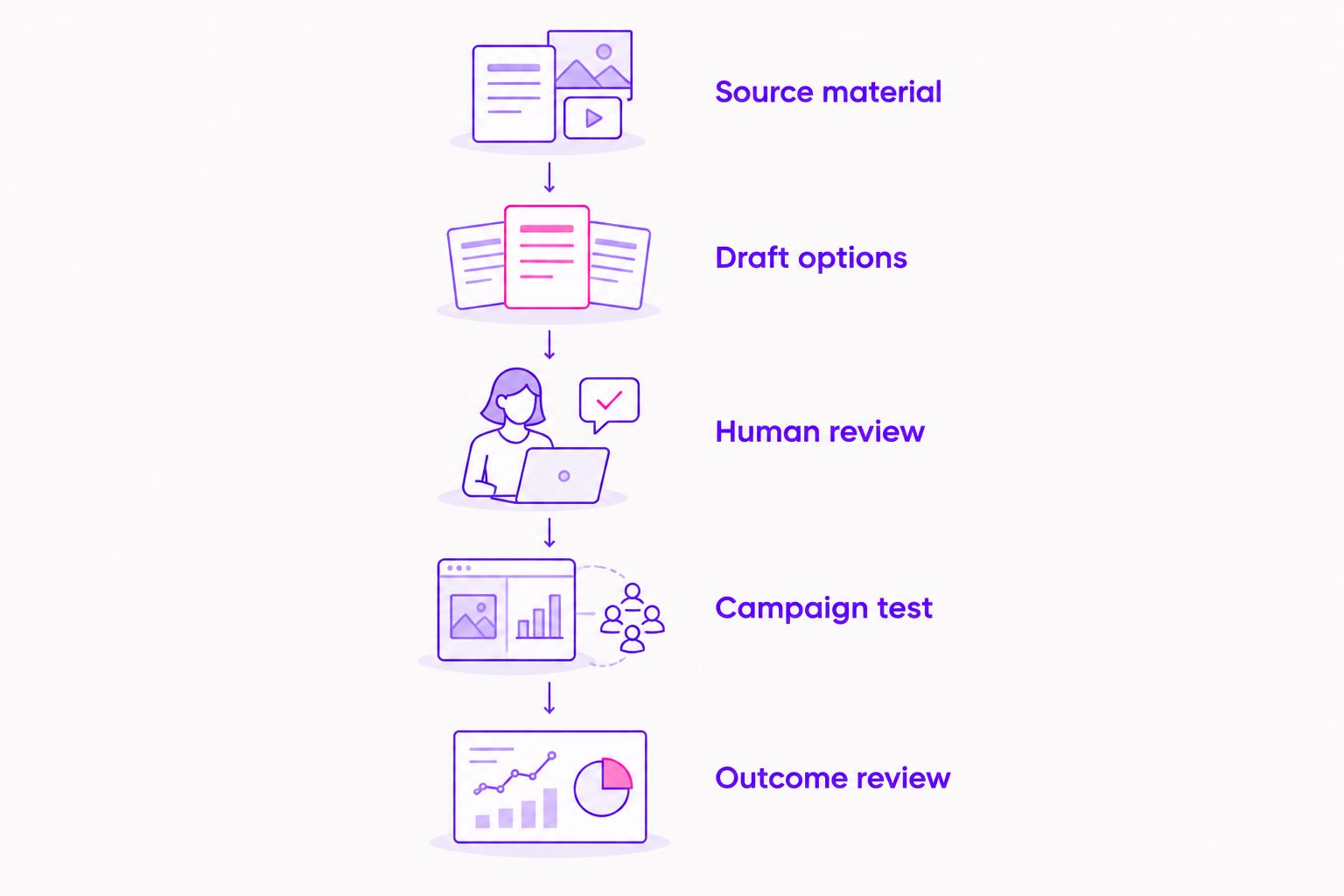
Use the following sequence for your 2026 creative review. It keeps production connected to your actual program rather than to whatever language sounds impressive in isolation.
1. Source material
Begin with your own teaching notes, accurate program information, and language you already approve. Include the intended audience, what the program contains, and the action you want someone to take.
Separate facts from aspirations. Helping people explore a practice is different from guaranteeing a personal transformation. Your brief should make that distinction explicit.
Leave private client information out of prompts unless you have the appropriate permission and understand how the service handles it. An anonymous example is not anonymous if its details identify the person.
2. Draft options
Give the draft a narrow task. Ask for a clearer opening, a shorter explanation, or an alternative invitation based only on your supplied material.
Require the draft to leave unknown details out. Do not invite it to invent participant experiences, research findings, qualifications, or program features to make the message more persuasive.
Keep the versions connected to a recognizable idea. A practice-focused opening and a teaching-focused opening offer different messages to evaluate; swapping adjectives does not necessarily create a useful distinction.
3. Human review
Read the copy aloud. Notice whether you would comfortably say it to someone considering your program and whether it describes what you actually offer.
Check every factual sentence against the source material. Then check the overall impression: accurate individual statements can still create an exaggerated promise when combined.
Remove language that defines the reader through pain, fear, or an assumed condition. You can describe your work without claiming to know a stranger's emotional history.
4. Campaign test
Compare the approved draft with an existing ad or a human-written alternative. Keep the offer and destination consistent when your goal is to understand the message's contribution.
Choose the result you care about before launch. For a course, that could be a purchase; for a coaching application, it should include whether the applicant fits the program.
Use testing ad creative for coaching offers to connect the creative decision to the campaign structure. Avoid declaring a winner solely because one version attracts more attention.
5. Outcome review
Review both the campaign record and the quality of the response. Look at what buyers understood, what applicants expected, and where people became confused.
Keep the messages that communicate accurately and support your chosen outcome. Revise the ones that attract interest through a promise your program does not deliver.
What should stay out of generated coaching ads?
Do not manufacture evidence. A generated participant story, testimonial, or before-and-after image is not proof that your program helped someone. Use actual evidence only with the necessary permission and an accurate description of what it shows.
Keep health and income promises out unless you have appropriate substantiation and have checked the applicable rules. Spiritual language does not turn a factual outcome claim into a harmless metaphor.
Your 2026 review should also catch subtler mismatches. A generated script might describe personal coaching when the offer is a recorded course, or imply ongoing access that you do not provide. Those details shape buying expectations.
For sensitive topics, describe the practice rather than labeling the reader. An illustrative invitation to explore a grounding practice gives someone room to choose; a statement that diagnoses their emotional state does not.
Review generated visuals with the same care. Ask whether the image communicates an idea or falsely represents a person, setting, or experience connected to your program. Decorative imagery should not masquerade as documentary evidence.
How do you know whether an AI-generated ad is working?
An ad works when it supports your chosen business outcome without misleading people. Define that outcome before spending, then follow the response beyond the first click.
Click-through rate describes how often an impression leads to a click. It does not tell you whether those visitors are suitable buyers. Cost per acquisition describes advertising spend relative to the customers acquired; ROAS compares attributed revenue with advertising spend.
Use those measures for the question they actually answer. ROAS is not profit, and a low lead cost does not establish that the leads are suitable for your offer.
For coaching applications, review fit as well as volume. For course sales, compare the ad's promise with what buyers receive. If a message produces confused expectations, improving the wording matters even when the campaign records conversions.
In your 2026 campaign notes, record the message, the result you intended, and what happened. That makes the next creative decision more useful than a general impression that the ad felt promising.
Should a spiritual brand use generated voices or avatars?
Use your real voice when the ad asks people to trust your personal teaching presence. A generated voice or avatar should not be presented as a real recording of you or as a genuine participant endorsement.
Consider what the audience needs to understand. If the ad demonstrates how you teach, replacing that demonstration with a synthetic performance changes what you are showing.
A generated asset can serve an illustrative purpose, but assess whether viewers could mistake it for evidence of a real experience. Explain its nature when needed and check the applicable platform requirements before publishing.
When does paid social support make sense?
ZIVA Marketing is suited to spiritual teachers and coaches seeking paid social advertising and marketing coaching for online courses and programs. We help these businesses work toward reaching a global audience.
The fit is the service category, not a promise that generated ads will outperform other creative. If you need only help rewriting a sentence, agency support addresses a broader need. If you need direction on the offer, campaign, and measurement together, paid social support is a more relevant conversation.
FAQ
Can AI-generated ads work for spiritual and coaching brands?
Yes, as human-reviewed drafts within an accountable advertising process. Whether a particular ad brings suitable buyers must be established through campaign results, not the quality of the draft alone.
Will AI-generated ads sound less authentic than my own writing?
Authenticity depends on the final message, not just how the draft was produced. Supply your own source material and remove wording you would not use or claims you cannot verify.
What's the best way to start using AI for coaching ads?
Start with a narrow drafting task based on approved program information. Ask for alternative wording, then review the facts, tone, and invitation before testing the ad.
Can I use AI to create testimonials for my coaching program?
No—generated testimonials are not evidence of a real client's experience. Use genuine feedback with appropriate permission and preserve its meaning.
Should I use my real voice in spiritual teaching ads?
Use your real voice when the ad is intended to demonstrate your teaching presence. Do not present a generated performance as an authentic recording or participant endorsement.
How do I measure whether an AI-assisted ad works?
Measure the business outcome you selected before launch, such as suitable applications or course purchases. Review buyer expectations alongside campaign metrics rather than judging success from clicks alone.
Can ZIVA Marketing help with advertising for spiritual programs?
ZIVA Marketing offers paid social media advertising and marketing coaching for spiritual teachers, healers, coaches, and conscious business leaders. Its services focus on helping online courses and programs reach a global audience.
One last thing
Save your original teaching language before you start generating variations. That source gives you something stable to compare each draft against, especially when repeated edits make the message sound polished but less like your work.
Your best next move is an approved brief, not a larger pile of drafts. Choose a truthful message, give it a clear next step, and let the campaign teach you what to refine.