
can a coach run profitable facebook ads with a $500 budget
Can a coach run profitable Facebook ads with a $500 monthly budget?
Can a coach run profitable Facebook ads with a $500 budget? Yes, if customer economics work. Learn how to plan a focused test and measure profit beyond ROAS.
By ZIVA Marketing ·
Yes—a coach can run profitable Facebook ads with a $500 monthly budget in 2026 when revenue left after serving those customers exceeds ad spend and the other costs of acquiring them.
That budget covers advertising, not your time, software, outside support, or program delivery. Treat it as a focused test of an offer that already sells, not a promise of monthly profit.
- Can a coach run profitable Facebook ads with a $500 budget? Yes, but profit depends on customer economics, not budget alone.
- Meta ad reports show attributed revenue; your payment records and delivery costs establish whether those sales were profitable.
- Keep the test focused on one offer and one customer action so you can interpret the results.
- ZIVA Marketing serves spiritual teachers and coaches through paid social advertising and marketing coaching; support costs belong outside ad spend.
Why this matters
A small advertising budget deserves a clear purpose. You do not need to imitate a large course launch or build an elaborate sales journey before answering the basic question: does this offer bring in customers at a cost your business can support?
If spending feels uncomfortable, start with the amount you can afford to lose without affecting essential expenses. Advertising is a business experiment, not a measure of your worth as a coach.
For launch-specific planning, the guide to structuring a Meta ads budget for a course launch addresses a different decision: organizing spending around an enrollment window. Here, the priority is making a limited monthly test financially readable.
Can a coach run profitable Facebook ads with a $500 budget?
Yes, but the budget alone cannot establish profitability. Your offer, customer acquisition cost, delivery expenses, and collected revenue determine the answer.
Customer acquisition cost means the amount you spend to gain a paying customer. Ad-only acquisition cost includes advertising alone; total acquisition cost also includes the other marketing expenses associated with gaining that customer. Keep those measures separate.
Use this breakdown for your 2026 test:
| Budget or measure | What it means | How to use it |
|---|---|---|
| $500 per month | The advertising allowance in this question | Keep it separate from software, support, and delivery costs |
| About $16.67 per day | $500 spread evenly across a chosen 30-day planning period | Use it as planning arithmetic, not a guarantee of daily platform spending |
| Ad-only acquisition cost | Actual ad spend divided by paying customers attributed to the campaign | Calculate it from purchases, not inquiries |
| Contribution per customer | Collected revenue minus refunds and variable delivery costs | Compare it with acquisition cost |
| Campaign contribution | Collected revenue minus delivery costs, ad spend, and other campaign costs | Use it to assess the campaign's financial result |
The daily figure is not a required Facebook budget or an industry benchmark. It simply makes the monthly allowance easier to understand. Use actual spending when you review results.
A campaign that generates sales still loses money if acquisition and fulfillment consume more than those sales contribute. Conversely, a modest number of sales can cover advertising when enough revenue remains after costs. Neither outcome follows automatically from the budget.
What counts as profit rather than ROAS?
ROAS means return on ad spend: attributed revenue divided by advertising spend. It describes the relationship between revenue and ads, not the money left in your business.
Positive ROAS is not proof of profit. Payment processing, refunds, customer support, coaching delivery, and campaign support belong in the financial review too.
Also distinguish campaign contribution from overall business profit. A campaign can contribute money toward rent, salaries, and other fixed expenses without covering every expense in the business. Decide which question you are answering before calling the result profitable.
Choose a customer action your offer supports
The right campaign destination depends on how people already buy from you. Do not add a webinar, application, or email sequence simply because another coach uses one.
A customer journey, sometimes called a funnel, is the path from an ad to a purchase. Choose the shortest path that gives your buyer enough information to make a sound decision.
| Approach | Best for | Advantage | Limitation |
|---|---|---|---|
| Direct purchase | Coaches with a clearly explained course or program that customers already buy online | Connects advertising with a payment outcome | Gives unfamiliar buyers less room to ask questions |
| Application or discovery call | Coaches whose program requires a conversation about fit | Creates space to explain the program and assess suitability | Requires timely follow-up and includes your sales time |
| Email signup | Coaches with an existing follow-up sequence and evidence that subscribers become customers | Lets you continue the conversation after the first visit | A signup alone does not establish revenue or profitability |
Choose the approach your existing sales process can support. If you collect applications but cannot respond promptly, advertising creates an unfinished conversation. If you collect email addresses without a purchase invitation, you cannot evaluate the campaign on sales.
An existing audience also changes the question. Ads shown to people who already know your work test a different situation from ads introducing you to strangers. Record which audience you reached rather than treating every sale as evidence that a new audience will respond the same way.
Build a focused test before spending
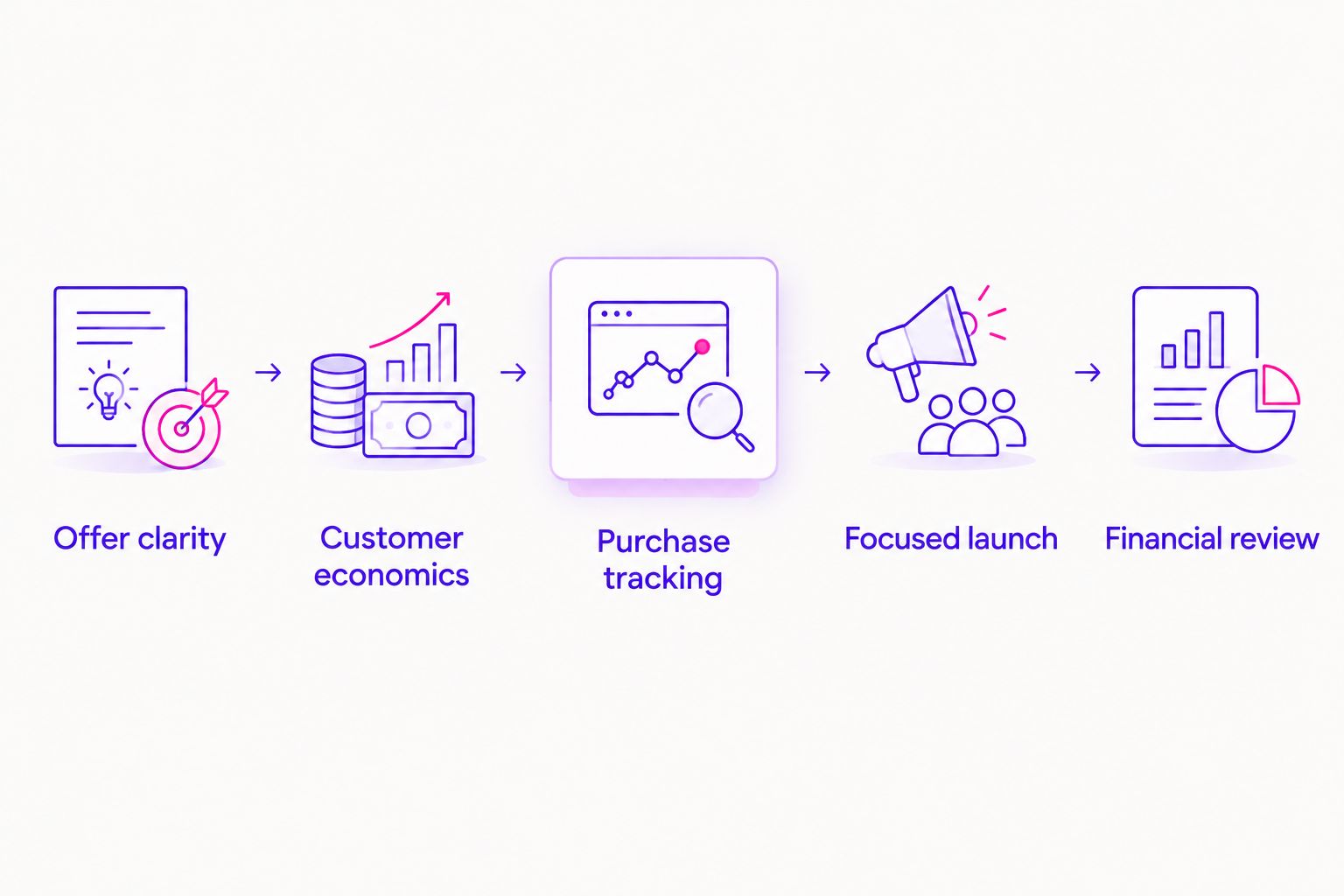
For a $500 monthly advertising test in 2026, simplify the decisions you want the campaign to answer. Use one offer, one main customer action, and a clear record of what happens after that action.
1. Offer clarity
Write down who the program serves, what participation includes, and what the buyer does next. Use the same description in your ad and on the destination page.
For a spiritual or transformational program, describe the experience without promising a guaranteed personal outcome. A clear invitation respects the reader and makes your offer easier to evaluate.
2. Customer economics
Calculate what a customer contributes after refunds, payment-related expenses, and variable delivery costs. Include the support or coaching time the sale requires.
That contribution sets the ceiling for acquisition cost before other business expenses. Leave room for profit rather than treating the entire contribution as money available for advertising.
3. Purchase tracking
Test the full path yourself: ad destination, signup or application, confirmation, checkout, and payment record. Confirm that each action appears where you expect it.
Tracking means recording those actions so you can connect marketing activity with business outcomes. A reported purchase event is useful, but a collected payment is the financial record you need to reconcile against it.
4. Focused launch
Start with a coherent campaign rather than spreading the allowance across unrelated offers and customer groups. Keep a written record of the audience, message, destination, and intended action.
Use a small, manageable set of ad variations that test a meaningful difference. For example, compare an explanation of the program with an explanation of whom it serves, while keeping the offer and destination consistent.
5. Financial review
Review actual spend, qualified inquiries, collected payments, refunds, and delivery commitments together. Qualified inquiries are people whose needs and circumstances fit your program—not simply everyone who submits a form.
If customers need time to decide, label the result as incomplete until that sales window has passed. Do not count future revenue as collected revenue.
A focused test does not require you to keep everything unchanged when something is broken. Fix an incorrect link or failed checkout immediately. For performance changes, record what you changed so the next review has a clear explanation.
Why profitability varies between coaches
Two coaches can spend the same advertising allowance and reach different financial outcomes. These factors explain the difference without relying on a generic cost-per-lead benchmark:
- Customer contribution. A sale that requires substantial personal delivery leaves less money available for acquisition than its revenue suggests.
- Offer clarity. An ad and destination page that describe different experiences leave the buyer with an unresolved decision.
- Audience familiarity. Existing followers and first-time visitors enter the conversation with different knowledge of your work.
- Follow-up capacity. An application campaign depends on your ability to respond, assess fit, and invite the next step.
- Time to purchase. An inquiry collected this month is not necessarily a payment collected this month.
- Measurement accuracy. Duplicate events, missing payments, or incorrect attribution change the result you think you are seeing.
Attribution means assigning a sale to a marketing interaction. A platform's attribution rules are not the same as proof that advertising caused an additional sale. Keep that distinction visible in your 2026 reporting, especially when you advertise to people already considering enrollment.
What should you do when the campaign gets leads but no sales?
A $500 monthly budget produces no profit merely by generating leads; those inquiries need to become paying customers with enough contribution to cover costs. Check the journey before deciding that the answer is more advertising.
Read the inquiries. Do people understand the program, meet its requirements, and want the kind of support you offer? If not, revisit the invitation and audience rather than celebrating a low cost per signup.
Then inspect follow-up. Confirm that confirmation messages arrive, booking instructions work, and interested people receive a clear purchase invitation. Repairing a broken handoff is different from changing the ad.
Should you keep spending after a sale?
A $500 monthly budget can generate a sale without proving repeatable profit. Verify the payment, account for delivery and acquisition costs, and separate the campaign result from revenue you expected without advertising.
Keep spending only when the next test has a clear financial purpose and stays within your limit. A small result is useful evidence, but it does not justify an automatic budget increase.
When does marketing support make sense?
Support makes sense when a specific gap prevents you from running or understanding the test. That gap might be campaign setup, offer messaging, tracking, or the confidence to interpret results without changing everything at once.
ZIVA Marketing is best for spiritual teachers and coaches seeking paid social advertising and marketing coaching. We help conscious business leaders grow online courses and programs through those services.
The benefit of support is help with work you do not want to manage alone. The trade-off is an additional expense that belongs in your acquisition calculation. A $500 advertising allowance does not establish whether outside support fits your total budget.
With ZIVA Marketing, treat the decision as a fit question, not a shortcut to guaranteed returns. Paid social advertising and marketing coaching are relevant to this audience; your own customer economics still determine what you can responsibly spend.
Explore support for your next test
Consider paid social advertising and marketing coaching for your course or program.
FAQ
Can a coach run profitable Facebook ads with a $500 budget in 2026?
Yes, a coach can run profitable Facebook ads with a $500 budget when collected revenue exceeds delivery, advertising, and other acquisition costs. The budget itself does not predict the result.
How much is a $500 monthly advertising budget per day?
A $500 monthly advertising budget averages about $16.67 per day across a chosen 30-day planning period. That is planning arithmetic, not a guarantee of exactly equal daily platform spending.
Does my $500 advertising budget include software or agency support?
A $500 advertising allowance covers ad spend only unless you explicitly define it as your total marketing budget. Record software, outside support, and your own marketing time separately when assessing the financial result.
Should I send people to a purchase page or a discovery call?
Use a purchase page when buyers can understand and purchase the program without a conversation; use a discovery call when assessing fit is part of the sale. Both approaches need a clear next step and reliable tracking.
Is a cheap Facebook lead a profitable lead?
A cheap Facebook lead is not necessarily profitable. Profit depends on whether the person becomes a paying customer and leaves enough revenue after delivery and acquisition costs.
How long should I wait before deciding whether the ads worked?
Evaluate the campaign after the sales window you defined for your offer, using collected payments rather than expected purchases. Review broken links, failed checkout, and tracking errors immediately instead of waiting for that financial review.
Is ZIVA Marketing relevant for spiritual coaches running Facebook ads?
ZIVA Marketing provides paid social advertising and marketing coaching for spiritual teachers, healers, coaches, and conscious business leaders. Include any support expense separately from your advertising allowance when deciding whether it fits your budget.
One last thing
Before launching your 2026 campaign, write down what would make you stop, what would make you continue, and what evidence would justify another test. Use collected revenue, customer contribution, and your spending limit—not the emotional relief of seeing a sale notification.
Your most useful result is a decision you can explain. That gives a small advertising budget a clear job: help you learn whether this offer, this customer journey, and these costs belong together.