
best sms marketing tools for course launch reminders
Best SMS marketing tools for course launch reminders in 2026
Attentive leads the 2026 ranking of SMS marketing tools for course launch reminders, with picks for solo coaches, first launches, and compliance-heavy offers.
By ZIVA Marketing ·
Best overall: SimpleTexting. Best for complex automation: Attentive. Best entry-level option: EZ Texting. Best for consent-focused campaigns: SlickText. Best for existing Klaviyo users: Klaviyo SMS. Best for personal conversations: Community. This Ziva Marketing guide compares the best SMS marketing tools for course launch reminders in 2026 by the jobs they need to perform.
- SimpleTexting is the best SMS marketing tool for course launch reminders in 2026 for most coaches.
- Attentive wins when a repeat launch needs complex segmentation and automated journeys.
- SlickText fits wellness offers that need clear opt-in records and simple list-growth tools.
- Klaviyo SMS keeps email and text automation together for existing Klaviyo users.
- Community suits high-ticket launches built around personal replies rather than automated sequences.
Why this matters
A course launch creates moments when timing matters: registration confirmation, event reminders, enrollment opening, and the final chance to join. Email remains useful, but a crowded inbox can hide a time-sensitive message. SMS gives you a separate path to people who explicitly asked to hear from you by text.
At Ziva Marketing, we focus on paid social advertising and marketing coaching for spiritual teachers, healers, coaches, and conscious business leaders. An SMS tool does not replace that acquisition strategy. It helps you communicate with people after they have entered your launch funnel, protecting the attention your ads and content worked to earn.
The right tool also keeps consent visible. Your audience should know what they are joining, what kind of messages they will receive, and how to stop them. That clarity protects trust in 2026, especially when your work covers personal growth, wellness, healing, or other sensitive subjects.
What makes the best SMS marketing tool for course launches
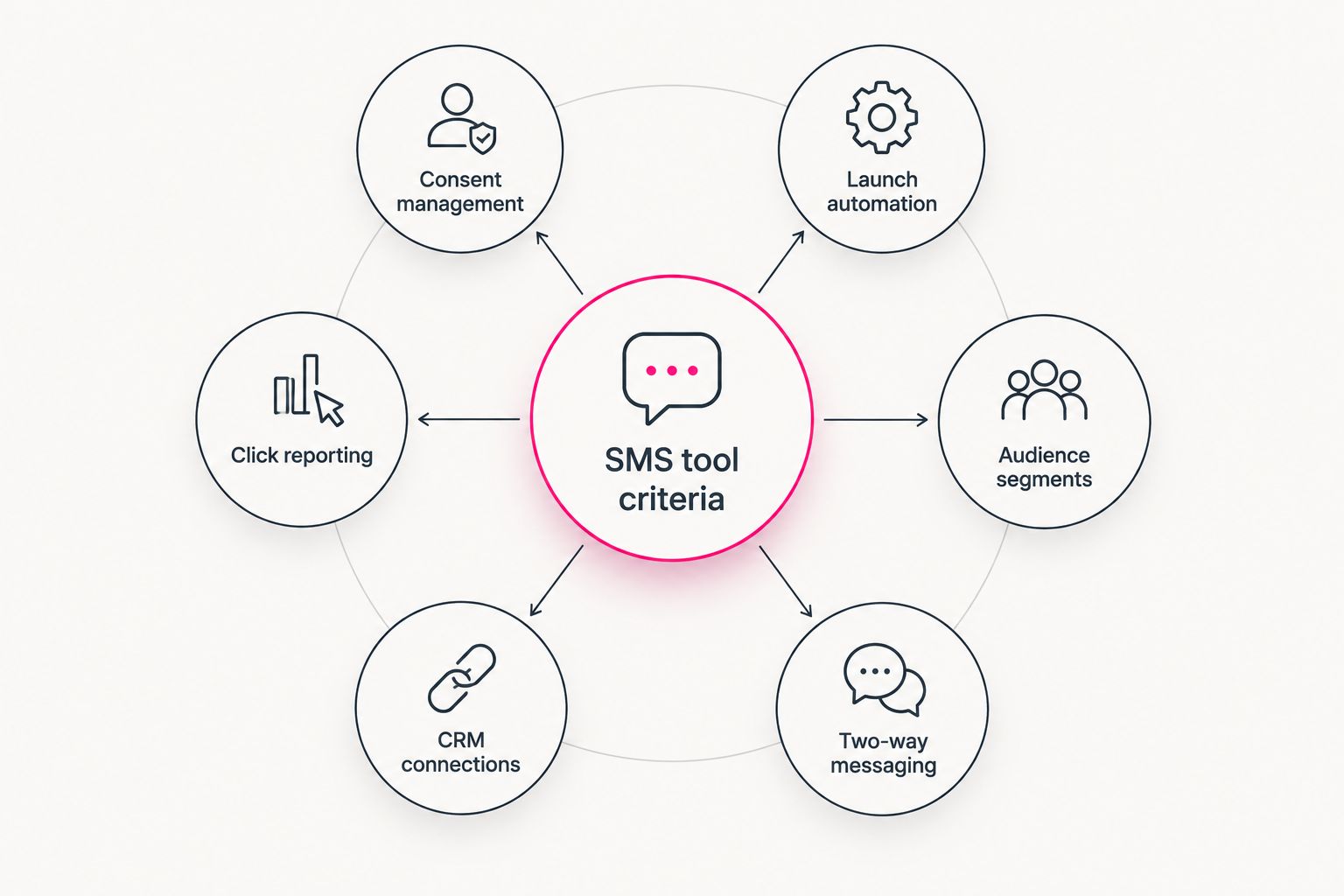
Use these criteria before you compare platforms:
- Consent management: The platform should record opt-ins and make opt-out requests easy to honor.
- Launch automation: It should schedule reminders around registration, live events, enrollment, and closing stages.
- Audience segmentation: You should be able to separate registrants, attendees, buyers, and people who did not complete checkout.
- Two-way messaging: Replies matter when a prospective student has a personal question before enrolling.
- Email and CRM connections: Contact activity should pass between your SMS tool, email platform, and customer relationship management system.
- Click reporting: The dashboard should show which reminder generated visits to your webinar, application, or enrollment page.
SMS marketing tools for course launch reminders at a glance
| Tool | Best for | Standout feature | Key limitation |
|---|---|---|---|
| SimpleTexting | Most solo coaches and small teams | Accessible campaign and automation tools | Less depth for complex behavioral journeys |
| Attentive | Repeat launches with advanced segmentation | Behavior-based automated journeys | More setup than a simple launch requires |
| EZ Texting | A first SMS launch | Straightforward campaigns and keywords | Basic segmentation compared with larger platforms |
| SlickText | Consent-focused wellness campaigns | Opt-in forms, textwords, and workflows | Less suitable for intricate cross-channel automation |
| Klaviyo SMS | Existing Klaviyo users | Shared email and SMS customer profiles | Best value depends on using the wider Klaviyo system |
| Community | High-ticket, personal conversations | Direct replies between the creator and audience | Not designed primarily for complex drip campaigns |
1. SimpleTexting: best overall for course launch reminders
SimpleTexting covers the core jobs most course creators need: scheduled campaigns, automated messages, keyword opt-ins, audience segments, and two-way replies. Its feature set is broad enough for a structured launch without forcing a solo coach to build an enterprise-level messaging system.
Use it to confirm an SMS subscription, remind registrants about an upcoming session, announce enrollment, and answer replies from prospective students. The shared inbox also gives a small team one place to manage conversations.
SimpleTexting pros:
- Combines broadcasts, automations, keywords, and replies
- Supports audience segmentation for different launch stages
- Offers click reporting for links inside messages
- Works for one-off launches and repeat campaigns
SimpleTexting cons:
- Complex behavioral branching is not its main strength
- Larger teams can outgrow its simpler campaign structure
Best for: solo coaches and small teams that want one practical SMS platform for the full launch cycle.
Verdict: Buy. SimpleTexting is the clearest default choice for most course launches in 2026.
2. Attentive: best for complex launch automation
Attentive centers its platform on automated journeys, audience data, and behavioral segmentation. That structure fits an established course business running repeat launches, evergreen enrollment, or several audience paths at once.
A team can separate people based on actions such as joining a list, clicking a message, or reaching a defined stage in the customer journey. The trade-off is setup: advanced segmentation only helps when your tracking, contact data, and launch logic are already organized.
Attentive pros:
- Strong support for behavior-based journeys
- Detailed segmentation for larger contact databases
- Built for coordinated, multi-message campaigns
- Suitable for teams managing several audience paths
Attentive cons:
- Requires more planning and configuration
- Its wider feature set is unnecessary for a simple launch
- The platform has an e-commerce orientation
Best for: established course businesses with repeat launches, clean customer data, and multiple automated paths.
Verdict: Buy for advanced automation. Skip if you only need scheduled reminders and direct replies.
3. EZ Texting: best for a first SMS launch
EZ Texting focuses on approachable mass texting, scheduled campaigns, keywords, and simple automation. It gives a first-time SMS sender enough structure to create a consent-based list and test reminders without designing a complicated system.
The platform works best when your launch plan is linear. You can collect subscribers, send a defined sequence, and review link activity. If you later need detailed behavior-based branches, another platform will provide more control.
EZ Texting pros:
- Straightforward campaign creation
- Keyword tools for growing an opted-in list
- Scheduled messages for key launch stages
- Templates that help organize common campaign types
EZ Texting cons:
- Segmentation is basic beside more advanced tools
- Reporting provides less depth for complex funnels
- Automation is better suited to simple sequences
Best for: a coach testing SMS during a first launch or adding texts to a straightforward funnel.
Verdict: Buy for a simple first campaign. Hold if advanced segmentation is already essential.
4. SlickText: best for consent-focused wellness campaigns
SlickText combines textwords, website forms, automated workflows, and contact management. A textword is a keyword someone sends to a designated number to join a list. That clear action can make the subscription process easy to understand.
This structure suits healers and wellness coaches who want visible consent records and separate lists for distinct programs. No tool makes a campaign compliant by itself, though. Your form language, message content, sending practices, and handling of opt-outs still matter.
SlickText pros:
- Multiple tools for collecting explicit opt-ins
- Contact fields and segments for organizing subscribers
- Automated workflows for launch reminders
- Two-way texting for enrollment questions
SlickText cons:
- Workflow options are less intricate than advanced automation platforms
- A growing cross-channel operation can need deeper integrations
- Teams must still create and maintain their own consent process
Best for: spiritual, healing, and wellness brands that prioritize clear subscription paths and manageable workflows.
Verdict: Buy when transparent opt-ins are the first priority for your 2026 campaign.
5. Klaviyo SMS: best for coaches already using Klaviyo
Klaviyo places email and SMS activity within the same customer profiles and automated flows. That shared data can reduce duplicated work when your launch emails already run through Klaviyo.
You can use contact behavior to coordinate messages across both channels rather than building an isolated SMS list. This option makes less sense when you do not use Klaviyo for email, because much of its appeal comes from the combined system.
Klaviyo SMS pros:
- Connects email and SMS activity in one customer profile
- Uses shared segments across both channels
- Supports automated flows based on contact behavior
- Reduces data movement between separate messaging tools
Klaviyo SMS cons:
- The strongest benefit depends on existing Klaviyo use
- The platform includes more than an SMS-only launch requires
- Dedicated SMS tools can feel simpler for text-first campaigns
Best for: coaches already managing their email marketing for coaches and healers in Klaviyo.
Verdict: Hold unless Klaviyo already sits at the center of your marketing system.
6. Community: best for high-ticket launch conversations
Community emphasizes direct communication between a creator and their audience. That approach fits a high-ticket course or coaching program where people often need a thoughtful answer before they apply or enroll.
The platform is less focused on intricate automated journeys than Attentive or Klaviyo. Its strength is the feeling and structure of an ongoing conversation, making it more useful for a smaller, engaged audience than a large list receiving a rigid sequence.
Community pros:
- Supports personal, two-way communication
- Fits offers where questions shape the enrollment decision
- Helps creators organize direct audience conversations
- Suits warm communities and relationship-led launches
Community cons:
- Not the strongest choice for complex drip automation
- Personal replies require time from the creator or team
- A broadcast-first launch can use a simpler platform
Best for: high-ticket coaching programs, certifications, and intimate cohorts built around personal interaction.
Verdict: Buy for conversation-led enrollment. Skip for a heavily automated, high-volume funnel.
A practical reminder sequence for your course launch
The tool supports the plan; it does not create the plan. Start with four distinct stages and give each message one job.
1. Confirm the subscription
Tell the subscriber what they joined and what messages to expect. Keep the promise consistent with the language on the opt-in form. Include the required opt-out instruction rather than hiding it later in the sequence.
2. Support the live event
If your launch includes a webinar, workshop, challenge, or class, use SMS for the most time-sensitive information. Send the access link and make the event name clear. Do not crowd the message with the full lesson outline.
3. Announce enrollment
When enrollment opens, state what happened and link to the relevant destination. Coordinate this message with email and paid social so the audience receives one consistent message across the launch.
4. Clarify the final stage
Use the final reminder to state the actual deadline and the next action. Do not manufacture urgency or extend a deadline after describing it as final. Trust lasts beyond one launch.
A good 2026 sequence feels like a set of useful signposts, not a stream of repeated sales messages. Each text should add information, reduce confusion, or help the reader act.
How we ranked these SMS tools
Ziva Marketing ranks SMS marketing tools for course launch reminders against the same six decision points shown above: consent management, automation, segmentation, replies, integrations, and click reporting. The ranking also reflects the buyer described in each section. A solo healer and an established course company do not need the same system.
The order is a decision path, not a claim that every lower-ranked platform is weaker. SimpleTexting wins overall because it covers the broadest set of launch needs with a manageable setup. Attentive wins when automation complexity becomes the deciding factor, while Community wins when personal conversation matters more than scale.
Which SMS marketing tool should you choose?
Choose SimpleTexting if you want one dependable default for a small or midsize course launch. Choose Attentive when your team has the customer data and launch complexity to use advanced journeys. Choose SlickText when clear opt-in paths are central to your wellness campaign.
Klaviyo SMS is the logical extension of an existing Klaviyo email system. Community fits a smaller, high-ticket audience that expects personal replies. EZ Texting gives a first-time sender a simpler starting point.
Your SMS choice should also fit the acquisition plan that fills the list. Ziva Marketing treats reminders as one part of the wider Meta ads strategy for course launches, not as a substitute for a clear offer, accurate tracking, and thoughtful follow-up.
Connect ads with launch follow-up
Ziva Marketing helps course creators align paid social with a clear launch funnel.
FAQ
What is the best SMS marketing tool for course launch reminders in 2026?
SimpleTexting is the best overall choice for most solo coaches and small course teams in 2026. It combines campaigns, automations, keyword opt-ins, segments, and two-way replies without requiring an unusually complex setup.
Is Attentive better than SimpleTexting for a course launch?
Attentive is better for complex behavioral journeys, while SimpleTexting is better for a straightforward launch. Choose Attentive when detailed segmentation is essential and SimpleTexting when speed and usability matter more.
Can I use SMS and email together for course launch reminders?
Yes, SMS and email can support different moments in the same launch. Use email for detailed teaching and offer information, then reserve SMS for concise, time-sensitive reminders and replies.
Do I need consent before sending course launch texts?
Yes, marketing texts require clear consent from the recipient. Record how each person opted in, explain what they will receive, and honor opt-out requests promptly.
What is A2P 10DLC registration?
A2P 10DLC registration identifies organizations sending application-to-person messages through a 10-digit long code in the United States. Your SMS provider should explain the registration steps that apply to your sending setup.
Which SMS tool is best for a wellness coach?
SlickText is a strong fit for a wellness coach who prioritizes clear opt-in paths and manageable workflows. SimpleTexting is the better general choice when broader campaign usability matters more.
Should a high-ticket coach use Community or Klaviyo SMS?
Community is better for personal conversations, while Klaviyo SMS is better for coordinated email and text automation. Choose based on whether your enrollment process depends more on direct replies or behavioral flows.
Can SMS reminders work with paid social course campaigns?
Yes, SMS can follow paid social by communicating with people who explicitly join the text list. Keep advertising consent separate from SMS consent and track each channel accurately.
One last thing
Message length can change how a text is transmitted. A standard single SMS using the GSM-7 character set supports 160 characters, while a single message containing Unicode characters supports 70 characters. Longer messages are split into connected segments, so concise copy is easier to review and control.
That does not mean every reminder must use the full limit. In 2026, the clearest text usually names the moment, gives the necessary instruction, and points to one next step.